Röntgen and the Night X-Rays Were Found, 8 November 1895
Key Points
- The Nobel Prize biography places Wilhelm Röntgen's discovery of X-rays on the evening of November 8, 1895, and the 131st anniversary falls on Sunday, 8 November 2026.
- He posted 90 reprints of his paper on New Year's Day in 1896, and Vienna's Die Presse ran the story days later under the headline "A sensational discovery".
- Röntgen deliberately did not patent the rays, and the Nobel Prize's Speed read says doctors were using them within weeks to find fractures and bullets.
- He received the first Nobel Prize in Physics in 1901.

Wilhelm Röntgen dated his discovery of X-rays to one evening in a university laboratory in Würzburg. According to the Nobel Prize's biography of him, on the evening of November 8, 1895, he found that a coated paper plate glowed1 when it sat in the path of rays from a sealed tube, even though the tube was wrapped in thick black carton. The 131st anniversary of that evening falls on Sunday, 8 November 2026. What happened in the weeks after it is a good story about how a science result becomes front-page news.
The glow that should not have been there
Röntgen was a physics professor who had been working on cathode rays, which come from passing an electric current through a gas at very low pressure. The Nobel biography says earlier work in the field had been done by Plücker, Hittorf, Varley, Goldstein, Crookes, Hertz and Lenard1, so he was not working alone in a new field. On the evening he is credited with the discovery, he enclosed the discharge tube in the carton and worked in a dark room. The same biography says a plate covered on one side with barium platinocyanide became fluorescent even when it was as far as two metres from the tube1.
The Nobel Prize's own account of the event describes a researcher who was puzzled. In its "Perspectives" essay, the fluorescent screen was too far from the tube to be affected by the cathode rays2. The essay says he did not leave his lab for weeks2 while he tried to find the source, and concluded that the impact of cathode rays on the glass tube was producing a new kind of invisible ray. A companion "Speed read" piece says the weeks were spent eating and sleeping in his lab3.
What the rays could and could not pass through
Röntgen's experiments, as the Nobel biography summarizes them, showed that objects of different thicknesses placed in the path of the rays showed variable transparency, recorded on a photographic plate1. The Nobel "Speed read" says the rays could pass through cardboard, wood and aluminum unimpeded, but not denser materials such as lead and, perhaps more notably, bone3.
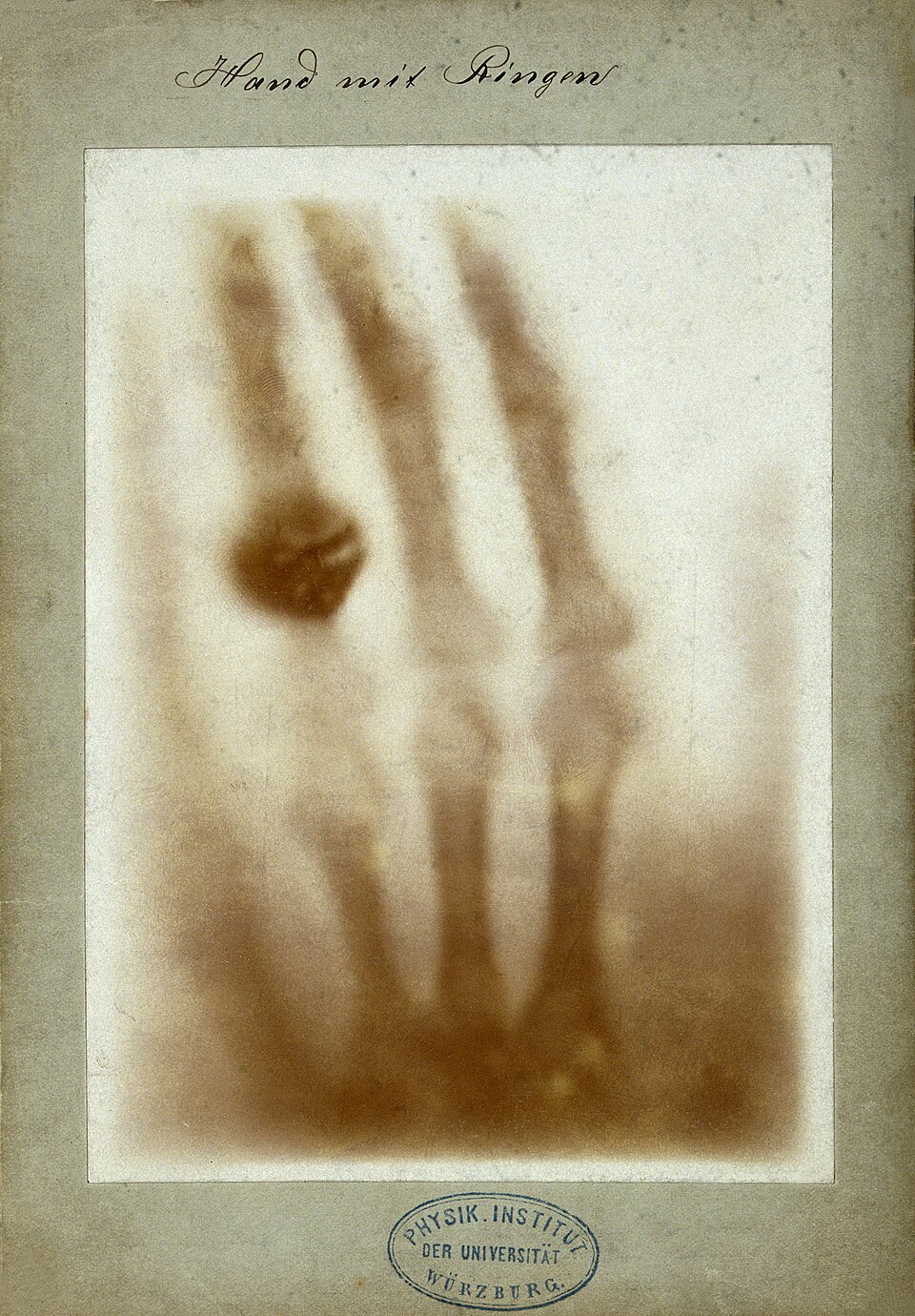
That last difference is why a famous image of the discovery shows a hand. The biography says that when he held his wife's hand still over a photographic plate, the developed plate showed the shadows of the bones of her hand and of a ring she was wearing1, with the flesh throwing a fainter shadow. It calls this the first röntgenogram ever taken1. The photo at the top of this page is a print from that period. The Wikimedia Commons file page6 describes it as a print of one of the first X-rays of the left hand of Anna Bertha Ludwig, Röntgen's wife, dated 22 December 1895, and as a retouched copy with scratches and spots cleaned.
He named the new rays X-rays, and the biography explains why: their nature was then unknown1. According to the "Speed read", he always preferred the term X-rays, from the mathematical designation for something unknown3. The biography adds that the German physicist Max von Laue and his pupils later showed that they are of the same electromagnetic nature as light, differing only in the higher frequency of their vibration1.
A paper, 90 envelopes and a newspaper scoop
Röntgen did not make his discovery public at once. The "Perspectives" essay says that over Christmas he wrote a 10-page article entitled On a new kind of rays2, and that the Proceedings of the Würzburg Physical-Medical Society accepted it on 28 December2. The essay describes the article as precise and reserved in tone, with no accompanying images.
The photographs went out by post. On New Year's Day in 1896, the essay says, he carried 90 envelopes to the post office in Würzburg, each holding a reprint of the article and addressed to physicists across Europe2. Twelve of them also held nine photographs2. One recipient was Franz Exner, a physics professor in Vienna, who showed the photographs to dinner guests on Saturday, 4 January. One guest, Ernst Lecher, borrowed them, and his father was the editor of the Vienna daily Die Presse. The essay says the paper changed its front page for the next day's issue2, running the story under the headline A sensational discovery2.
From there the news moved quickly. The essay says leading German newspapers carried it on Monday, 6 January 1896, and that the UK's Daily Chronicle published the first British report. It also notes a small slip: Die Presse had misspelled the name, crediting the findings to Professor Routgen2. The scientific press followed the newspapers. According to the same essay, Nature gave Röntgen 17 lines in its 16 January issue2 and a week later published an English translation of his paper. Nature's own page for that translation is dated 23 January 18967 and carries the opening sentence of the paper, which describes passing a discharge from a large induction coil through a vacuum tube surrounded by black paper. The full text sits behind a subscription, and only that opening was read for this article.
Why other labs could copy him
The Nobel "Perspectives" essay credits one decision with the speed of what came next. Röntgen deliberately did not patent his discovery2, convinced, in the essay's words, that his inventions and discoveries belonged to the world at large. It quotes the physicist Arthur Schuster, who received some of the photographs and later recalled that there were few laboratories in which attempts were not immediately made to repeat the experiment2.
The medical uses came within weeks. The "Speed read" says doctors within weeks were using X-rays to diagnose bone fractures, locate embedded bullets and identify causes of paralysis3. The "Perspectives" essay gives two examples. In Montreal, a man had been shot in the leg and the bullet could not be found for weeks, until John Cox, a physics professor at McGill University, used X-rays to show it was lodged between the tibia and fibula2. And it says the British Army expedition up the Nile in spring 1896 carried two X-ray machines2 for locating bullets and diagnosing fractures. By the end of 1896, the essay adds, more than 1,000 books and papers had been published on X-rays2.
The first Nobel Prize in Physics
In 1901 the Royal Swedish Academy of Sciences gave Röntgen the first Nobel Prize in Physics. The Nobel Prize's facts page gives the motivation as in recognition of the extraordinary services he has rendered by the discovery of the remarkable rays subsequently named after him4, and lists his share as the whole prize. At the ceremony on December 10, 1901, the Academy's president said the actual constitution of this radiation of energy is still unknown5. The speech singled out surgery: a bullet or needle that X-rays cannot pass through could be located by taking a shadowgraph of it on a photographic plate5. It also said, in 1901, that severe skin diseases, such as lupus, had been successfully treated with Röntgen rays5.
The "Perspectives" essay presents Röntgen as a reluctant celebrity. It says he published only two more papers on X-rays2 and, apart from one public lecture in Würzburg, declined invitations to lecture. The essay also notes that he gave no lecture after receiving his Nobel Prize. He died in Munich on February 10, 1923, according to the Nobel biography1.
Trivia
- On what date in 1895 is Röntgen's discovery of X-rays placed by the Nobel Prize's biography? November 8, 18951, an evening in his laboratory in Würzburg.
- What did Röntgen put around the discharge tube so no light could escape? A sealed, thick black carton1.
- Why did he call the rays X-rays? Because their nature was then unknown1, so the name borrowed the mathematical symbol for the unknown.
- How many envelopes did he post on New Year's Day in 1896? 902, each with a reprint of his article, and twelve of them also held photographs.
- Why could other laboratories repeat his experiments so quickly? He had deliberately not patented his discovery2.
Sources
- Wilhelm Conrad Röntgen, Biographical, Nobel Lectures, Physics 1901-1921, NobelPrize.org. Accessed November 4, 2026.
- Joachim Pietzsch, Perspectives: A helping hand from the media, NobelPrize.org. Accessed November 4, 2026.
- Joachim Pietzsch, Speed read: An illuminating accident, NobelPrize.org. Accessed November 4, 2026.
- Wilhelm Conrad Röntgen, Facts, NobelPrize.org. Accessed November 4, 2026.
- Award ceremony speech, Nobel Prize in Physics 1901, NobelPrize.org. Accessed November 4, 2026.
- First medical X-ray by Wilhelm Röntgen of his wife Anna Bertha Ludwig's hand, 22 December 1895, Wikimedia Commons file page. Accessed November 4, 2026.
- On a New Kind of Rays, Nature, vol. 53, pp. 274-276, 23 January 1896 (opening paragraph). Accessed November 4, 2026.