Silverpit Crater Under the North Sea Came From a Space Impact
Key Points
- The Silverpit Crater lies about 700 m below the southern North Sea seabed, about 80 miles off the Yorkshire coast.
- A team led by Uisdean Nicholson of Heriot-Watt University found two shocked mineral grains in cuttings from an old well near the crater.
- The team estimates an object about 160 m wide hit at a low angle from the west, 43 to 46 million years ago, raising a tsunami more than 100 m high.
- In 2009, an audience at a Geological Society of London debate voted overwhelmingly for a non-impact origin.
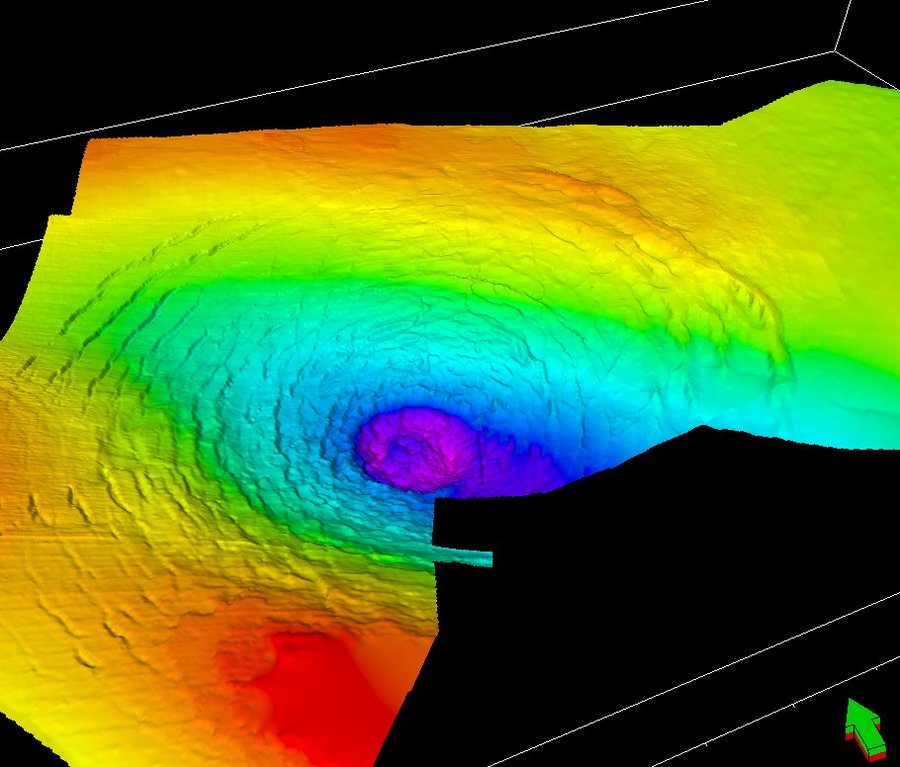

For more than 20 years, a round hole buried under the North Sea split geologists into two camps. One side saw the scar of something that fell from space. The other saw the slow work of salt deep underground. In 2025, a team led by Uisdean Nicholson of Heriot-Watt University reported that the Silverpit Crater was made by an asteroid or comet that struck 43 to 46 million years ago2. Their paper appeared in Nature Communications on September 20, 20251.
Where it is
Silverpit sits in the southern North Sea, about 80 miles (about 129 km) off the Yorkshire coast and roughly 700 m below the seabed2, which is about 2,300 feet3.
The crater itself is small. The new paper defines it as a 3.2 km wide depression with a nested inner crater of about 1.2 km1, and the Heriot-Watt release describes it as about 3 km across, inside a 20 km zone of circular faults2. In the middle, the paper maps a central uplift about 200 m high1.
How it was found
The structure turned up in data collected for a different purpose. Petroleum geoscientists Simon Stewart and Philip Allen spotted it while working through seismic data gathered during gas exploration in the Southern North Sea7, and they proposed an impact origin in a 2002 paper in Nature1. Back then the impact was put at 60 to 65 million years old6, close to the age of the Chicxulub impact, which invited speculation that several space rocks had struck at the same time7. The new dating puts Silverpit millions of years later.
The long argument
Doubters had other explanations. Earlier work proposed salt withdrawal in the deep subsurface1. Others suggested hydrothermal venting linked to dykes1, or argued that the uplift in the middle was an artefact of the seismic data1. The case for an impact also lacked petrographic evidence of shock metamorphism1, the physical proof geologists look for in the rocks themselves.
In 2009 the question went to an audience. At a Geological Society of London debate, those present voted "overwhelmingly" for a non-impact origin1. The paper calls it a public vote, not a decision by an expert panel, and Nicholson notes that the audience was mostly petroleum geologists, according to the Society report4. He has also admitted that before he looked at the data himself, he had "bought into the prevailing wisdom"4.
The new evidence
Two things changed. The first was better pictures. In 2022 a high resolution 3D seismic survey was acquired on behalf of the Northern Endurance Partnership1, a project that Nicholson says was surveying for deep CO2 storage, and the data extended across the disputed central uplift4. The new images show a central uplift, a moat around it, a damage zone and numerous secondary craters on the seabed of the time1, some as wide as about 150 m1. The pattern of faults also points to an oblique, low angle strike from the west1.
The second was proof in the rocks. The team went back to cuttings from an old exploration well about 1 km northwest of the crater rim1, sampling about every 6 m4 through hundreds of metres of rock. The first pass found nothing, a search Nicholson called a "needle-in-a-haystack" approach4. A second set of samples from around the old seabed depth, prepared by Thomas Kenkmann, turned up what they were hunting for. The paper reports two shocked grains, quartz at 463 m and potassium feldspar at 494 m1, carrying fine lamellae that point to pressures of about 10 to 13 GPa1. Nicholson said the grains have a fabric that can only be created by extreme shock pressures2. Nannofossils from the same well date the event to the middle Eocene1.
How big a hit it was
The team estimates the object was about 160 m (about 525 feet3) wide and came in at a low angle from the west2. The release describes a curtain of rock and water about 1.5 km high2 thrown up by the impact, which then collapsed into a tsunami more than 100 m high2 (330 feet3). Gareth Collins of Imperial College London, who provided the numerical models, said he had always thought an impact was the simplest explanation2.
Nicholson calls Silverpit "a rare and exceptionally preserved hypervelocity impact crater"2. The paper counts only about 200 confirmed impact craters on land and about 33 confirmed or probable craters under the sea1.
How it compares
The Heriot-Watt release places Silverpit alongside two better known sea impacts. One is Chicxulub in Mexico, the crater tied to the extinction of the nonavian dinosaurs 66 million years ago3. The other is Nadir, a crater Nicholson spotted off West Africa, announced in 2022 as 8.5 km wide and buried 300 to 400 m below the seabed about 400 km off the coast of Guinea8. Nadir is thought to date from about 66 million years ago8 and to have been made by an asteroid about 400 m wide8, a far bigger blow than Silverpit. According to the new paper, Nadir is the only impact crater on Earth fully imaged with 3D seismic1, while Chicxulub is too large to image that way1.
Nadir also explains how Silverpit got a second look. Nicholson writes that the new Silverpit data looked "remarkably similar to the 3D data across the Nadir Crater"4.
Not everyone is convinced
The proof in the rocks rests on two grains. Matthew Huber, a planetary scientist at the Planetary Science Institute who was not involved in the research, pointed out to Eos that only one quartz grain and one feldspar grain had been found5, and said, "This could wind up being a controversial paper within the impact community."5
Trivia
- Which company drilled the well whose cuttings held the shocked grains, and in what year? British Gas, in 19851.
- What is the Silverpit Crater named after? The Silver Pit, a nearby sea floor valley recognized by generations of fishermen7.
- What did Philip Allen do with an image of the strange rings after he first saw them? He hung it in his office7.
- How wide did the 2002 Nature paper say the structure was? About 20 km, described as multi ringed1.
- At what speed did the team's computer model send the impactor into the seabed? 15 km per second1.
- Which geologist, of the University of Edinburgh, argued for salt withdrawal instead of an impact? John Underhill7.
- How high a tsunami do simulations suggest the Nadir impact raised? More than 1 km8.
- Who emailed the team about Silverpit in late 2022, and from which body? Ron Parr, of the North Sea Transition Authority4.
Sources
- Uisdean Nicholson, Iain de Jonge-Anderson, Alex Gillespie, Thomas Kenkmann, Tom Dunkley Jones, Gareth S. Collins, James Frankel, Veronica Bray, Sean P. S. Gulick and Ronnie Parr, Multiple lines of evidence for a hypervelocity impact origin for the Silverpit Crater, Nature Communications 16, 8312 (September 20, 2025). Accessed October 21, 2026.
- Scientists find proof that an asteroid hit the North Sea over 43 million years ago, Heriot-Watt University (September 20, 2025). Accessed October 21, 2026.
- A massive asteroid slammed into the North Sea and triggered a 330-foot tsunami, ScienceDaily, source Heriot-Watt University (2026). Accessed October 21, 2026.
- Uisdean Nicholson, The Silver Bullet for Silverpit Crater: solving a 20-year-old geological controversy, Springer Nature Research Communities (September 20, 2025). Accessed October 21, 2026.
- Katherine Kornei, Submerged Crater near Europe Tied to an Impact, Eos (September 20, 2025). Accessed October 21, 2026.
- Adrian R. Ashford, Ancient Impact Crater Found in North Sea, Sky & Telescope (July 23, 2003). Accessed October 21, 2026.
- Silverpit crater, Wikipedia. Accessed October 21, 2026.
- Five-mile asteroid impact crater found below Atlantic Ocean, Heriot-Watt University (August 18, 2022). Accessed October 21, 2026.