South Korea's October Exports Nearly Double to $115.3 Billion
Key Points
- South Korea's October 2026 exports rose 93.7% from a year earlier to $115.28 billion, the second highest month on record after September's $121.1 billion, per Xinhua.
- Semiconductor exports jumped 259.4% to $56.44 billion, 48.9% of the total, the highest share for any October.
- Exports excluding semiconductors rose 34%, and the trade surplus was $42.5 billion.
- January through October exports reached $930 billion, and the trade minister said $1 trillion for the year is all but certain in November.

South Korea's exports nearly doubled in October 2026. Figures released on Sunday, 1 November 2026, put shipments abroad at 115.28 billion U.S. dollars, up 93.7 percent from a year earlier2, with semiconductors doing most of the lifting. It was a big month by any measure, though not quite the biggest the country has ever had.
The headline numbers
According to Xinhua, the trade ministry's data put October exports at 115.28 billion dollars, which was the second highest monthly total after a record 121.1 billion dollars in September2. Seoul Economic Daily describes the figure as preliminary and says it topped $110 billion for a second consecutive month1. Average daily exports, which adjust for the number of working days, rose 76% from a year earlier to $5.24 billion, staying above $5 billion for a second month running.
Outlets did not all frame it the same way. The Korea JoongAng Daily's headline calls the month a record $115.3 billion3, while Xinhua and Seoul Economic Daily both place it second behind September. This article follows the two that name September's higher figure, since the 121.1 billion dollar total is the one stated outright.
Imports rose 36.0% to $72.78 billion, which left a trade surplus of $42.5 billion, above $40 billion for a second straight month1. For January through October, exports reached $930 billion, up 60.6% from a year earlier and past $900 billion for the first time. That leaves $70 billion to reach $1 trillion for the year. Trade Minister Kim Jung-kwan said that exports growing past $110 billion in October made it "all but certain" that annual exports will reach $1 trillion in November1.
Chips at the center
Semiconductors were the story. Exports of chips jumped 259.4% to $56.44 billion1, above $50 billion for a second consecutive month. Seoul Economic Daily ties the gain to capital spending by global technology companies building out artificial intelligence capacity, which kept both prices and volumes high. The Asia Business Daily, reporting the ministry's own explanation, says the ministry pointed to continued excess demand centered on DRAM and sustained increases in fixed prices for both DRAM and NAND4.
Chips made up 48.9% of total exports, the highest share ever recorded for October4. Exports of everything except semiconductors also grew, by 34%. Computer exports rose 496.6% to $5.85 billion, helped by expanding investment in server infrastructure and growing demand for server solid-state drives1. The Asia Business Daily adds that computer exports have posted triple-digit growth for nine months in a row.
Beyond semiconductors
The gains were broad. Of the 20 largest export items, 18 posted gains, with ships and household goods the exceptions1. Auto exports rose 18.1% to $6.55 billion, the highest for any October on record, a result Seoul Economic Daily attributes to more working days and strong hybrid vehicle shipments. Exports of electrical equipment such as transformers, wires and cables rose 74.0% to $1.99 billion, a monthly record, on demand from AI data centers. Cosmetics rose 57.5% to $1.44 billion on rising demand in China, the United States and the European Union3.
Fuel shows how a value figure can differ from a volume figure. Petroleum product exports rose 80.0% and petrochemicals 27.5%, but shipment volumes fell 7.5% and 6.8%1. The higher values came from higher export prices tied to rising global oil prices. Export value is price times quantity, so a jump in the total does not by itself say that more goods left the docks.
Where the goods went
Exports rose in seven of the nine major markets1. Shipments to the United States surged 185.8% to $24.9 billion, lifted by semiconductors, computers and electrical equipment used in AI infrastructure. Exports to China soared 133.6% to $26.98 billion, and the JoongAng Daily notes they topped $20 billion for the fifth consecutive month3.
The import side
Imports grew more slowly than exports but still by 36.0%. Energy imports were $16.49 billion, up 63.1%, and imports excluding energy were $56.29 billion, up 29.7%. The price of oil mattered here too: the volume of crude oil imports edged down 6.3%, but the unit price rose 62.0%, pushing the value of crude oil imports up 51.9% to $10.7 billion4. Among non-energy imports, semiconductor equipment rose 49.2% to $2.52 billion and automobiles rose 38.5% to $1.46 billion.
The October surplus of $42.5 billion was up $36.5 billion from a year earlier. For the first ten months the surplus stood at $294.9 billion, an increase of $239.1 billion from the same period last year4.
What the figures do and do not say
These are preliminary monthly trade figures from the government, reported on the first day after the month ended, and they can be revised. They measure the value of goods shipped, not profits or wages, and they do not say how long a run of price increases in memory chips will last. The reports cited here describe what happened in October 2026 and quote the ministry's explanation for it. They do not forecast November beyond the minister's statement that the $1 trillion mark is expected.
Why Busan comes up
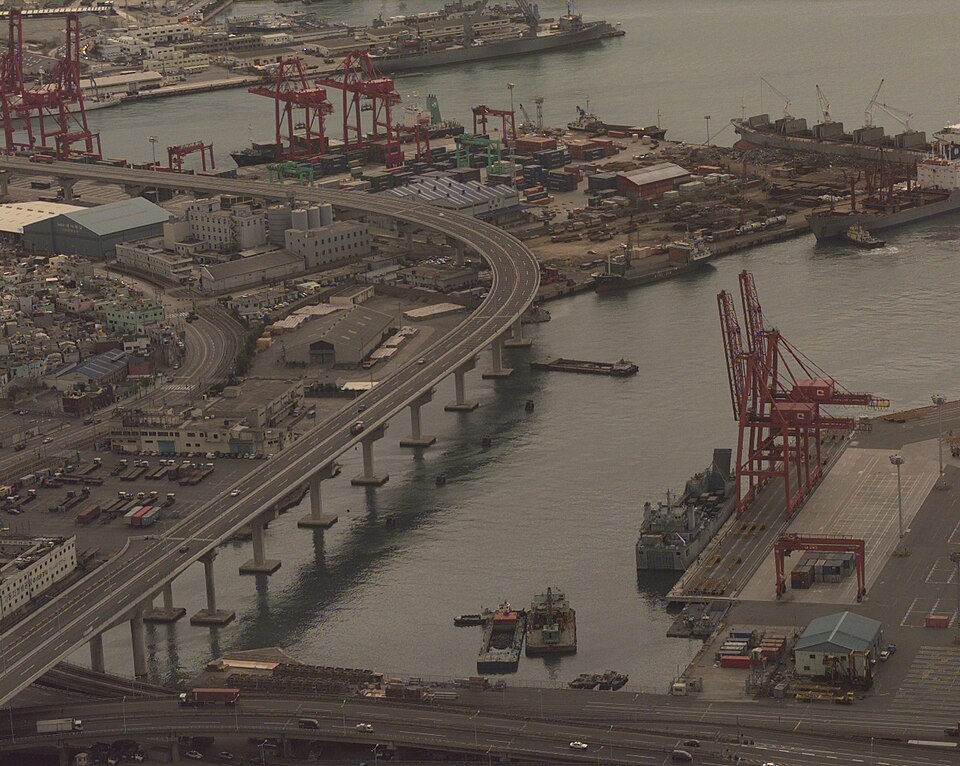
Much of the physical cargo behind figures like these moves through one city. Wikipedia describes the port of Busan as the largest and busiest port in South Korea5, and says it handled 24.4 million TEUs in 2024, its busiest year on record (a TEU is a twenty-foot equivalent unit, a measure of container capacity). The photograph above shows Busan's port in 1998, not in October 2026.
Trivia
- In which year was the port of Busan established? 18765, as a small port.
- How many million TEUs did the port of Busan handle in 2024, its busiest year on record? 24.4 million TEUs5.
- Who invented the single transistor, single capacitor architecture of modern DRAM in 1966, and at which company's research center? Robert Dennard, at the IBM Thomas J. Watson Research Center6.
- Which chip was the first commercially available DRAM, released in October 1970? The Intel 11036.
- Who founded Hyundai Electronics in 1983, the company that is now part of SK Hynix? Chung Ju-yung7, the founder of Hyundai Group.
Sources
- Lee Jung-hoon, Korea's October Exports Surge 93.7% to Second-Highest on Record, Seoul Economic Daily, 1 November 2026. Accessed November 2, 2026.
- S. Korea's October exports nearly double on semiconductor surge, Xinhua, 1 November 2026. Accessed November 2, 2026.
- Exports jump nearly 94% in October to hit record $115.3 billion on chip demand, Korea JoongAng Daily (Yonhap), 1 November 2026. Accessed November 2, 2026.
- Ju Sangdon, Semiconductors Drive South Korea's Exports, Accounting for 49% of October's $115.3 Billion Total, The Asia Business Daily, 1 November 2026. Accessed November 2, 2026.
- Port of Busan, Wikipedia, accessed 2 November 2026. Accessed November 2, 2026.
- DRAM, Wikipedia, accessed 2 November 2026. Accessed November 2, 2026.
- SK Hynix, Wikipedia, accessed 2 November 2026. Accessed November 2, 2026.