Sputnik 2 and Laika at 69: What the Sources Say
Key Points
- NASA's History Division chronology lists Sputnik 2, at 508.3 kilograms and carrying the dog Laika, as launched on November 3, 1957, which is 69 years before November 3, 2026.
- A NASA history paper says the Soviet leader asked for something new in space for the 40th anniversary of the Revolution, while RussianSpaceWeb calls the story of a one-month build a myth.
- NASA's paper says Laika died when the capsule overheated after failing to separate from its booster, while RussianSpaceWeb says the satellite was designed to stay attached and gives two different timings for her death.
- Wikipedia's article says the satellite reentered the atmosphere on April 14, 1958, after 162 days in orbit.
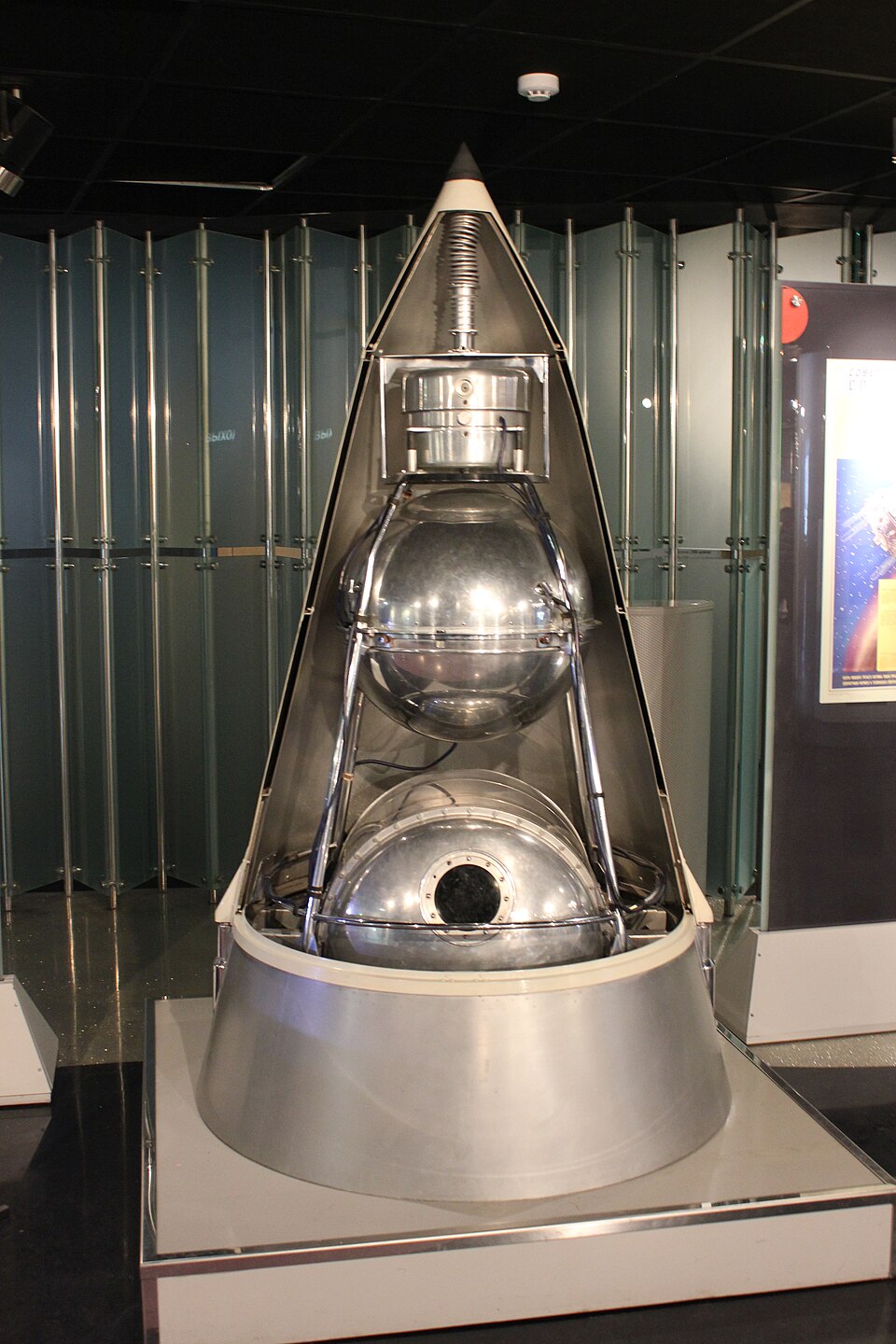

NASA's History Division chronology of the Sputnik era lists Sputnik 2, at 508.3 kilograms and carrying the dog Laika as passenger, as launched on November 3, 19572. That launch was on November 3, 1957, which makes November 3, 2026 its 69th anniversary. This piece follows what NASA's history pages and an independent Russian space history site say about how the mission came together, what was aboard and how it ended, and flags the points where those sources disagree.
Sources differ on who ordered the launch
In a NASA History Division paper adapted from his 1997 biography of Sergei Korolev, James Harford writes that after Sputnik 1 the Soviet leader Nikita Khrushchev, "realizing what a hot property he had," asked Korolev to do something bold for the 40th anniversary of the Revolution, only a month away1. Harford quotes the cosmonaut Grechko, who says he heard from Korolev himself that Khrushchev's request was to launch something new in space for the revolution's anniversary, and that the launch took place on November 3, 1957, in time for the celebration1.
Anatoly Zak's RussianSpaceWeb page reads the same history more skeptically, calling the story that Khrushchev imposed the mission on Korolev a myth and saying Korolev more likely used Khrushchev's enthusiasm to speed his own plans, including putting a person into orbit3. It also disputes that the satellite was developed in under a month, saying the dog's cabin and equipment container already existed when the decision was made, that the USSR had extensive experience flying dogs on ballistic missiles, and that preliminary plans to orbit a dog were apparently drafted at least a year earlier3. The two accounts agree on the date and on the pressure of the anniversary. They differ on how much of the spacecraft was new.
Harford also reports that on September 14, 1957, before Sputnik 1 flew, Mstislav Keldysh told the presidium of the Soviet Academy of Sciences that planners were considering placing a live organism in a satellite, a dog, because biologists considered a dog's perception the most similar to a human's1. RussianSpaceWeb adds that a note Korolev sent to the Central Committee on October 16 described the dog experiment as preparation for crewed spaceflight, and that the committee's presidium approved the plan on October 174.
What was aboard
Harford puts the payload of Sputnik 2 at 508 kilograms, more than six times the weight of Sputnik 1, with a carrier holding the mongrel dog Laika and a duplicate of the Sputnik 1 sphere1. He notes that two flight-ready spheres had been built for Sputnik 1, one to fly and one for ground testing, and that the second was later launched with Laika's carrier1.
According to RussianSpaceWeb, the core of the satellite was an aluminum animal cabin 0.8 meters long and 0.64 meters across, derived from the container used to fly dogs on ballistic rockets, with sensors for pressure, temperature, the dog's blood pressure, breathing and heartbeat, and a small window in its forward bulkhead4. It says alkaline compounds in flat panels beside the dog generated oxygen and absorbed carbon dioxide and water vapor, and that a ventilation system was added because weightlessness removes convection4. Food came as a jelly-like ration in small trays on a belt, each tray holding a day's worth, for a total supply of 20 days4.
The page says two radio transmitters, at 20.005 and 40.002 megahertz, sat in the spare Sputnik 1 sphere above the cabin and sent a continuous tone, unlike Sputnik 1, whose transmitters pulsed at 0.3-second intervals4. At the top, an instrument called SP-65 was designed to register solar ultraviolet and X-ray radiation, and the telemetry system was set to report temperatures from 12 locations around the satellite4. A timer switched the science payload on only while the satellite passed over Soviet ground stations, mainly to conserve power4.
On the television camera, RussianSpaceWeb's design page says some sources claim the cabin carried one that sent 10 frames per second at 100 lines, but that its developer said the system was not ready until the first Vostok test flights, and that more reliable sources do not list it4. Its overview page, though, lists a television camera among the cabin's equipment3, and Wikipedia's article also describes a camera in the passenger compartment5. The sources conflict, so the camera is left unsettled here.
The orbit and the overheating
Wikipedia's article gives the launch time as 02:30:42 UTC on November 3, 1957, and an orbit of roughly 212 by 1,660 kilometers with a period of 103.7 minutes, a figure it attributes to NASA's archive5. RussianSpaceWeb says telemetry later showed Laika's heart beating at 260 cycles per minute during the ride to orbit, about three times normal, and her breathing 4 to 5 times faster than usual, though overall she survived the launch unscathed3. Wikipedia gives a lower peak of 240 beats per minute, from a pre-launch rate of 103, and says her pulse settled back to 102 after three hours of weightlessness5.
Harford says Laika is reported to have barked and eaten food in orbit, and that she died when the capsule overheated after failing to separate from its booster, which left the thermal control system inoperative1. RussianSpaceWeb notes that the cabin's rudimentary thermal control system was borrowed from the first satellite and became the mission's Achilles' heel4.
On separation the sources disagree. RussianSpaceWeb calls the claim that Sputnik 2 failed to separate from its rocket not true, saying it was designed from the outset to remain attached to the second stage3. It adds that Korolev's October 16 note proposed acknowledging publicly that the satellite would stay attached, and it puts the satellite's mass at 508.3 kilograms and the total mass of the orbiting vehicle, counting the empty core stage it stayed attached to, at 7.79 tons4. The sources also disagree on timing. RussianSpaceWeb says Russian sources revealed that Laika survived four days before the cabin overheated, while other sources place the severe overheating and her death five or six hours after orbit was reached3. It says plans to put her to sleep had been reported but that no hardware aboard was designed to euthanize her, and that she was not put to sleep at the end of the mission3.
Science and the reaction
Wikipedia's article says the cosmic ray detector, mounted on the rocket stage with its own battery, transmitted for about a week and went silent on November 9, and that it recorded a jump from about 18 to 72 pulses per second at the highest latitudes of the orbit, which the article says likely reflected the lower reaches of the Van Allen belt, though telemetry could be received only over the Soviet Union, so the data were too sparse for conclusions5. It adds that the ultraviolet and X-ray photometers were calibrated in a way that left them oversaturated by orbital radiation, so they returned no usable data5.
Harford says animal protection groups protested the flight, while the Soviets presented Laika as a martyr for a noble cause, and that veterans of the project regard Sputnik 2 as an even more significant achievement than Sputnik 11. RussianSpaceWeb says the news was stunning enough that the CIA wrote a memorandum titled "SPUTNIK II, With or Without Dog?" on March 17, 1958, which concluded that the agency believed the satellite did carry a live dog3. In a speech on November 6, 1957, Harford writes, Khrushchev said the Soviet satellites had proved to be in the vanguard, a pointed reference to the American Vanguard program, whose first launch attempt exploded on its pad on December 61.
The satellite reentered the atmosphere on April 14, 1958, after 162 days in orbit5. According to the article, no provision was made for the dog's recovery5.
Trivia
- On what date in 1957 was Sputnik 2 launched? November 32.
- What was the launch mass of Sputnik 2, not counting the rocket stage, in kilograms? 508.34.
- Which anniversary was the launch timed to? The 40th anniversary of the Revolution1.
- Which earlier satellite's duplicate sphere flew with Laika's carrier? Sputnik 11.
- After how many days in orbit did Sputnik 2 reenter the atmosphere? 1625.
Sources
- James J. Harford, "Korolev's Triple Play: Sputniks 1, 2, and 3," NASA History Division, Sputnik and the Origins of the Space Age (adapted from Korolev, John Wiley, 1997). Accessed November 1, 2026.
- Chronology, NASA History Division, Sputnik and the Origins of the Space Age. Accessed November 1, 2026.
- Anatoly Zak, "The USSR orbits second artificial satellite with dog Laika onboard," RussianSpaceWeb.com. Accessed November 1, 2026.
- Anatoly Zak, "Design of Sputnik-2," RussianSpaceWeb.com, last updated October 4, 2026. Accessed November 1, 2026.
- Sputnik 2, Wikipedia. Accessed November 1, 2026.