Bleached Corals Recover After Touching Healthy Clones in Stanford Lab
Key Points
- In a Stanford lab, bleached Pocillopora damicornis fragments that touched healthy, genetically identical fragments regained their algae, while fragments kept 5 to 7 mm apart did not recover.
- Bleached fragments that touched for one week or longer, and one that touched for five days, went on to "complete polyp recovery within 7 weeks."
- The effect worked only between clones, and none of the bleached fragments paired with a different genet recovered.
- Palumbi said the technique "doesn't blunt heatwaves; it just helps the aftermath."
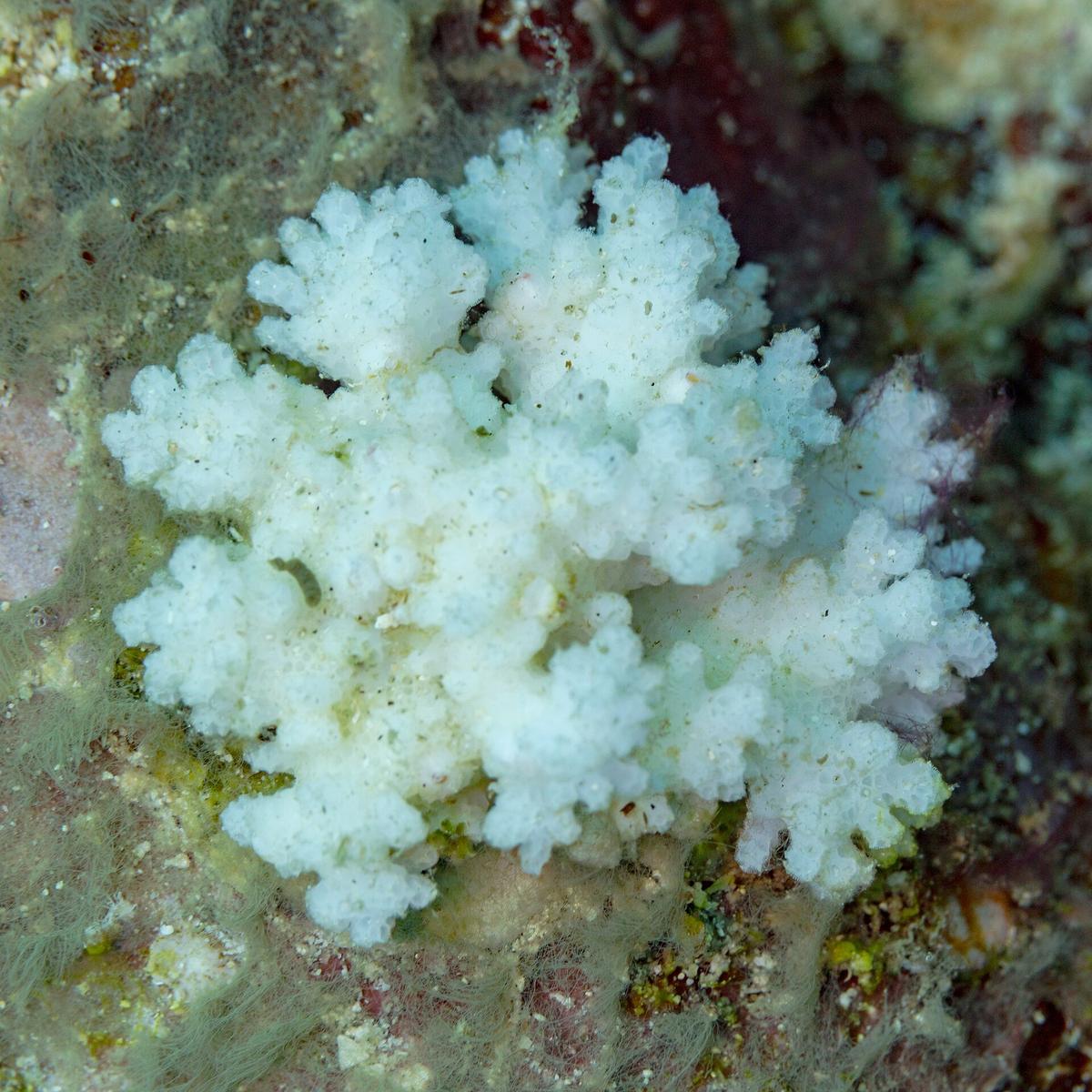

A pale, bleached coral is starving, but it is not always finished. Researchers at Stanford University report that bleached coral fragments in a laboratory tank regained their algae and their color after resting against healthy, genetically identical fragments, while bleached fragments kept a few millimeters away did not recover. The study was published October 14, 2026, in Science Advances1, and the Stanford Doerr School of Sustainability calls the result the fastest documented recovery from bleaching to date.
Why bleaching matters
Reef-building corals live with beneficial algae inside their tissue, and those algae supply the energy the coral needs to grow. When ocean water warms, corals expel the algae, which leaves them pale, starved and open to harmful algae1, according to the Stanford release. The response is often fatal, and corals that survive can take months to years to recover. Reefs shelter about a third of known marine species, buffer coasts from storms and flooding, and support food and livelihoods for hundreds of millions of people, the release adds.
Heat stress on that scale has become common. NOAA Coral Reef Watch reports that from January 1, 2023 to September 30, 2025, about 84.4% of the world's coral reef area6 experienced bleaching-level heat stress, with mass bleaching documented in at least 83 countries and territories. NOAA counts that period as the fourth global bleaching event and, in its June 2, 2026 update, says it likely ended in 2025. The Global Coral Reef Monitoring Network reports that global hard coral cover fell by a relative 8.9% between 2023 and 202412, the largest single-year decline on record.
An accident in a tank
The idea came from a mishap. Steve Palumbi, a Stanford marine biologist, noticed that two coral fragments sampled from the same colony, one bleached and one healthy, had tipped over in a tank1 in his lab and were touching. Where they made contact, color was returning to the bleached fragment. The lab is at Hopkins Marine Station, in Monterey County3, KQED reported.
Danny Collins, a PhD student in oceans at Stanford and the paper's lead author, turned that observation into an experiment. The corals were the branching species Pocillopora damicornis, chosen for its relevance on Indo-Pacific reefs. They came from aquarium-maintained colonies originally obtained from aquarium suppliers2 and had been kept at Hopkins Marine Station for three and a half years, the paper says. The team bleached branches with heat, raising the water from 28.3°C to 34.4°C in steps, holding it near 34.5°C for four hours, then keeping the fragments in tanks for 12 to 16 days until their visible color was gone.
What happened when they touched
Collins set up ten pairs, each a healthy and a bleached fragment from the same parent colony. Five pairs touched, and in the other five the fragments sat 5 to 7 mm apart2. Algae moved from the healthy fragments into the bleached ones within three days1 of contact, according to the release.
Under the microscope, the researchers found the touching corals had fused. The paper identifies tissue fusion as the mechanism2 that moves the algae, and Palumbi told Good News Network that genetically identical corals recognize one another when they come into contact5, and their tissues fuse. Good News Network reports that microscopic channels in the coral tissue align shortly after contact, creating a pathway that carries algae and the nutrients they produce between the corals.
The bleached fragments kept in continuous contact all reached complete recovery within eight weeks, and one did so after only four, according to the paper. Of the five that never touched, two were overgrown by algae and died, and the other three were at least 87% covered by algae by week nine.
A short touch was enough
The team also tested how long the fragments had to stay together, separating pairs after three weeks, two weeks, one week, five days, three days or one day, with two pairs at each length. Bleached fragments that had touched for one week or longer, and one that touched for five days, went on to complete polyp recovery within 7 weeks2. The Stanford release says that after one week of contact, and in some cases after just five days1, the bleached fragments had received enough algae to recover on their own. Fragments separated after three days showed early recovery but were later covered by algae, and those separated after one day showed none.
The recovery continued after separation because the algae kept multiplying inside the bleached coral. The paper measured the algae doubling about every 18 hours in the first six days and about every four days in the next six. The release puts that second rate at about ten times faster than in wild corals1, and the authors write that the recovery was up to an order of magnitude faster2 than most recovery times for corals in the field.
"While bleached corals may be dying, they are not dead yet," Collins told Euronews4. Fiorenza Micheli, a Stanford professor and one of Collins's faculty advisors, said in the same report that bleached corals are often considered a lost cause4 because recovery after a heatwave is very slow, if it happens at all.
The limits
The method works only between clones. When the team paired fragments from different genets, the corals deployed stinging mesenterial filaments within hours of mixed pairings2, only a little algae moved across, and none of those bleached fragments recovered. The paper states that the mechanism is currently limited to same-genet pairing2 and sustained contact, and that it is unknown how consistently the effect occurs across other coral species, algae and colony shapes. The authors note the corals were probably better fed than corals on a reef. Every pair was in a lab tank, and the contact, noncontact and contact-duration groups held two to five pairs each.
The method needs a healthy, genetically identical partner for every bleached coral, which the Stanford release says is not feasible at the scale needed to restore reefs1. "This is a recovery story. It doesn't blunt heatwaves; it just helps the aftermath," Palumbi told Euronews4.
What comes next
The team plans to look for ways to deliver beneficial algae without continuous contact. One idea in the release is to collect algae from healthy corals before heat waves1 and deliver them in large batches to corals that bleach. KQED reported that the researchers also hope to grow extracted algae in a lab, with field tests planned in Hawaii and Palau3 in the coming months to years. The paper closes by saying the findings may inspire a new class of responsive, postbleaching interventions2. The work was funded by the National Science Foundation and Stanford, including seed funds from the Big Ideas for Oceans program, according to the release.
Trivia
- What are two common names for Pocillopora damicornis? Cauliflower coral or lace coral8.
- How long can the larvae of Pocillopora damicornis stay viable? As much as 100 days8. The larvae are helped by a lipid-rich yolk.
- In what year was Hopkins Marine Station founded? In 18929. It is the oldest marine laboratory on the US Pacific coast.
- Who is Hopkins Marine Station named after? Timothy Hopkins9, founder of Palo Alto and an early Stanford trustee.
- Which animal phylum do corals belong to? Cnidaria11, in Anthozoa, the group that also includes the sea anemones.
- Which organization publishes Science Advances? The American Association for the Advancement of Science10, which put out the journal's first articles in early 2015.
- What share of the world's reef area did the third global bleaching event, 2014 to 2017, expose to bleaching-level heat stress? 68.2%6, the record until the fourth event.
- What did the Stanford team 3D print for the experiment? A movable platform called the Coral Slider7, used to bring coral pairs into contact and separate them.
Sources
- Katie Jewett, Stanford scientists discover a way to reverse coral bleaching at record speed, Stanford Doerr School of Sustainability, 14 October 2026. Accessed October 24, 2026.
- Collins D.S., Sipkova J., Mollica N.R., Rolander T., Klepac C.N., Calistro G.F., Barone V., Micheli F., Palumbi S.R., Rapid coral bleaching recovery via symbiont transfer from healthy corals, Science Advances 12(42), 14 October 2026 (PubMed Central copy). Accessed October 24, 2026.
- Danielle Venton, Stanford Scientists Find New Way to Revive Bleached Coral, KQED, 14 October 2026. Accessed October 24, 2026.
- Craig Saueurs, They're not dead yet: Bleached corals recover in record time after touching healthy clones, Euronews, 15 October 2026. Accessed October 24, 2026.
- Coral Bleaching Reversed at Record Speed Using New Stanford Method, Good News Network, 17 October 2026. Accessed October 24, 2026.
- NOAA Coral Reef Watch, NOAA Coral Reef Watch's Fourth Global Coral Bleaching Event, updated 2 June 2026. Accessed October 24, 2026.
- Daniel Collins, Raw data and 3D printing design files for: Rapid coral bleaching recovery via symbiont transfer from healthy corals, Stanford Digital Repository, 2026. Accessed October 24, 2026.
- Pocillopora damicornis, Wikipedia. Accessed October 24, 2026.
- Hopkins Marine Station, Wikipedia. Accessed October 24, 2026.
- Science Advances, Wikipedia. Accessed October 24, 2026.
- Coral, Wikipedia. Accessed October 24, 2026.
- Global Coral Reef Monitoring Network, Status of Coral Reefs of the World: 2025, executive summary. Accessed October 24, 2026.