Swiss Glaciers Lose 5.5 Percent of Their Ice in 2026
Key Points
- Glacier Monitoring Switzerland puts the loss at 5.5 percent of the country's ice volume in 2026, the second worst year on record after 2022.
- Swiss glacier ice is down almost 20 percent since 2021.
- The freezing level sat above 4,000 meters on a record 76 days from May to September 2026.
- Allalin, Clariden, the Great Aletsch and the Rhône lost more ice in 2026 than in any year on record.
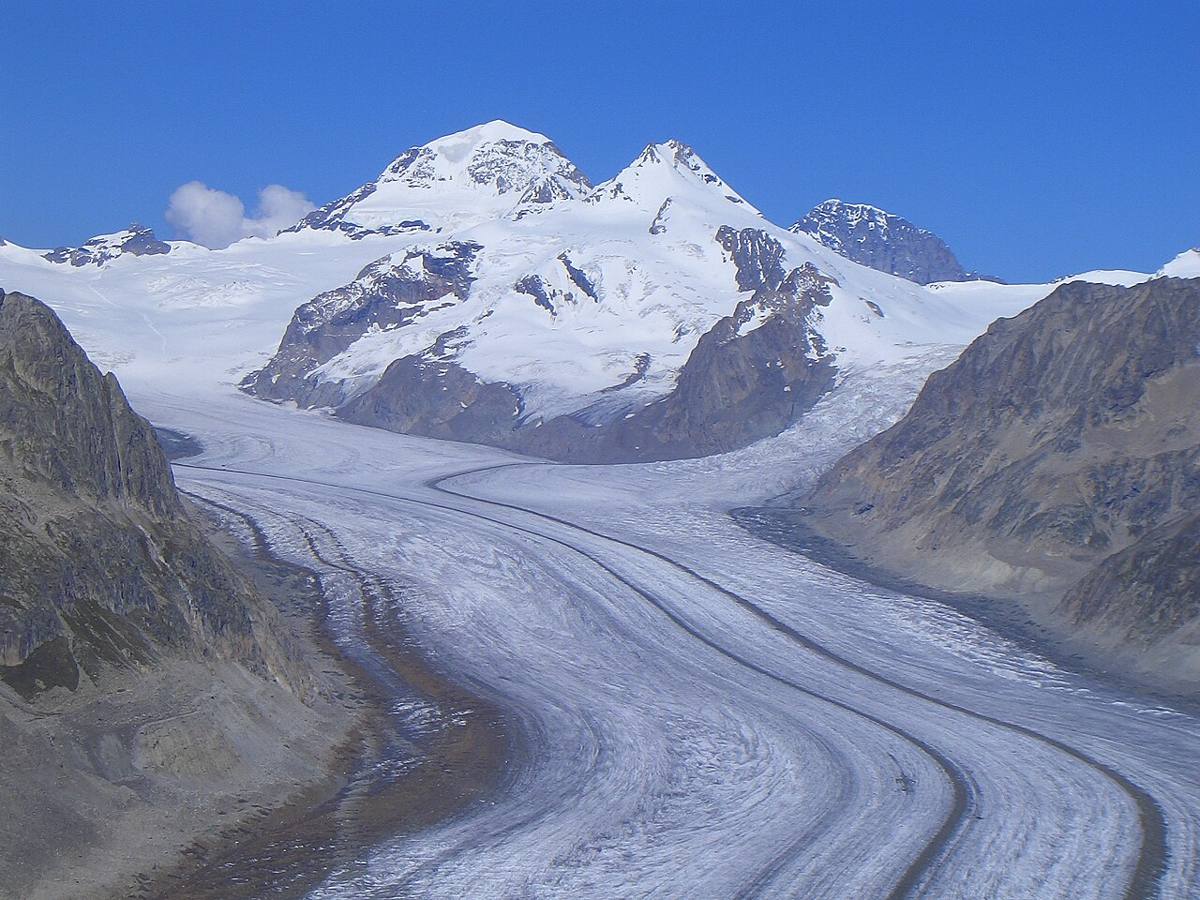

Switzerland's glaciers had their second worst year on record in 2026, behind only 2022. Glacier Monitoring Switzerland (GLAMOS) puts the loss at 5.5 percent of the country's ice volume in one year1, and at almost 20 percent since 2021.
What the 2026 measurements found
GLAMOS teams visited 23 glaciers across the Swiss Alps in September 20261 to measure how much ice each had lost over the hydrological year, which runs from October 1 to September 30. Averaged across all Swiss glaciers, the year's mass balance (the snow and ice a glacier gains minus what it loses) came to a loss of about 2.9 meters of water equivalent. Put another way, the mass lost would make a layer of water about 2.9 meters deep over the whole glacier surface. The only year with a more negative balance was 2022, at a loss of about 3.1 meters.
The last five years stand out in the record. The report says melt rates from 2022 to 2026 were more than twice as high as in any earlier five-year period it monitored1. It estimates that about 42.6 cubic kilometers of glacier ice was left in Switzerland at the end of 2026, over 30 cubic kilometers less than in 2000, and that the glacier area of about 714 square kilometers is a third smaller than it was in 2000.
Why 2026 was so hard on the ice
The trouble started with a dry winter. November 2025 to April 2026 was among the ten least snowy winters since measurements began, and every month from May to September was dry with at least one heatwave2. The freezing level (the zero-degree line) sat above 4,000 meters on 76 days in those months, more than twice the average and a record. By September no snow was left even at 3,500 meters.
The report puts snow on the glaciers 25 percent below normal at the end of winter and, citing MeteoSwiss, calls June to August the hottest on record1. The "Glacier loss day", when all the snow added over the winter has melted, came on July 2 on average for 13 closely studied glaciers1, the second earliest after 2022.
So why wasn't 2026 worse than 2022? A press release from the Swiss Academy of Sciences (SCNAT) gives two reasons. Many glaciers had slightly more snow than in 2022, and less Saharan dust settled on the snow, so more sunlight was reflected2.
Records broken, and glaciers gone
Four large glaciers, Allalin, Clariden, the Great Aletsch (the Aletsch Glacier) and the Rhône, lost more ice in 2026 than in any year on record, 2022 included1. About 13 meters of ice melted in the year at the lowest measuring site on the Great Aletsch Glacier, at 1,980 meters above sea level1.
Some small glaciers are now gone. The report says photographic reports indicate the complete loss of the Bella Tola Glacier in the canton of Valais and the Griessfiren (also called Plattalvafirn) in the canton of Glarus1, two glaciers that had been measured for many years. More than 1,000 Swiss glaciers vanished between 1973 and 2016 and about 100 more between 2016 and 20231. A count for 2026 will wait for the next Swiss Glacier Inventory, in about 20281.
Where the water goes
From July to September, the glaciers lost around 2,200 billion liters of water in those three months alone, more than four times the annual drinking water use of all Swiss households2. The release says that melt still helps ease summer water shortages, but the effect is already shrinking along with the ice2.
Measured by volume rather than share, 2026 looks smaller. At 2.5 cubic kilometers, the ice lost in 2026 ranks only third in recent decades and is smaller than the 2003 loss1, because the glaciers now cover so much less ground. The report says the peak in meltwater from Swiss glaciers has likely passed1.
Trivia
- What is the largest glacier in the Alps? The Aletsch Glacier, in the canton of Valais3.
- How many glaciers did GLAMOS teams visit to measure in September 2026? 231.
- Which year had a more negative mass balance for Swiss glaciers than 2026? 20221.
- On how many days from May to September 2026 was the freezing level above 4,000 meters? 76, a record2.
- Which protected area, declared a UNESCO World Heritage Site in 2001, includes the Aletsch Glacier? The Jungfrau-Aletsch Protected Area3.
Sources
- Matthias Huss, Andreas Bauder, Andreas Linsbauer and Martina Barandun, Annual mass balance of Swiss glaciers in 2025/2026, Glacier Monitoring Switzerland (GLAMOS), September 23, 2026. Accessed October 23, 2026.
- Swiss glaciers lose a further five per cent of their volume, University of Fribourg (press release of the Swiss Academy of Sciences SCNAT), October 1, 2026. Accessed October 23, 2026.
- Aletsch Glacier, Wikipedia. Accessed October 23, 2026.