The 10,000-Hour Rule and the Deliberate Practice Record
Key Points
- The 10,000-hour rule was popularized by Malcolm Gladwell’s Outliers and rests on the deliberate practice view from a 1993 study of violin students.
- A 2014 meta-analysis found deliberate practice explained 26 percent of performance variance in games, 21 percent in music, 18 percent in sports, 4 percent in education and less than 1 percent in professions.
- A 2019 preregistered replication of the violin study did not reproduce its core finding, though practice still explained 26 percent of the variance.
- Ericsson’s 2021 reply argues that the 2014 meta-analysis defined deliberate practice too broadly, so the sides disagree about what the numbers measure.

The 10,000-hour rule says that about 10,000 hours of practice turns a person into an expert. It is a popular idea, and the science behind it is a good deal more contested than the slogan. This article reads four papers from the deliberate practice debate: a 2014 meta-analysis, a 2019 attempt to repeat the best-known study, a 2020 review, and a 2021 response by the theory's originator to Macnamara and Hambrick.
Where the rule came from
Macnamara and Maitra, writing in Royal Society Open Science in 2019, describe a 1993 article by Ericsson, Krampe and Tesch-Römer in Psychological Review as the origin of the deliberate practice view, and say, citing Google Scholar as of November 12, 2018, that the article had been cited over 9,000 times2 . They add that the view inspired popular books, including Malcolm Gladwell’s Outliers, where Gladwell described what the paper calls the now famous 10,000-hour rule: with 10,000 hours of deliberate practice, one becomes an expert2 .
The 1993 study recruited three groups of 10 violin students from the Music Academy of West Berlin: a best group nominated by faculty as having the potential for careers as international soloists, a good group, and a group of future music teachers2 . The students estimated, from memory, how many hours a week they had practiced alone since they first took up the violin, and the researchers added those estimates up to age 182 . The original paper reported mean accumulated practice alone to age 18 of 7,410 hours for the best violinists and 5,301 hours for the good ones2 .
A meta-analysis of the whole field
Macnamara, Hambrick and Oswald published a meta-analysis in Psychological Science in 2014 that covered the major domains in which deliberate practice had been investigated1 . They defined deliberate practice as engagement in structured activities created specifically to improve performance in a domain1 . By their estimates, deliberate practice explained 26 percent of the variance in performance for games, 21 percent for music, 18 percent for sports, 4 percent for education and less than 1 percent for professions1 .
The authors concluded that deliberate practice is important, but not as important as has been argued1 . Those figures describe how much of the differences between people each domain’s data could be linked to practice amounts. They do not say practice is unimportant, and the abstract does not say that either.
The 2019 attempt to repeat the violin study
Macnamara and Maitra ran a preregistered replication of the 1993 violin study, with a double-blind procedure so that neither the interviewers nor the violinists knew the skill groups, and with analyses they judged better suited to the design2 . They recruited from the Cleveland Institute of Music: faculty nominated 24 students as having the potential for careers as international soloists, and 13 agreed to take part2 .
Their abstract says they did not replicate the core finding that accumulated amounts of deliberate practice corresponded to each skill level2 . The less accomplished violinists had accumulated less practice alone than the other two groups, but there was no statistically significant difference to age 18 between the best and the good violinists, and most of the best violinists had accumulated less than the good group’s average2 .
On effect size, the original comparison explained 48 percent of the variance in performance, while the replication’s three-group comparison explained 26 percent, close to the 23 percent meta-analytic average for music2, a little above the 21 percent for music in the 2014 meta-analysis1 . The authors write that 26 percent is not an inconsequential amount, but that it does not support the claim that performance can largely be accounted for by differential amounts of practice2 .
One detail bears on the slogan itself. By age 20, both the best and the good violinists in the replication had accumulated more than 10,000 hours of practice alone on average2 . The authors also note that the 95 percent confidence interval around the best group’s mean in the original study, 2,894 to 11,926 hours as Ericsson revealed in 2014, contains the good group’s mean of 5,301 hours2 . In other words, the two groups the replication compared both passed 10,000 hours on average by age 20, and the original’s intervals overlapped, so a single round number does not separate best from good.
The paper offers several possible explanations for the different results, including that the replication’s violinists may have had a higher overall level of expertise, that the original’s non-blind interviews may have introduced bias, and that the original’s analyses made significance easier to find2 . It presents these as possibilities, not as findings.
The definition dispute
Hambrick, Macnamara and Oswald published a review in Frontiers in Psychology in 2020 titled Is the Deliberate Practice View Defensible?3 . Reviewing more than 25 years of Ericsson and colleagues’ writings, they say they document critical inconsistencies in the definition of deliberate practice, along with apparent shifts in the standard for evidence, and they discuss what this means for whether the view can be tested and falsified3 . They then discuss a multifactorial perspective on expertise3 .
Ericsson replied in Psychological Research in 2021, in a response to Macnamara and Hambrick. He wrote that the 2014 meta-analysis misinterpreted the concept and defined deliberate practice much more broadly than he and his colleagues did, and he listed five criteria that he says defined the original concept4 . In his account, activities such as attending lectures, studying alone and group sessions led by a coach do not meet one or more of those criteria4 . He closed by offering a proposal for how the different perspectives could be reconciled4 .
Where the evidence stands
Taken together, the papers narrow the slogan. The 2014 and 2019 papers describe practice as important but not a full explanation. What the four papers dispute is how much of the difference between people practice accounts for, and what counts as deliberate practice in the first place. The 2014 meta-analysis puts the figure well below a full explanation for most domains, and the 2019 replication did not reproduce the original violin result. Ericsson’s 2021 reply argues that the meta-analysis counted activities that were not deliberate practice, so the two sides disagree about what the numbers measure, not only about the numbers.
This article read the abstracts of the 2014 meta-analysis, the 2020 review and the 2021 reply, and the full text of the 2019 replication, so it reports the 2014, 2020 and 2021 papers only as far as their abstracts go. It does not read the 1993 article itself, and the figures it gives for that article come from the 2019 paper. It draws no advice for any learner from them.
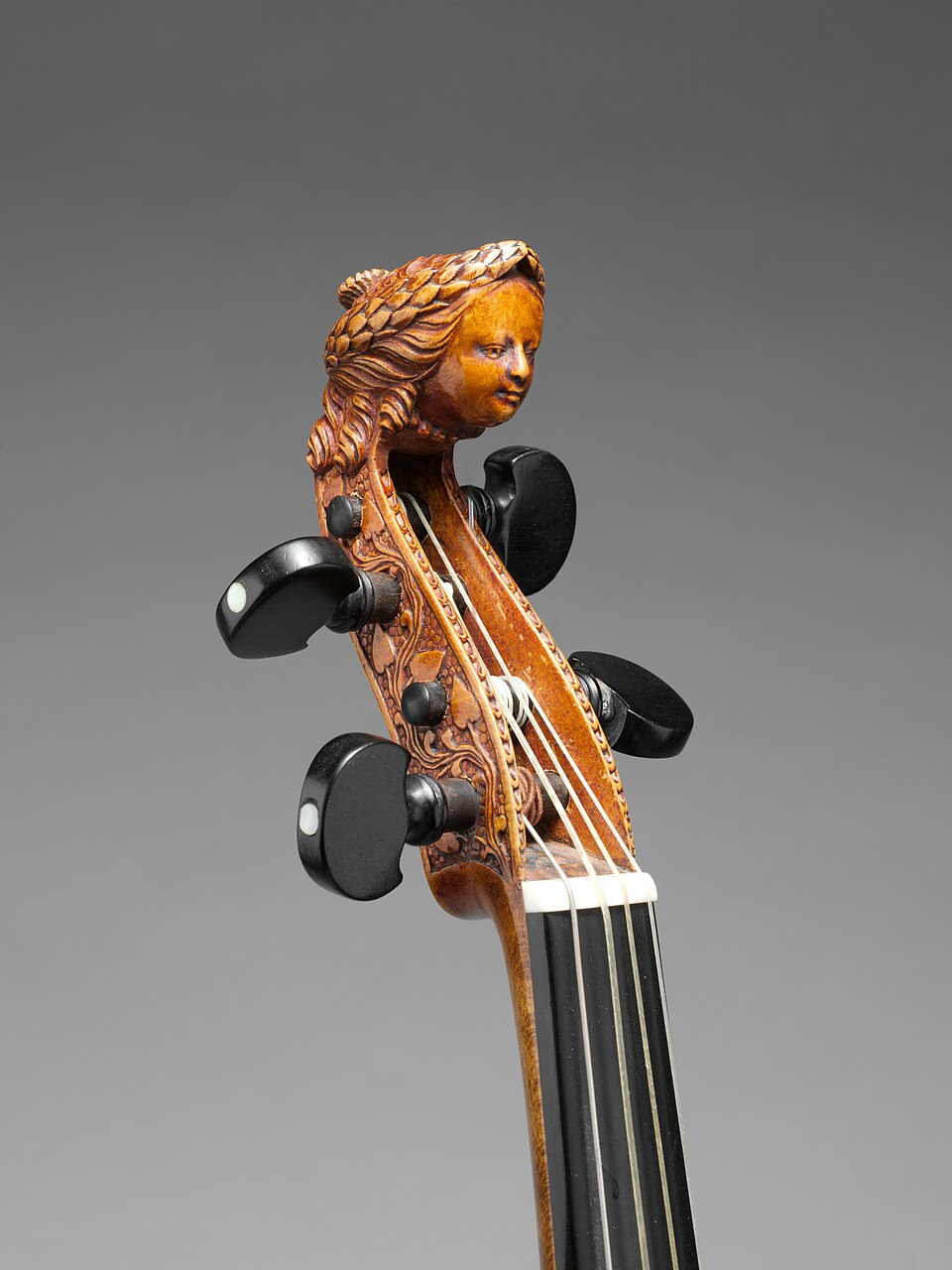
The image at the top is a violin attributed to Joachim Tielke, made around 1685 in Hamburg and held by the Metropolitan Museum of Art, shown here for its carved scroll. It has no connection to the violinists in the papers above.
Trivia
- In which journal did Macnamara, Hambrick and Oswald publish their 2014 deliberate practice meta-analysis? Psychological Science1.
- According to that meta-analysis, what share of performance variance did deliberate practice explain for music? 21 percent1.
- Which instrument did the 1993 study and its 2019 replication examine? The violin2.
- In the 2019 replication, how many violinists agreed to take part from the 24 nominated at the Cleveland Institute of Music? 132.
- Which 2021 reply in Psychological Research argued that the meta-analysis defined deliberate practice too broadly? Ericsson’s reply to Macnamara and Hambrick4.
Sources
- Macnamara BN, Hambrick DZ, Oswald FL. Deliberate practice and performance in music, games, sports, education, and professions: a meta-analysis. Psychological Science, 25(8), 1608-1618, 2014. Accessed November 5, 2026.
- Macnamara BN, Maitra M. The role of deliberate practice in expert performance: revisiting Ericsson, Krampe & Tesch-Römer (1993). Royal Society Open Science, 6(8), 190327, 2019. Accessed November 5, 2026.
- Hambrick DZ, Macnamara BN, Oswald FL. Is the deliberate practice view defensible? A review of evidence and discussion of issues. Frontiers in Psychology, 11, 1134, 2020. Accessed November 5, 2026.
- Ericsson KA. Given that the detailed original criteria for deliberate practice have not changed, could the understanding of this complex concept have improved over time? A response to Macnamara and Hambrick (2020). Psychological Research, 85(3), 1114-1120, 2021. Accessed November 5, 2026.