Treasury Estimates $618 Billion in Borrowing for Q4 2026
Key Points
- On November 2, 2026, Treasury estimated it will borrow $618 billion in privately-held net marketable debt in October to December 2026, $10 billion less than it estimated in August.
- For January to March 2027, Treasury estimated $800 billion, assuming an end-of-March cash balance of $1.000 trillion.
- Treasury says it borrowed $742 billion in July to September 2026 and ended that quarter with a cash balance of $984 billion.
- Additional quarterly refunding details are due at 8:30 a.m. on Wednesday, November 4, 2026.
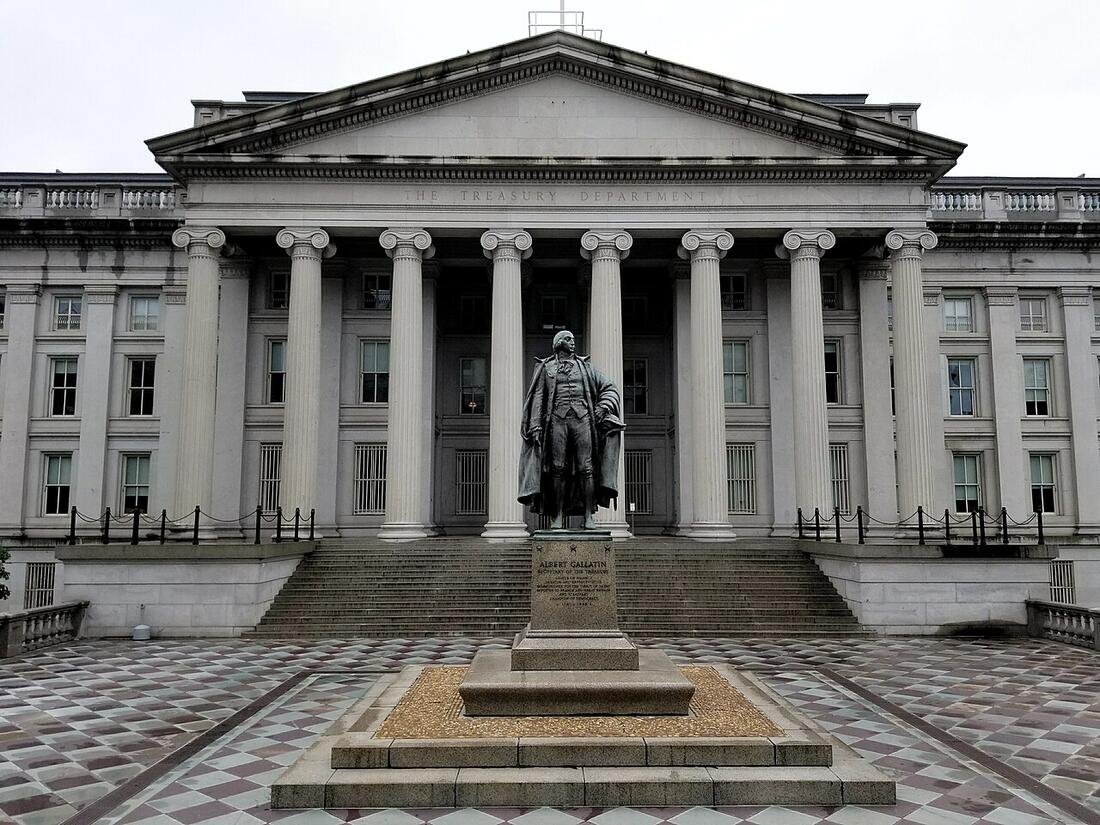

On Monday, November 2, 2026, the U.S. Treasury published its latest estimates of how much it expects to borrow from the public. For the October to December 2026 quarter, it expects to borrow $618 billion in privately-held net marketable debt1, which is $10 billion less than it estimated in August. Here is what that phrase means, what moved the number, and what comes next.
The numbers Treasury published
The announcement covers two quarters. For October to December 2026, Treasury assumes an end-of-December cash balance of $850 billion1 and says the $618 billion estimate is $10 billion lower than the one announced in August 20261. For January to March 2027, Treasury expects to borrow $800 billion, assuming an end-of-March cash balance of $1.000 trillion1. Adding the two estimates gives $1.418 trillion across the six months (Big Time Trivia's arithmetic).
The release also looks back. Treasury says that during July to September 2026 it borrowed $742 billion and ended the quarter with a cash balance of $984 billion1. In August it had estimated borrowing of $739 billion and assumed an end-of-September cash balance of $950 billion1. Treasury describes the gap between estimate and result as $4 billion in higher privately-held net marketable borrowing1.
Why the estimate moved
Treasury gives one main reason for the $10 billion drop in the October to December figure. The change was primarily due to the higher-than-assumed beginning of quarter cash balance, partially offset by lower projected net cash flows1. In plain terms, the quarter started with more cash in the government's account than the August estimate assumed, which reduces the amount to be raised, while projected net cash flows are lower than in August.
Treasury also sets the cash effect aside. Excluding the higher-than-assumed beginning-of-quarter cash balance, the current quarter borrowing estimate is $24 billion higher than announced in August1. The same exercise for the July to September quarter points the other way, because excluding the higher-than-assumed end-of-quarter cash balance, actual borrowing in July to September was $30 billion lower than announced in August1. The two adjustments move in opposite directions, which is why Treasury reports both the headline change and the change with cash left out.
A table attached to the release lays out the cash assumptions. For July to September, the opening balance was $919 billion in both the prior and the current estimate, while the closing balance rose from $950 billion to $984 billion1. For October to December, the opening balance moves from $950 billion to $984 billion1, the closing balance stays at $850 billion, and the table's line for the impact of cash on borrowing changes from negative $100 billion to negative $134 billion1. The $34 billion change in that line matches the $34 billion rise in the opening balance (Big Time Trivia's arithmetic).
What "privately-held net marketable borrowing" means
Each word narrows the measure. "Marketable" refers to securities that can be traded. TreasuryDirect, the Treasury's retail site, explains that a marketable security can be transferred to someone else and sold before it matures2. Savings bonds are different, because they are not marketable: each is registered to one person and cannot be sold or transferred2.
"Privately-held" is defined in a footnote to the release. The measure excludes rollovers (auction add-ons) of Treasury securities held in the Federal Reserve System Open Market Account, but includes financing required due to redemptions from that account1. The footnote adds that buybacks are not expected to significantly affect privately-held net marketable borrowing, as new issuance replaces securities that are bought back1. So the figure measures new borrowing from holders outside the Federal Reserve's account, not the size of the national debt and not the federal deficit.
What Treasury sells
The estimate covers marketable securities of every kind. According to TreasuryDirect, the Treasury offers five types of marketable securities2, all backed by the full faith and credit of the United States government2. Bills run from 4 weeks up to 52 weeks and are sold at face value or at a discount2. Notes carry maturities of 2, 3, 5, 7 and 10 years and pay interest every six months2. Bonds were historically a 30-year security and are now also offered in 20-year terms2. Floating rate notes are issued for two years, with interest that rises and falls with 13-week bill discount rates2, and Treasury Inflation-Protected Securities, or TIPS, adjust their principal with the Consumer Price Index and come in 5, 10 and 30 years2.
What comes next
The November 2 numbers are one piece of a quarterly routine. Treasury says additional financing details relating to the Quarterly Refunding will be released at 8:30 a.m. on Wednesday, November 4, 20261. Its refunding page explains that changes in debt management policy are generally informed by and communicated through the quarterly refunding process near the middle of each calendar quarter3. Each quarter, the same page says, Treasury debt managers consult with the Treasury Borrowing Advisory Committee and meet with the primary dealers that trade with the Federal Reserve Bank of New York3, and Treasury provides a live web stream of its refunding presentation and questions and answers with the press3.
How to read the figures
- The $618 billion and $800 billion figures are estimates, each tied to an assumed end-of-quarter cash balance1, and Treasury's estimate for the July to September quarter was off by what it put at $4 billion once the results were in.
- They are quarterly amounts, covering three months each, not annual totals.
- They count privately-held net marketable debt1 only, so they leave out non-marketable savings bonds and securities rolled over by the Federal Reserve's account.
- They are estimates of borrowing, not forecasts of interest rates, prices or markets, and this article makes none.
Trivia
- How much did Treasury estimate it would borrow in privately-held net marketable debt for October to December 2026? $618 billion1, which is $10 billion below the August estimate.
- What end-of-March 2027 cash balance did Treasury assume? $1.000 trillion1.
- What range of terms do Treasury bills cover? From 4 weeks up to 52 weeks2.
- Which type of Treasury security has principal that adjusts with the Consumer Price Index? Treasury Inflation-Protected Securities, or TIPS2.
- When will Treasury release additional quarterly refunding financing details? 8:30 a.m. on Wednesday, November 4, 20261.
Sources
- U.S. Department of the Treasury, Treasury Announces Marketable Borrowing Estimates, press release, November 2, 2026. Accessed November 3, 2026.
- U.S. Department of the Treasury, Bureau of the Fiscal Service, TreasuryDirect, Marketable Securities. Accessed November 3, 2026.
- U.S. Department of the Treasury, Treasury Quarterly Refunding. Accessed November 3, 2026.