Voyager 1 Nears One Light-Day From Earth on November 18
Key Points
- NASA says Voyager 1 will be one light-day from Earth on Wednesday, November 18, 2026, at 5:16:07 a.m. EST, about 16.09 billion miles away.
- At that distance a radio message takes 24 hours to reach the probe and another 24 for the reply.
- NASA says the milestone changes nothing on the spacecraft, and that Voyager 2 is on pace to reach it in November 2035.
- NASA's October 29 post reports a power-saving swap finished in early September and a loss of contact on October 18 and 19, with the cause still under investigation.

NASA says Voyager 1 will reach a point one light-day from Earth on Wednesday, November 18, 2026, at 5:16:07 a.m. EST. NASA's explainer calls it a mile marker reached by no other human-made object1. That is 13 days after November 5, and it comes just after a busy autumn for the probe, which missed two scheduled contacts in October and had a power-saving swap finished in early September.
What a light-day measures
A light-day is a distance, not a length of time. NASA defines it as the distance light travels in 24 hours, 16,094,799,096 miles (25,902,068,356 kilometers)1. Light covers about 186,000 miles every second1, and the same speed applies to radio waves, which is how the spacecraft talks to Earth.
NASA's page builds a ladder of smaller light-distances to make the number easier to hold. The Moon is 238,855 miles from Earth on average, and light crosses that distance in 1.3 seconds1. Sunlight takes about eight minutes and 20 seconds to travel the 93 million miles from the Sun to Earth1. Between Earth and Mars, light takes anywhere from three minutes to 22 minutes1, depending on where the two planets sit in their orbits.
Neptune is the best yardstick for a spacecraft. NASA gives its average distance from Earth as about 2.8 billion miles, or four light-hours and 10 light-minutes1. Voyager 2, traveling at about 35,000 miles per hour, took 12 years to reach Neptune1. Voyager 1 is about to pass a distance nearly six times as far in light-travel terms (24 hours against four hours and 10 minutes), which shows how far past the planets it has gone.
The numbers for November 18
On Thursday, October 29, 2026, NASA's Voyager team posted that on November 18 the spacecraft will be 16.09 billion miles (25.89 billion kilometers) from Earth2, the equivalent of one light-day. Its post says that is the distance at which radio waves used to communicate with the probe take 24 hours to reach it, and the radio waves carrying the spacecraft's return message take another 24 hours2. The post quotes Suzanne Dodd, Voyager project manager at NASA's Jet Propulsion Laboratory: "If you want to say 'hello' to Voyager, you send your message and then you go home and you wait two days before you finally get a response."2
The spacecraft is moving at 38,000 mph (61,155 kph)2. NASA's explainer puts the elapsed time at about 49 years1 when the milestone arrives, and says Voyager 1 launched on Sept. 5, 1977, about two weeks after its twin, Voyager 21. It also calls that speed a relative crawl compared to the speed of light1.
The milestone has no physical effect. NASA's October 29 post says the spacecraft will not detect any change in its environment when it passes one light-day, nor will anything change aboard the spacecraft2. It describes the significance as a demonstration of the vastness of the universe and the endurance of humanity's most distant explorer2.
Voyager 2 and the long view
Voyager 2 took a different route after launch, flying past Uranus and Neptune. NASA's explainer says it is on pace to be one light-day away from Earth in nine more years, in November 20351.
Voyager 1 is pointed toward a star called AC +79 3888, also known as Gliese 4451, an obscure star in the constellation Ursa Minor that NASA says is more than 17 light-years away from Earth1. The explainer says the probe is expected to pass within about 1.7 light-years of it, in 40,000 years1. For scale, NASA gives a light-year as about 5.88 trillion miles1, the closest neighboring star system, Proxima Centauri, as about 4.24 light-years away1, and the Andromeda galaxy as about 2.5 million light-years away1.
The autumn before the milestone
The same October 29 post reports two pieces of recent news. The first is a power fix. The Voyagers run on radioisotope thermoelectric generators, which convert heat from decaying plutonium into electricity2, and NASA says both probes lose about 4 watts of power each year2. In early September the team turned off three devices on Voyager 1 and substituted them with three lower-power alternatives2, in an effort nicknamed the Big Bang that was finished about six weeks after the mission team performed the same swap on Voyager 22. The post says the swaps had to happen together, because the six devices help keep the spacecraft warm enough to operate2. Without the work, it says, the mission would have needed to turn off another instrument on Voyager 1 as early as summer 20272.
The second item is a scare. NASA's Deep Space Network, the large antennas at three sites around the globe, was unable to detect a radio signal from the probe during two scheduled communications attempts, 24 hours apart2, on October 18 and 19. The post says the signal reappeared on October 20 and contact has held since. Engineers found that one group of thrusters went offline and their backups turned on2, an automatic swap the post calls fault protection, which puts the spacecraft in a safe configuration and pauses normal operations. The cause is still under investigation, according to NASA. Kareem Badaruddin, Voyager mission manager at JPL, is quoted as saying: "This is the first time we've seen the spacecraft do something like this, but we are also at a point in the mission where we have to expect the unexpected."2
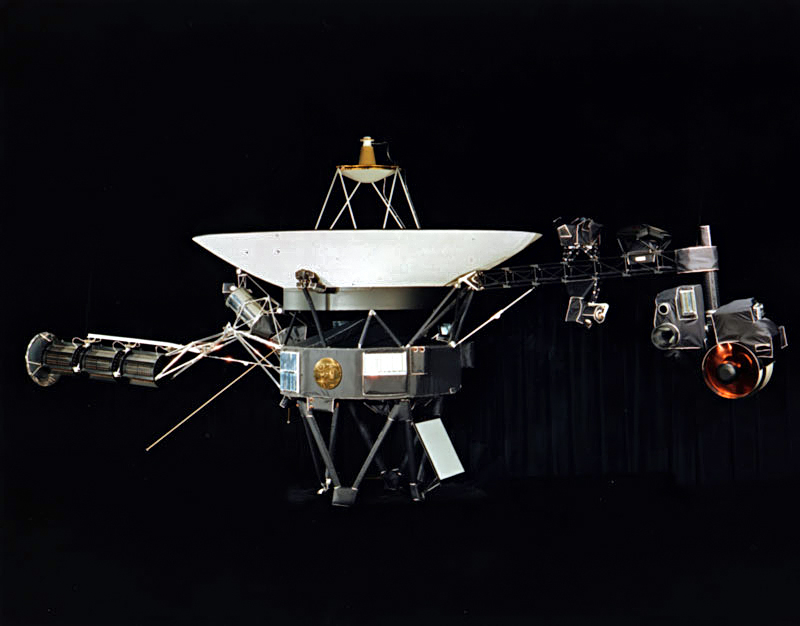
The photo at the top of this page is a NASA photograph of one of the two identical Voyager probes, from the Wikimedia Commons file page. It shows the dish, the generator boom on the left and the instrument boom on the right.
Trivia
- What date does NASA give for Voyager 1 reaching one light-day from Earth? Wednesday, November 18, 2026, at 5:16:07 a.m. EST1.
- How long does it take light to travel from the Sun to Earth? About eight minutes and 20 seconds1.
- How many hours will it take a radio message to reach Voyager 1 at one light-day? 24 hours2, with another 24 for the reply.
- When is Voyager 2 on pace to reach one light-day? November 20351.
- What did the team find after the signal went quiet on October 18 and 19? One group of thrusters had gone offline and the backups turned on2, with engineers still investigating why.
Sources
- What Is a Light-Day?, NASA Science, Voyager 1 mission page. Accessed November 5, 2026.
- NASA's Voyager 1 Conserves Power, Resolves Brief Communications Pause, NASA Science Editorial Team, NASA Science Voyager blog, October 29, 2026. Accessed November 5, 2026.
- File:Voyager.jpg, Wikimedia Commons file page. Accessed November 5, 2026.