Alcatraz Occupation Began November 20, 1969
Key Points
- The Indians of All Tribes arrived on Alcatraz Island on November 20, 1969, and the National Park Service says the occupation lasted 19 months.
- The Park Service lists three separate occupations: March 9, 1964, November 9, 1969, and the one that began on November 20, 1969.
- Its pages give two different dates for the final removal, June 10 and June 11, 1971.
- The Park Service calls it the first intertribal protest action to focus the nation's attention on the situation of native peoples.

Friday, November 20, 2026, is 57 years after the day a group of Indigenous activists called the Indians of All Tribes arrived on Alcatraz Island, November 20, 19691. They stayed for 19 months. The island had been a prison. The Park Service's Golden Gate page says the occupation is recognized today as one of the most important events in contemporary Native American history3.
Three landings, not one
The National Park Service says there were three separate occupations of Alcatraz Island: one on March 9, 1964, one on November 9, 1969, and the one that began on November 20, 19692. In 1964, five Sicangu Lakota people landed and declared the island Indian land, citing the 1868 Fort Laramie Treaty. That occupation lasted four hours2.
On November 9, 1969, a group that included Richard Oakes set out in a chartered boat, the Monte Cristo, to claim the island symbolically. Many tribes were represented, so the group took the name Indians of All Tribes. It left the island that same evening2. Eleven days later, a second landing became a full occupation, as the Park Service describes.
The pre-dawn crossing
Photographer Brooks Townes was living on a sailboat in Sausalito when the occupation organizers asked whether he could round up fellow sailors and boats to take 60 people to Alcatraz before dawn on November 20, 19691. He did, and 93 people showed up, so two of the three boats made two round trips1. Seeing no photographers on the island, Townes, with permission, photographed the first nine days of the occupation1.
The Park Service puts the number who occupied the island at about 100, among them 80 students from UCLA2.
Life on the rock
Once the occupiers were established, an elected council was put into place and everyone had a job: security, sanitation, day care, school, housing, cooking and laundry. Decisions were made by unanimous consent2. They wanted the deed to the island, an Indian university, a cultural center and a museum, and the government negotiators refused all of it2.
The federal government took a position of non-interference: the FBI was told to stay clear, the Coast Guard not to interfere and the General Services Administration not to remove the occupiers2. The Park Service says the government was playing a waiting game, hoping support would fade2. By early 1970 the organization had begun to fall into disarray, and on January 5, 1970, the 13 year old stepdaughter of Oakes died after a fall in a stairwell. Oakes left the island afterward2. In the meantime the government shut off the electrical power and removed the water barge, and three days after that a fire destroyed several historic buildings; the government blamed the occupiers, and the occupiers blamed infiltrators2.
How it ended
In January 1971 two oil tankers collided at the entrance to San Francisco Bay, which pushed the federal government to act, and President Nixon gave the go ahead to develop a removal plan, to take place when the fewest people were on the island and to use as little force as possible2. The Park Service's We Hold the Rock page says armed federal marshals, FBI agents and special forces police removed five women, four children and six unarmed men on June 10, 19712. The Park Service's 50th anniversary page gives a different day for the final removal: the biography of a photographer there says the remaining occupiers were removed on June 11, 19711. The Park Service's pages give both dates (the We Hold the Rock page itself says June 11 in one place and June 10 in another), so this article names both.
What came after
The Park Service calls the occupation the first intertribal protest action to focus the attention of the nation on the situation of native peoples in the United States, and says it ignited a protest movement that culminated with the occupation of Wounded Knee in South Dakota in 19733. It adds that the goals of the occupiers were to awaken the public and to assert the need for self-determination, and the essay by historian Dr. Troy Johnson on that page says that, either directly or indirectly, the occupation ended the official policy of termination and made self-determination the official policy2. Separately, during the occupation, President Nixon returned Blue Lake and 48,000 acres of land to the Taos Indians2.
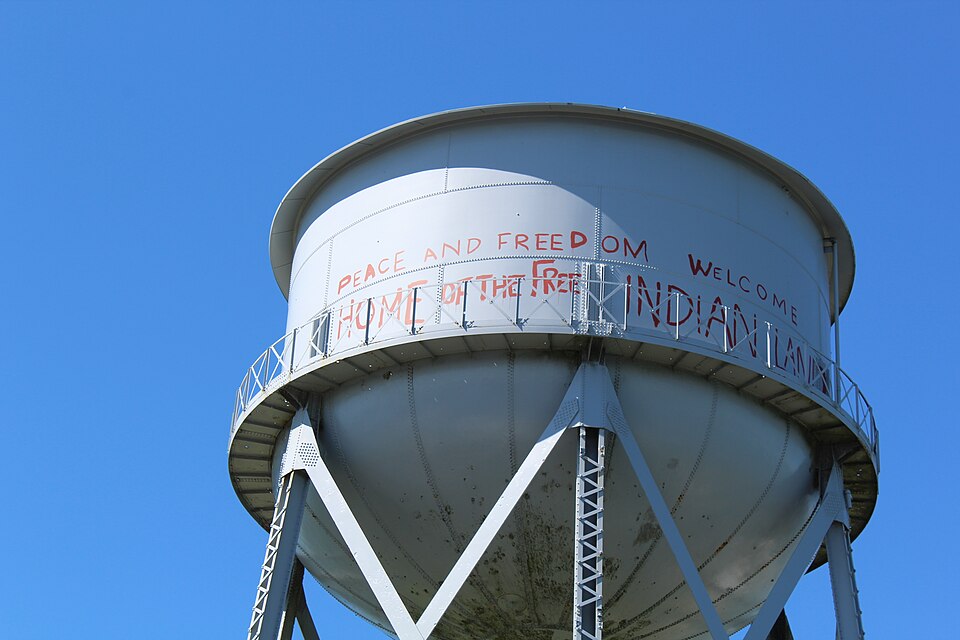
On November 20, 21 and 23, 2019, former occupiers, their descendants and the community returned to Alcatraz to mark 50 years, and the Park Service says it works with former occupiers and their families to restore the messaging and political art from the occupation1. The water tower in the photo above carries painted words, among them "Indian Land."
Trivia
What name did the group that took Alcatraz in November 1969 use?
Indians of All Tribes, chosen because many tribes were represented2
How long did the occupation that began on November 20, 1969, last?
19 months1
Which treaty did the five Sicangu Lakota cite when they landed in March 1964?
The 1868 Fort Laramie Treaty2
What was the name of the chartered boat used in the symbolic landing on November 9, 1969?
The Monte Cristo2
What land did President Nixon return to the Taos Indians while the occupiers were on the island?
Blue Lake and 48,000 acres of land2
Sources
- Occupation of Alcatraz, 50th Anniversary Commemoration, National Park Service. Accessed November 17, 2026.
- We Hold the Rock, The Alcatraz Indian Occupation, Dr. Troy Johnson, Alcatraz Island, National Park Service. Accessed November 17, 2026.
- Alcatraz Occupation, Golden Gate National Recreation Area, National Park Service. Accessed November 17, 2026.