Congress Met in Washington for the First Time on November 17, 1800
Key Points
- Congress first met in the Capitol in Washington on November 17, 1800, after ten years in Philadelphia.
- Only 15 of the 17 senators needed for a quorum answered the first roll call, and the Senate reached its first Washington quorum four days later.
- Only the north wing of the Capitol was ready, and it held the Senate, the House, the Supreme Court and the Library of Congress.
- John Adams moved into the unfinished President’s House on November 1, 1800, and gave his annual message to a joint session in the Capitol on November 22.
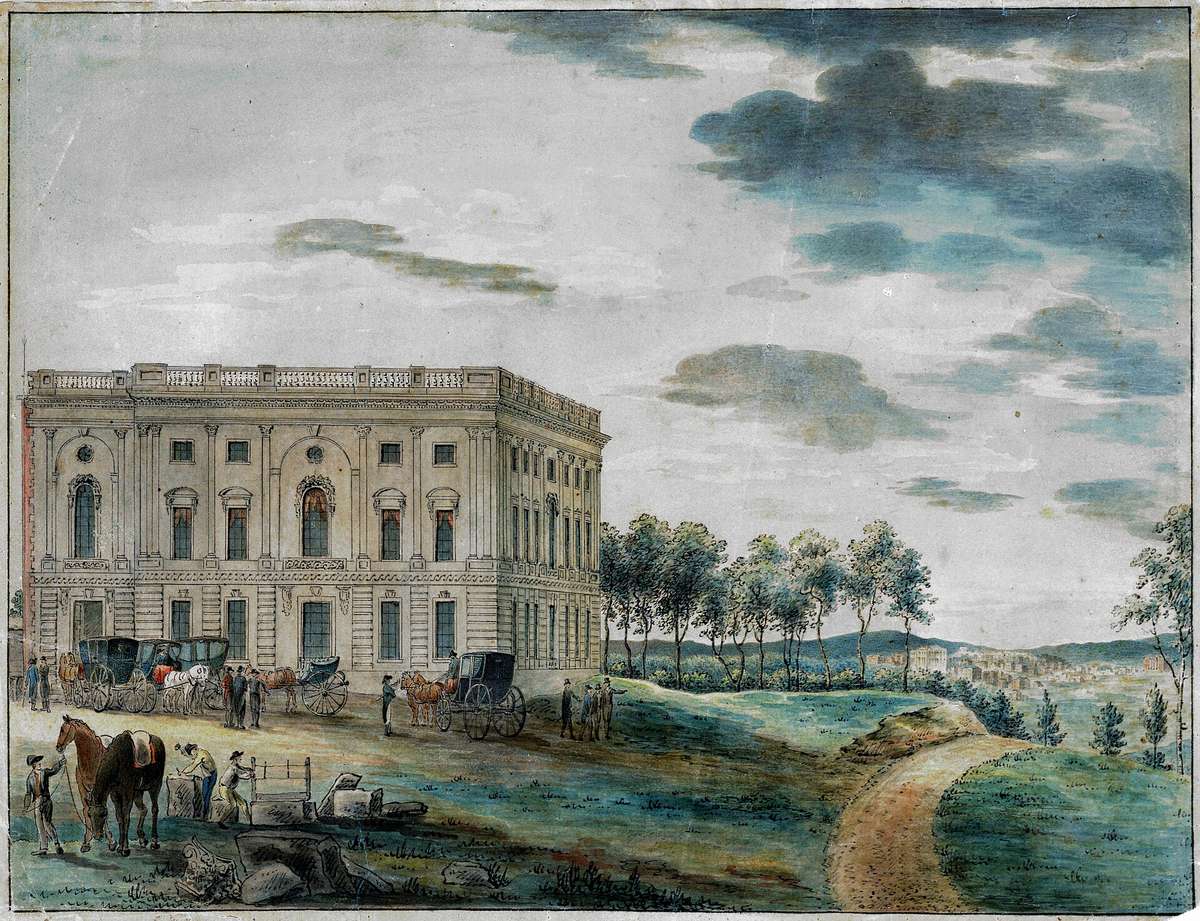

On November 17, 1800, after a 10-year stay in Philadelphia, the Senate of the Sixth Congress met for the first time in the Capitol Building1. The House assembled the same day, also for the first time, in the Capitol’s north wing2. Tuesday, November 17, 2026, marks 226 years since that first sitting10, which followed a snowstorm and opened with a roll call that came up short, in a Capitol that was still unfinished.
A deadline set in 1790
On July 16, 1790, President George Washington signed the Permanent Seat of Government Act, which placed a federal district “not exceeding ten miles square” on the Potomac River5. The location came out of a compromise fashioned by Thomas Jefferson and Alexander Hamilton with the tacit support of Representative James Madison, in which southern Representatives dropped their opposition to having the federal government assume the states’ Revolutionary War debt in exchange for a southern capital5.
Under that law Washington selected the area in 1791, from land ceded by Maryland, and named three commissioners, who hired the French engineer Pierre Charles L’Enfant to plan the city9. L’Enfant put the Capitol at the east end of the Mall on what was then called Jenkins’ Hill, a site he called “a pedestal waiting for a monument.”9 Meanwhile Congress sat in Philadelphia, where it convened on December 6, 1790, and held its final day there on May 14, 18004. The 1790 law’s occupancy deadline, along with outbreaks of cholera and yellow fever in Philadelphia, spurred the move2.
One wing of a building
Washington laid the Capitol’s cornerstone in the building’s southeast corner on September 18, 1793, with Masonic ceremonies9. Funding was inadequate, and by August 1796 the commissioners had to focus the entire work effort on the north wing so it could at least be ready for the government on schedule9. That wing was built for the Senate, and although some third-floor rooms remained incomplete by moving day, it was substantially ready to receive the Senate, the House, the Supreme Court, the Library of Congress and the district courts1.
The House set up a temporary chamber there, in the only completed part of the Capitol3. In the fall of 1800, the only functional pieces of the new capital were the President’s House, the north wing of the Capitol and Pennsylvania Avenue, the road connecting the two2. The same 1800 law that provided for moving the government from Philadelphia gave $5,000 for books for the use of Congress, the beginning of the Library of Congress, overseen by the first joint committee of Congress11.
A president in a half-finished house
John Adams wrote to Abigail Adams on November 2, 1800, from the “Presidents house, Washington City,” that he had arrived the day before at one o’clock, dined and slept there, and found the building “in a State to be habitable.”8 The editors of the Adams Papers note that when he took up residence on November 1, the walls were unplastered, few furnishings were in place and only one of three staircases had been built8. Despite offers of private lodgings, he resolved to stay in the house while work continued8.
Abigail had not yet arrived, and the same letter says he was glad she had agreed to come8. Before closing it, he wrote, “I pray Heaven to bestow the best of Blessings on this House and all that shall hereafter inhabit it. May none but honest and wise Men ever rule under this roof.”8
Snow and a short roll call
A late fall storm snarled travel along the east coast, delaying senators on their way to the new session, and a heavy blanket of snow forced the cancellation of a welcoming parade1. The Senate convened in the ground-floor room now restored as the Old Supreme Court Chamber, where only 15 of the necessary 17 members answered the quorum call1.
Four days later, on Friday, November 21, the Senate finally reached its first Washington quorum and, together with the House, told Adams that Congress awaited any communication he wished to make1.
The address of November 22
On November 22, 1800, Adams delivered his fourth annual message to a joint session of the Sixth Congress in the new Capitol6. The Senate Chamber that day was crowded, leaky and unheated, though elegantly appointed1. He opened by reporting that the public offices, records and property had been moved from Philadelphia, and then congratulated the members “on the prospect of a residence not to be changed.”7 He allowed that “accommodations are not now so complete as might be wished,” but predicted the inconvenience would end with the session7.
He called the Capitol “this solemn temple” and asked Congress to consider whether to exercise at once the local powers over the District of Columbia that the Constitution gave it7. He also urged them to take up the judiciary system of the United States7.
It was the last presidential message delivered in person to Congress until Woodrow Wilson in 1913, because Adams’s successor, Thomas Jefferson, believed the tradition was too monarchical6.
First impressions of the capital
Six months earlier, the Senate had thanked Philadelphia in a resolution for its “convenient and elegant accommodations,” and some members looked back on them fondly as they took in the unfinished Capitol and its rustic surroundings1. A New York senator offered what the Senate Historical Office calls perhaps the first known instance of “Washington bashing,” saying sarcastically that the city needed only “houses, cellars, kitchens, well informed men, amiable women, and other little trifles of this kind” to be perfect1.
Trivia
- Whose plan for the Capitol did the commissioners accept on April 5, 1793? William Thornton, a Scottish-trained physician living in Tortola in the British West Indies9, who asked to enter after the design competition had closed.
- Where was the Capitol’s sandstone quarried? At Aquia, Virginia, and it had to be ferried to the site by boat9.
- Which architect, better known for another building, saw the Capitol’s first phase through to completion? James Hoban, the architect of the White House9.
- When was the cornerstone of the President’s House laid? On October 13, 17928.
- On what date did Thomas Jefferson move into the President’s House? March 19, 18018.
- By what margin did the House approve moving the federal government in July 1790? By a vote of 32 to 29, on July 95.
- Which Roman poet did Adams quote in his November 2, 1800, letter to Abigail? Horace, whose “Solicitudines Mordaces” Adams translated as “biting Cares”8.
- With which kingdom did Adams report a treaty of amity and commerce in his 1800 annual message? Prussia7.
Sources
- The Senate Moves to Washington, Senate Historical Office, United States Senate. Accessed November 17, 2026.
- The First Time the House Met in the North Wing of the Capitol, November 17, 1800, History, Art and Archives, U.S. House of Representatives. Accessed November 17, 2026.
- House History Timeline, 1800 to 1899, History, Art and Archives, U.S. House of Representatives. Accessed November 17, 2026.
- First Meetings, History, Art and Archives, U.S. House of Representatives. Accessed November 17, 2026.
- The Permanent Seat of Government Act, July 16, 1790, History, Art and Archives, U.S. House of Representatives. Accessed November 17, 2026.
- President John Adams’s Annual Message of 1800, November 22, 1800, History, Art and Archives, U.S. House of Representatives. Accessed November 17, 2026.
- Fourth Annual Message of John Adams, November 22, 1800, The Avalon Project, Lillian Goldman Law Library, Yale Law School. Accessed November 17, 2026.
- John Adams to Abigail Adams, 2 November 1800, Adams Family Correspondence, volume 14, Adams Papers Digital Edition, Massachusetts Historical Society. Accessed November 17, 2026.
- History of the U.S. Capitol Building, Architect of the Capitol. Accessed November 17, 2026.
- About the U.S. Capitol Building, Architect of the Capitol. Accessed November 17, 2026.
- History of the Library of Congress, Library of Congress. Accessed November 17, 2026.