The Armistice of November 11, 1918: Railway Car to 11 a.m.
Key Points
- The armistice that ended the fighting of the First World War was signed in Marshal Foch’s railway carriage in the Forest of Compiègne early on November 11, 1918, recorded at 5 a.m. French time with the last signatures a few minutes later, and came into force at 11:00 a.m. Paris time.
- Foch and Admiral Rosslyn Wemyss signed for the Allies, and Matthias Erzberger led the four German signatories.
- By most accounts the last American killed was Pvt. Henry Gunther, shot a minute or two before 11 a.m.
- Public Law 380, approved on June 1, 1954, turned Armistice Day into a day to honor American veterans of all wars.
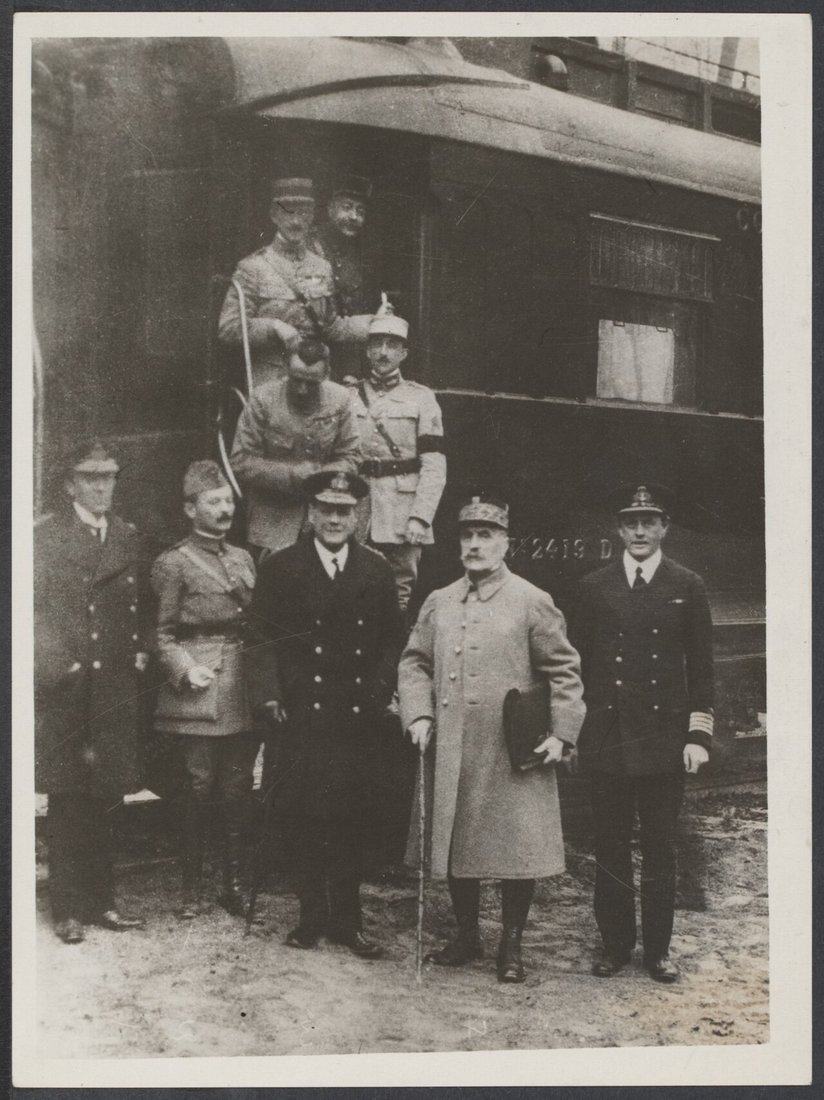
The fighting of the First World War stopped when an armistice between the Allied nations and Germany went into effect on the eleventh hour of the eleventh day of the eleventh month, which is why November 11, 1918, is generally regarded as the end of the war1. That was a Monday morning. The 108th anniversary falls on Wednesday, November 11, 2026. The agreement is also known as the Armistice of Compiègne, after the town near the forest where it was signed in a railroad car3.
Three days in a forest siding
By the autumn of 1918 the German Army was close to collapse, and Germany sought an armistice2. A German delegation led by Matthias Erzberger crossed the front line in five cars and was escorted for ten hours across the wrecked country of northern France, arriving on the morning of November 83. They were taken to Marshal Ferdinand Foch’s private train, parked on a railway siding in the Forest of Compiègne3.
Foch’s carriage was a dining car, No. 2419D, built in Saint-Denis in May 1914 and commandeered by the French Army in October 1918 as an office and mobile headquarters for Foch, who began using it on October 284. Foch appeared only twice in the three days of talks, once at the start to ask the Germans what they wanted and once at the end to see to the signatures3. The German delegation was given 72 hours to accept terms that left no room for negotiation2.
On November 10 the Germans learned that Kaiser Wilhelm II had abdicated, along with instructions from the new government to sign2.
Who signed
Both Allied signatories were military men. Marshal Foch was the Allied supreme commander, and Admiral Rosslyn Wemyss was the British First Sea Lord3. Four signed for Germany: Erzberger, a civilian politician of the Catholic Centre Party, Count Alfred von Oberndorff of the Foreign Ministry, Major General Detlof von Winterfeldt for the army and Captain Ernst Vanselow for the navy3.
Why 11 o’clock
The convention itself records that it was signed at 5 o’clock in the morning, French time9. The last signatures seem to have gone on a few minutes later. The Australian War Memorial says the German delegation finally signed at 5:10 a.m.7, and the Armistice Museum at Compiègne gives 5:15 a.m.8 One clause stopped hostilities by land and in the air six hours after the signing, and with the signature recorded at 5 a.m. that meant 11 o’clock9. That was 11:00 a.m. Paris time, and noon in Berlin3. Foch sent word to Allied commanders that “Hostilities will be stopped on the entire front beginning at 11 o'clock, November 11th (French hour).”2
The last morning
Fighting went on in many sectors right up to the appointed hour, and some artillery units kept firing to avoid hauling away their spare ammunition3. The historian Joseph Persico put the last day’s toll at 10,944 casualties, 2,738 of them deaths3.
By most accounts the last American killed was Pvt. Henry N. Gunther of the 79th Infantry Division’s 313th Infantry Regiment, shot as he charged a German roadblock in the village of Chaumont-devant-Damvillers, and the National Archives describes him as the last combatant from any nation to be killed in the war6. A war diary held by the National Archives records that he stood up and ran toward the German lines at 10:58 a.m., two minutes before the armistice6, while other accounts put his death at 10:59 a.m., about a minute before 115. Gunther had been demoted from sergeant after an army censor intercepted a critical letter home, and the reporter James M. Cain, who interviewed his comrades for The Baltimore Sun, wrote that he had brooded over the loss of rank5. According to Wikipedia’s account of his life, General John J. Pershing’s order of the day that followed named him as the last American killed, and the Army restored his rank of sergeant5.
At 11 a.m. there was some spontaneous fraternization, but reactions were mostly muted, with silence more common than cheering3.
The terms, in broad strokes
The agreement ran to 34 clauses, largely written by Foch3. Its terms were made deliberately severe so that Germany could not resume fighting2. Among them, Germany had to evacuate France, Belgium, Luxembourg and Alsace-Lorraine within 15 days, pull back from the west bank of the Rhine, and hand over 5,000 artillery pieces, 25,000 machine guns, 1,700 aircraft and 5,000 locomotives3. Allied prisoners of war were to be released at once with no release of German prisoners in return, and the naval blockade of Germany stayed in place3.
An armistice is a temporary cessation of hostilities, and the war officially ended only with the Treaty of Versailles, signed on June 28, 19191. This one was prolonged three times before the peace was ratified on January 10, 19203.
How Americans heard
On November 7, a United Press cable from France reported an armistice that had not happened11. From big cities to small towns, fire stations rang their bells and factory whistles blared on what became known as False Armistice Day11. Secretary of State Robert Lansing issued a denial, and the real news reached the United States on the morning of November 11, to celebrations that were more subdued the second time11.
In a letter dated November 12, Nannie Howard of Kansas City told her brother that people there had been “awoken at 3 o’clock by whistles blowing, guns firing and every kind of noise you could think of”2. An official American communiqué, published at 2:30 p.m., stated that hostilities on the fronts of the American armies were suspended at eleven o’clock that morning3.
From Armistice Day to Veterans Day
In November 1919, President Woodrow Wilson proclaimed November 11 as the first commemoration of Armistice Day1. The original idea was a day of parades and public meetings, with a brief suspension of business beginning at 11 a.m.1 Congress officially recognized the end of the war with a concurrent resolution on June 4, 1926, and an act approved on May 13, 1938, made November 11 a legal holiday known as Armistice Day1.
After World War II and Korea, the 83rd Congress, urged on by veterans’ organizations, struck the word Armistice from the 1938 act and inserted Veterans, and with Public Law 380, approved on June 1, 1954, November 11 became a day to honor American veterans of all wars1. A 1968 law moved the holiday to a Monday, and a 1975 law signed by President Gerald Ford returned it to November 11 beginning in 1978, where it stays whatever the day of the week1.
What became of the carriage
After the war the car went on display, and from 1927 it stood in a purpose-built shelter at the Glade of the Armistice near Compiègne4. In June 1940 Adolf Hitler had it moved back to the exact spot of 1918 for the signing of the French armistice4. The original was destroyed near the end of World War II, most likely in 19454.
Trivia
- Which company built the dining car in which the armistice was signed? The Compagnie Internationale des Wagons-Lits, best known for operating the Orient Express4.
- Where in Paris was the carriage displayed from 1921 to 1927? In the Cour des Invalides, after it was donated to the Army Museum4.
- What number did the replica car carry before it was renumbered 2419D in 1950? 2439D, a car from the same series that had been part of Foch’s train in 19184.
- What job did Henry Gunther hold before he was drafted? Bookkeeper and clerk at the National Bank of Baltimore5.
- What was the nickname of Gunther’s regiment, the 313th Infantry? Baltimore’s Own6.
- Which soldier is usually named as the last French soldier killed, shot around 10:45 a.m. on November 11? Augustin Trébuchon, a runner who, as reported, still had in his hand a message reading “Muster at 11.30 for food”10.
- On what date was the first Veterans Day under the Monday holiday law observed? October 25, 19711.
- Which president issued the first Veterans Day Proclamation, and when? Dwight D. Eisenhower, on October 8, 19541.
Sources
- History of Veterans Day, U.S. Department of Veterans Affairs. Accessed November 11, 2026.
- Armistice, November 11, 1918, National WWI Museum and Memorial. Accessed November 11, 2026.
- Armistice of 11 November 1918, Wikipedia. Accessed November 11, 2026.
- Compiègne Wagon, Wikipedia. Accessed November 11, 2026.
- Henry Gunther, Wikipedia. Accessed November 11, 2026.
- Michael Davis, Records Shed Light on Last American Killed in World War I, National Archives News, November 9, 2018. Accessed November 11, 2026.
- Ashley Ekins, The Armistice of 11 November 1918, Australian War Memorial, Wartime issue 84. Accessed November 11, 2026.
- The Armistice of 1918, Musée de l’Armistice (Armistice Museum), Compiègne. Accessed November 11, 2026.
- Terms of the Armistice With Germany, Signed November 11, 1918, transcription in The Paris Peace Conference and the Treaty of Versailles, ctevans.net. Accessed November 11, 2026.
- Augustin Trébuchon, Wikipedia. Accessed November 11, 2026.
- Christopher Klein, The False WWI Armistice Report That Fooled America, HISTORY, November 7, 2018, updated January 31, 2025. Accessed November 11, 2026.