Articles of Confederation Approved on November 15, 1777
Key Points
- The Continental Congress adopted the Articles of Confederation on November 15, 1777, while meeting in York, Pennsylvania, after 16 months of debate.
- Every state had to approve, and Maryland, the last, ratified on March 1, 1781.
- The Articles set up a one-house Congress with one vote per state, no executive branch and no power to tax, and any amendment needed every state legislature.
- The Constitutional Convention met in Philadelphia in 1787, and the Constitution formally replaced the Articles on March 4, 1789.
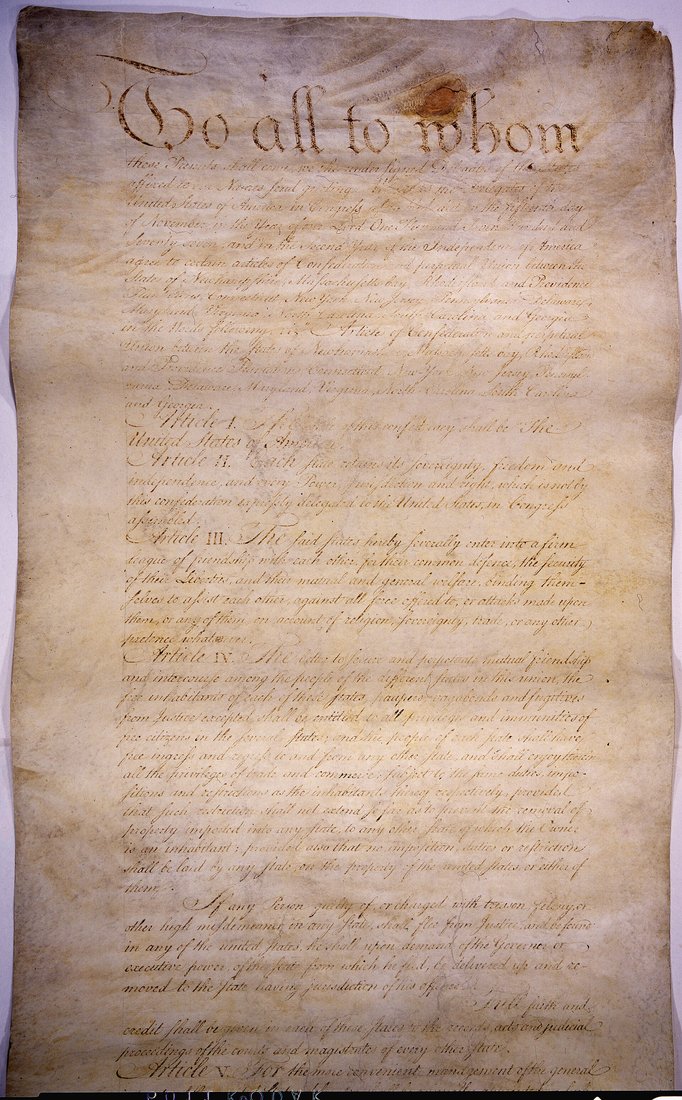

On November 15, 1777, the Continental Congress adopted the Articles of Confederation and Perpetual Union while sitting in its temporary capital, York, Pennsylvania5. Sunday, November 15, 2026, marks 249 years since that vote. The National Archives calls the document the first constitution of the United States, a league of friendship among 13 sovereign and independent states1. It governed from March 1, 1781, until March 4, 1789, when the government under the new Constitution took over4.
Sixteen months of argument
Work began in June 1776, when Congress formed a drafting committee with one representative from each colony1. Congress was then meeting in the Pennsylvania State House in Philadelphia, and the committee reworked a plan for colonial union that Benjamin Franklin had put to Congress on July 21, 17756. Its draft reached Congress on July 12, 1776, and debate ran on until November 17774.
The final version was finished in 1777, after the British occupation of Philadelphia had sent Congress to York6. By the time of the vote, the document had been under debate for 16 months5. Delegates split over whether representation and voting would be proportional or state by state. They agreed on voting state by state and on tax burdens in proportion to land values, and left state claims to western lands unresolved2.
A slow road through the states
Congress sent the Articles to the states two days after adopting them6, with a cover letter dated November 17 signed by the President of Congress, Henry Laurens4. Nothing could take effect until every one of the 13 states approved2. The engrossed copy is dated at Philadelphia on July 9, 17781.
Maryland, Delaware and New Jersey held back at first. The smaller states wanted the states with claims to western lands to give them up before they joined2. Delaware ratified on February 1, 1779, leaving Maryland as the last holdout. It came in only after Virginia agreed to give up its western land claims2. When Maryland ratified on March 1, 1781, the Congress of the Confederation came into being1.
How the government was built
The first article gave the confederacy its name, “The United States of America”, and the second declared that “Each state retains its sovereignty, freedom, and independence,” with every power not expressly delegated to Congress left to the states3. Congress was a single house in which each state held one vote5, whatever the size of its delegation of two to seven members3.
There was no executive branch and no standing national judiciary4. Congress could appoint courts to try piracies and felonies on the high seas and to hear appeals in cases of captures, and could form special courts to settle disputes between states3. Congress had no power to tax; it could only ask the states for money, and the states often failed to pay in full4. Its presiding officer carried the title President of the United States in Congress Assembled, but he was not a chief executive4. Common expenses came from a shared treasury, and the taxes to fill it were laid by the state legislatures3.
Major steps, such as declaring war, needed the assent of nine states1. The text declared that “the Union shall be perpetual”, and any change had to be agreed in Congress and then confirmed by the legislature of every state3, so an amendment needed the approval of all 13 states5.
What it managed to do
On January 10, 1781, Congress voted to set up a Department of Foreign Affairs2. The Land Ordinance of 1785 laid out western land in townships six miles square, each divided into 36 sections of 640 acres, and reserved section 16 of every township for public schools8.
On July 13, 1787, the Confederation Congress passed the Northwest Ordinance, which chartered a government for the territory north and west of the Ohio River7. It provided for dividing that land into “not less than three nor more than five States”, prohibited slavery and involuntary servitude there, and declared that schools and the means of education should forever be encouraged7.
Why it was replaced
The central government could not regulate commerce effectively or properly support a war. Its treasury ran low, and paper money brought extraordinary inflation1. Georgia ran its own policy toward Spanish Florida, and Congress lacked the authority to enforce the 1783 Treaty of Paris, so British forces kept their forts in the Great Lakes region2. The treaty itself sat in Congress for months because too few delegates attended to make a quorum4.
Shays’s Rebellion, an uprising against the state courts in western Massachusetts in 1786 and 1787, threatened the state’s stability4. The weak national response convinced leaders that a more powerful central government was necessary2, and James Madison and George Washington feared the country was nearing collapse1. In September 1786, delegates from five states met at Annapolis over trade barriers between the states and called for a wider convention4.
On February 21, 1787, Congress called for delegates to meet in Philadelphia to revise the Articles6. The convention opened in May 1787. By mid June the delegates had decided to redesign the government entirely, and the new Constitution was signed after three months of debate1. The Constitution formally replaced the Articles on March 4, 17895.
Trivia
- Who was the principal writer of the Articles of Confederation? John Dickinson1.
- Which state ratified the Articles first, and on what date? Virginia, on December 16, 17772.
- Which President of Congress signed the November 17, 1777, letter that sent the Articles to the states? Henry Laurens of South Carolina4.
- Were the signers of the Articles ever all in Congress at the same time? No, they were never all present together4.
- Which neighbor could join the confederation without a vote of nine states? Canada3.
- How long could one person serve as a delegate under the Articles? No more than three years in any term of six years3.
- How many parchment sheets make up the engrossed copy of the Articles? Six, and the last carries signatures from all 13 states1.
- Whom did Congress elect on August 10, 1781, as Secretary of Foreign Affairs? Robert R. Livingston2.
Sources
- Articles of Confederation (1777), Milestone Documents, National Archives. Accessed November 14, 2026.
- Articles of Confederation, 1777 to 1781, Milestones in the History of U.S. Foreign Relations, Office of the Historian, U.S. Department of State. Accessed November 14, 2026.
- Articles of Confederation, The Avalon Project, Lillian Goldman Law Library, Yale Law School. Accessed November 14, 2026.
- Articles of Confederation, Wikipedia. Accessed November 14, 2026.
- Articles of Confederation adopted, This Day in History, November 15, HISTORY.com Editors. Accessed November 14, 2026.
- Michael DiCamillo, Articles of Confederation, The Encyclopedia of Greater Philadelphia. Accessed November 14, 2026.
- Northwest Ordinance (1787), Milestone Documents, National Archives. Accessed November 14, 2026.
- Continental Congress, Land Ordinance of 1785, Encyclopedia.com. Accessed November 14, 2026.