The Battle of Trafalgar, 21 October 1805: How Nelson Won and Died
Key Points
- The Battle of Trafalgar was fought on 21 October 1805 off Cape Trafalgar, between Nelson's British fleet and the combined fleet of France and Spain.
- Nelson had 27 ships against 33 and planned to attack in two columns, one under him and one under Vice-Admiral Cuthbert Collingwood.
- When the firing stopped, 17 enemy ships had been captured and another was a blazing wreck, but Nelson had been shot at 1.15pm and died at 4.30pm.
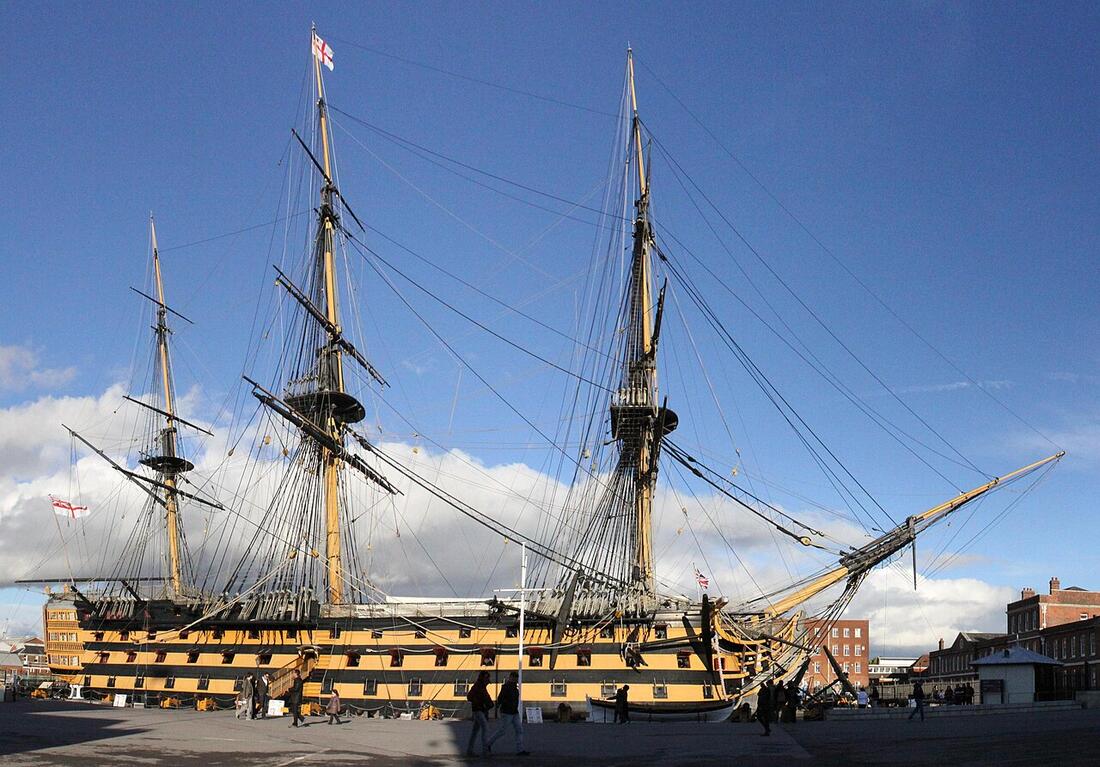
- HMS Victory, Nelson's flagship, has been in dry dock at Portsmouth since 1922 and is the world's oldest naval vessel still in commission.

On 21 October 18052, off Cape Trafalgar in southwest Spain, a British fleet under Vice-Admiral Lord Nelson attacked the combined fleet of France and Spain. When the firing stopped, 17 enemy ships had been captured and another was a blazing wreck2, the British lost none4, and Nelson was dead.
How the fleets met
Napoleon ordered the Franco-Spanish fleet under Vice-Admiral Pierre Villeneuve out of Cádiz, and on 19 October 1805, 33 ships set sail for an attack on Naples1, to divert Austrian forces towards Italy. Nelson, who had chased Villeneuve's fleet to the West Indies and back that summer, assembled his 27 ships1 to meet it. The enemy had nearly 30,000 men and 2,632 guns, against Nelson's 18,000 men and 2,148 guns2.
Why the fleets were there
In 1805, Napoleon and the First French Empire dominated continental Europe while the Royal Navy ruled the seas1. Napoleon had attempted an invasion of Britain in 18041, and when that failed he turned to Austria, which had declared war.
Nelson's plan
Nelson explained his plan to his captains at dinner parties and called it "The Nelson Touch"1. The fleet was to divide into two columns, one under Nelson and one under his friend Vice-Admiral Cuthbert Collingwood, and both were to sail straight at the enemy line. At 11.45am, Nelson had a signal flown from Victory that read "England expects that every man will do his duty"2.
Victory went for Villeneuve's flagship. Nelson ordered his flag captain, Thomas Hardy, to attack the Bucentaure2, and Victory passed under her stern, firing a broadside as she went. Victory then became entangled with the French ship Redoutable.
How the fighting went
The fleets sighted each other at 6am on 21 October, and at 6.40am Nelson ordered his ships to prepare for battle2. The French were sailing in line while the British came in from the west, gradually forming two lines. At 11.50am Villeneuve signalled the order to engage, and the French ship Fougueux fired the first shots, at Collingwood's flagship Royal Sovereign2.
Collingwood was first to reach the enemy line, firing a broadside into a Spanish flagship, Santa Anna2. The ships in his division followed, approaching in a slanting line, which spread the force of the impact. Victory's passage under the Bucentaure's stern and her tangle with the Redoutable left a large gap in the line, and Nelson's division poured through it, splitting the enemy fleet in two2.
Nelson's death
Nelson was shot onboard Victory at 1.15pm and died at 4.30pm2, an hour before the firing ceased. Royal Museums Greenwich counts 449 British sailors killed and 1,217 wounded2. For the journey home, his body was soaked in French brandy3, and at Gibraltar it was moved into a lead-lined casket and steeped in distilled wine. Nelson lies at the centre of the crypt of St Paul's Cathedral, directly beneath the middle of the Dome3.
The aftermath
The enemy paid heavily. Royal Museums Greenwich puts French and Spanish losses at 4,408 dead and 2,545 wounded, with some 20,000 taken prisoner2. Of the ships that were neither captured nor wrecked on the day, four escaped but were taken a few weeks later, and 11 struggled back to Cádiz2.
A fierce storm raged after the battle and forced the British to abandon most of their captured ships2. Nelson, as he lay dying, had ordered the fleet to anchor because a storm was predicted4. News reached London in the early hours of 6 November 18052, and public rejoicing was muted by sorrow at his death. As rewards, Collingwood was made a baron, every captain received the Naval Gold Medal, and the government made a special grant of money to everyone who took part2, to make up for prize money lost when the captured vessels sank.
Why it mattered
Trafalgar cemented Britain's reputation as ruler of the seas2, and afterwards the Royal Navy was never again seriously challenged by the French fleet in a large-scale engagement4. It did not decide the wider war, though. Six weeks later Napoleon confirmed his ascendancy over Europe with a decisive victory over Austria and Russia at Austerlitz2. The same Wikipedia article adds that Napoleon had already abandoned his invasion plans before the battle4, and that the Napoleonic Wars ran on for roughly ten more years.
HMS Victory now
Nelson's flagship still exists. Victory was launched on 7 May 17655. She has been in dry dock at Portsmouth since 1922, kept as a museum ship5. With 248 years of service as of 2026, she is the world's oldest naval vessel still in commission5, and since 2012 she has been the flagship of the First Sea Lord.
Trivia
- How many ships did Nelson assemble for Trafalgar? 27, against 33 that sailed from Cádiz1.
- What did Nelson call his battle plan? "The Nelson Touch"1.
- At what time was the "England expects" signal flown? 11.45am2.
- Who was Victory's flag captain at Trafalgar? Thomas Hardy2.
- What was Nelson's body first preserved in? French brandy3, later replaced with distilled wine at Gibraltar.
- In what year was HMS Victory launched? 17655.
Sources
- The Battle of Trafalgar: background and Nelson's plan, Royal Museums Greenwich. Accessed October 31, 2026.
- Battle of Trafalgar timeline, Royal Museums Greenwich. Accessed October 31, 2026.
- Nelson's tomb in the crypt of St Paul's, Royal Museums Greenwich collections. Accessed October 21, 2026.
- Battle of Trafalgar, Wikipedia. Accessed October 31, 2026.
- HMS Victory, Wikipedia. Accessed October 21, 2026.