The Night the Berlin Wall Opened, November 9, 1989
Key Points
- East German police sealed the border in Berlin in the early morning of August 13, 1961, and a ZZF and Berlin Wall Foundation project found that "at least 140 people were killed at the Berlin Wall or died under circumstances directly connected with the East German border regime" between 1961 and 1989.
- At a live press conference on November 9, 1989, party official Guenter Schabowski said the new travel rules took effect, in the usual English rendering, "immediately, without delay".
- At Bornholmer Strasse, Harald Jaeger ordered the border open without having been told to, at 10:45 p.m. or 11:30 p.m. depending on the account.
- Germany was officially reunited on October 3, 1990.
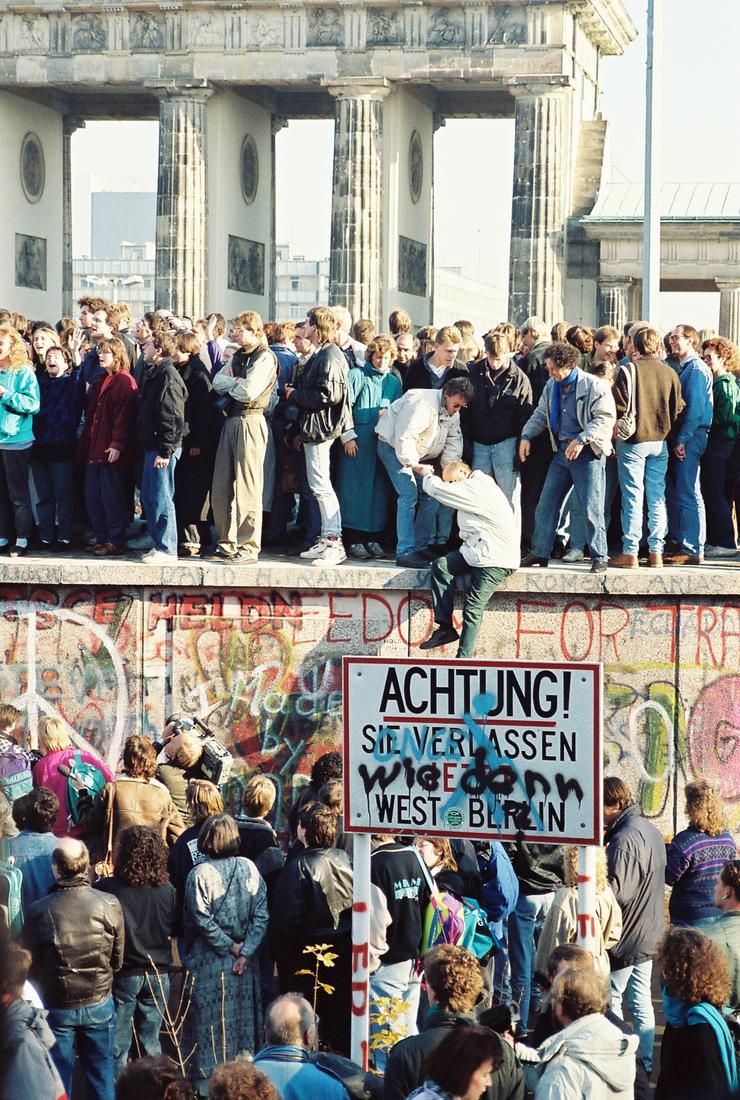

Monday, November 9, 2026, marks 37 years since the night the Berlin Wall opened. An East German official read out a new travel rule at a press conference, answered one question loosely, and before midnight East Berliners were walking into the West. Germany was formally reunited on October 3, 19904, less than a year later.
A wall built overnight
In the early morning of August 13, 1961, East German People's Police sealed off the border to the Soviet sector, tearing up streets in central Berlin, building barricades of asphalt and paving stones, driving in concrete posts and stringing barbed wire5. The Chronik der Mauer, a German online chronicle of the wall, says Walter Ulbricht, as party leader and chairman of the National Defence Council, gave the order on the night of August 12 to 135, and that Erich Honecker passed the sealing orders to the responsible political and military personnel that evening at East Berlin police headquarters5.
Barbed wire was only the first version. Over the years the wall was reinforced with concrete and extended to more than 90 miles6, according to the National Archives, and its final version was 12 feet high and almost 4 feet wide6. The Berlin Wall Foundation describes the stretch on Bernauer Strasse as part of a 155-kilometer-long border that went all around West Berlin9. The line that cut through the city itself, between West and East Berlin, ran 43.1 kilometers (26.8 miles)4.
Behind the concrete was empty ground. Houses between the wall and the fences were razed, creating what later became known as the death strip4, an area that offered no cover and, most importantly, offered clear fields of fire for the Wall guards4.
The people who died there
A joint project of the Leibniz Centre for Contemporary History in Potsdam (ZZF) and the Berlin Wall Foundation found that "at least 140 people were killed at the Berlin Wall or died under circumstances directly connected with the East German border regime"7 between 1961 and 1989. That figure breaks down into 101 escapees who were shot, died in accidents or took their own lives; 30 people from East and West Germany and one Soviet soldier who were shot or died in accidents with no intention of escaping; and eight East German border soldiers killed while on duty7. The project calls this "the current status"7 of its work, says it kept investigating suspected cases after its funding ended in 2009, and notes that the count leaves out "the unknown number of people who died from grief and despair"7. Separately, it found that at least 251 travelers from East and West died before, during or after controls at Berlin border crossings7.
Six o'clock, a press conference
By early November 1989 East Germany had a draft travel law on the table. At 6 p.m. on Thursday, November 9, party official Guenter Schabowski opened an international press conference that GDR television and radio broadcast live1. He had been handed a note from Egon Krenz, the party's General Secretary, announcing the changes, but no further instructions on how to handle the information2.
At 6:50 p.m. he announced the new travel regulations1. Near the end of the conference, at 6:53, Riccardo Ehrman of the Italian news agency ANSA asked about the government's draft travel law2, and a reporter asked when the rules would take effect2. The answer usually quoted in English is "As far as I know, it takes effect immediately, without delay"2; the Chronik der Mauer renders the same answer as "As of now; immediately!"1.
Television carried the news across the city. West German ZDF aired excerpts at 7:17 p.m., and ARD's Tagesschau led with the story at 8 p.m.2
The crowd at Bornholmer Strasse
By 8:15 p.m. 80 East Berliners in all had gathered at Bornholmer Strasse, Invalidenstrasse and Heinrich-Heine-Strasse, and border guards were told to send them back until the next day1. At 9:30 p.m. between 500 and 1,000 people stood at Bornholmer Strasse1, and the State Security Service tried a "valve solution," letting people through gradually1.
The officer in charge of passport control there that night was Harald Jaeger, a lieutenant colonel and the deputy chief at the Bornholmer crossing12. His superiors, according to his Wikipedia biography, told him to turn people away but let so-called provocateurs through, without telling those people they would not be let back in3. The valve did not hold. At 11:30 p.m. the situation became threatening for the passport inspectors; the Chronik says flatly that the "valve solution" had "proved to be unwise."1. Jaeger, under pressure from a large crowd and without orders to do so, ordered the border open3, judging that keeping it closed could endanger people in the crowd and his own officers3. Wikipedia gives the time as 10:45 p.m. or, alternatively, 11:30 p.m.2, and an account in The Local puts it at around 11:30 p.m.12
On top of the wall
A crowd of West Berliners jumped on top of the Wall and were soon joined by East German youngsters2. At the Brandenburg Gate, thousands of East and West Berliners passed through the Wall and crossed Pariser Platz between 1 and 2 a.m. on November 10, while several thousand people kept the cement embankment occupied1. At 2 p.m. that day thousands were occupying the anti-tank wall at the gate1.
At 7 a.m. on November 11, after hours of hammering, an attempt to remove a section of the Wall was close to succeeding1. By 1 p.m. the situation had calmed, and border soldiers cleared the Wall of people without force and took it over themselves1.
What came after
East Germany held its first free elections on March 18, 19908. The Two Plus Four Treaty with the four Allies was signed on September 12, 19908, and Germany was officially reunited at midnight Central European Summer Time on October 3, 19908. October 3 has been the national holiday of Germany, German Unity Day, ever since8, and the reunited Berlin became the capital of the enlarged Federal Republic8.
November 9 is the night the border opened after 28 years; October 3, German Unity Day, is the date Germany marks as its reunification.
Trivia
What did East German leader Walter Ulbricht say at a press conference on June 15, 1961, less than two months before the wall went up?
"No one has the intention to erect a wall"11, in German "Niemand hat die Absicht, eine Mauer zu errichten!"
Who said "Mr. Gorbachev, tear down this wall!", and when?
President Ronald Reagan, in his remarks at the Brandenburg Gate in West Berlin on June 12, 198710.
Which news agency sent the flash "GDR opens border" at 7:05 p.m. on November 9, 1989?
The Associated Press (AP); the German agency DPA followed at 7:41 p.m.1
What was the first new border crossing opened after November 9, 1989?
The Glienicke Bridge between Potsdam and West Berlin, at 6 p.m. on November 101.
When did a crossing open at Potsdamer Platz?
At 8 a.m. on November 12, 19891.
When did the Brandenburg Gate reopen?
On December 22, 19894.
When did the official demolition of the wall begin, and where?
On June 13, 1990, at Bernauer Strasse and Ackerstrasse13.
Sources
- Chronicle, November 1989, Chronik der Mauer. Accessed November 5, 2026.
- Fall of the Berlin Wall, Wikipedia. Accessed November 5, 2026.
- Harald Jaeger, Wikipedia. Accessed November 5, 2026.
- Berlin Wall, Wikipedia. Accessed November 5, 2026.
- Chronicle, August 1961, Chronik der Mauer. Accessed November 5, 2026.
- Gregory Marose, The Berlin Wall, now a vital piece of history, Pieces of History, U.S. National Archives, August 25, 2011. Accessed November 5, 2026.
- The Victims at the Berlin Wall, 1961 to 1989, Leibniz Centre for Contemporary History Potsdam (ZZF). Accessed November 5, 2026.
- German reunification, Wikipedia. Accessed November 5, 2026.
- Berlin Wall Memorial, Stiftung Berliner Mauer (Berlin Wall Foundation). Accessed November 5, 2026.
- Remarks on East-West Relations at the Brandenburg Gate in West Berlin, June 12, 1987, Ronald Reagan Presidential Library. Accessed November 5, 2026.
- Berlin Crisis of 1961, Wikipedia. Accessed November 5, 2026.
- AFP/The Local, "The guard who opened the Berlin Wall," The Local Germany, November 6, 2014. Accessed November 5, 2026.
- Redaktion, "Vor 30 Jahren: Abriss der Berliner Mauer," Hintergrund aktuell, Bundeszentrale fuer politische Bildung (bpb), June 10, 2020. Accessed November 5, 2026.
- File:BerlinWall-BrandenburgGate.jpg, Sue Ream, Wikimedia Commons. Accessed November 5, 2026.