Black Thursday 1929 and the Wall Street Crash That Followed
Key Points
- On 24 October 1929, the New York Stock Exchange lost 11% of its value at the opening bell, and a record 12,894,650 shares traded that day.
- Bankers sent Richard Whitney to bid $205 a share for U.S. Steel, and the Dow closed down only 6.38 points.
- The Dow lost 12.82% on Monday, 28 October, and 11.73% on Tuesday, 29 October, then slid to 41.22 on July 8, 1932, 89 percent below its peak.
- Congress answered with the Securities Act of 1933, the Banking Act of 1933 and the Securities Exchange Act of 1934, which created the SEC.
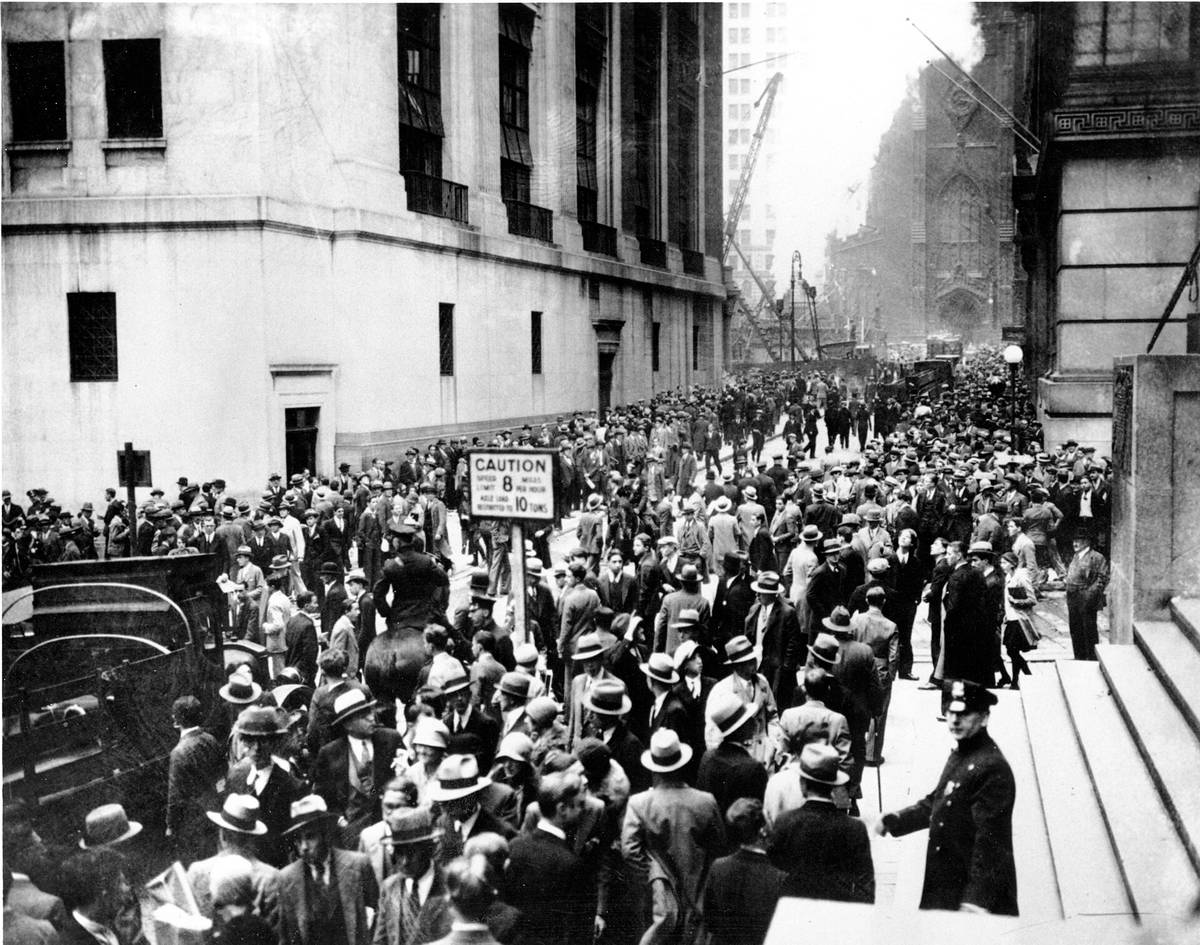

On Thursday, 24 October 1929, panic selling hit the New York Stock Exchange. The market lost 11% of its value at the opening bell2, and by the close a record 12,894,650 shares3 had been traded. Black Thursday did not end the boom on its own, but it opened the week that did. Saturday, 24 October 2026, marks 97 years.
The boom before the bell
The Dow Jones Industrial Average increased six-fold from sixty-three in August 1921 to 381 in September 19291, and the index peaked at 381.17 on September 3, 19292. Much of the buying was done on borrowed money. Purchasers put down a fraction of the price, typically 10 percent, and borrowed the rest1, with the stock itself as collateral for the loan.
The Fed saw the speculation and argued over what to do about it. The Board in Washington asked reserve banks to deny credit to member banks that lent to speculators and warned the public of the dangers of speculation1, while the Federal Reserve Bank of New York pushed for a higher discount rate. In August the Board gave way, and New York’s discount rate reached 6 percent1.
Thursday, 24 October
Selling hit as soon as trading began. W.W. Forster, financial editor of the Pittsburgh Press, called it “the wildest day in stock market history”4, and wrote that traders “threw stocks overboard in a wholesale manner and without consideration of price.”4 The stock tickers ran more than three hours behind4, and Forster added, “No one seemed to know what was going on.”4
Financiers met at the offices of J.P. Morgan & Co.4 The group included Thomas W. Lamont, acting head of Morgan Bank, and Albert Wiggin, head of the Chase National Bank2, along with Charles E. Mitchell of National City Bank, and they chose Richard Whitney, vice president of the Exchange2, to act for them. Whitney placed a bid to purchase U.S. Steel at $205 per share2, well above the going price, then made similar bids for other large stocks. The buying halted the slide, and the Dow recovered, closing down only 6.38 points (2.09%) for the day2. The Federal Reserve met but took no action4.
The next day, President Herbert Hoover answered press questions with a statement that began, “The fundamental business of the country, that is the production and distribution of commodities, is on a sound and prosperous basis.”5 The bankers’ buying held long enough to produce a moderate rally on Friday3.
Black Monday and Black Tuesday
On Monday, 28 October, more investors faced margin calls, and the Dow posted a record one-day loss of 38.33 points, or 12.82%2, closing at 260.642.
On Tuesday, 29 October, a record 16,410,030 shares3 changed hands, and some stocks had no buyers at any price2. The Dow fell 30.57 points (11.73%), closing at 230.072, a two-day loss of 68.90 points (23.05%)2. The volume was so heavy that it made the ticker continue to run until about 7:45 p.m.2 William C. Durant, members of the Rockefeller family and other financiers bought large blocks of stock to show confidence, and their efforts failed to stop the decline2.
After the crash, the Federal Reserve Bank of New York stepped in. It bought government securities, sped up lending through its discount window and lowered the discount rate1, and it assured commercial banks that it would supply the reserves they needed. The market bounced on Wednesday, when the Dow regained 28.40 points, closing at 258.472, then kept falling to an interim bottom of about 199 on November 13, 19292. By mid-November, the Dow had lost almost half of its value1.
The long slide to 1932
Stocks staged a bear market rally to 294.07 on April 17, 19302, then began a slow decline that ran for more than two years. On July 8, 1932, the Dow closed at 41.22, its lowest value of the twentieth century, 89 percent below its peak1.
Washington responds
Congress started asking questions while the slide was still going. On March 2, 1932, the Senate passed Resolution 84, authorizing its Committee on Banking and Currency to examine “practices with respect to the buying and selling and the borrowing and lending”6 of securities. In early 1933 the committee hired Ferdinand Pecora as chief counsel, and his hearings put Wall Street figures on the stand. Among the first witnesses was Charles Mitchell, chairman of National City Bank6, one of the men behind the Black Thursday rescue. He admitted selling stock to a family member at a loss to avoid income taxes, and offered his resignation to the bank’s board shortly after testifying. Whitney, by then New York Stock Exchange president6, testified too.
The Securities Act of 1933 was enacted on May 278 of that year and required certain issuers of securities to file registration statements. On June 16, 1933, President Franklin Roosevelt signed the Banking Act of 1933, sponsored by Sen. Carter Glass (D-VA) and Rep. Henry Steagall (D-AL)7, which separated commercial banking from investment banking and created the FDIC to insure deposits. Then came the Securities Exchange Act, which Roosevelt signed into law on June 6, 19346. It required stock exchanges to register, and the U.S. Securities and Exchange Commission was created pursuant to the Act8.
Trivia
- Who was the first chairman of the Securities and Exchange Commission? Joseph P. Kennedy8, named by President Roosevelt.
- Before the SEC existed, which agency received registration statements under the Securities Act of 1933? The Federal Trade Commission8.
- What was discovered about Richard Whitney on March 7, 1938? That the former Exchange president had embezzled millions8.
- What 1929 income did Charles Mitchell disclose under questioning in the Senate? $1,206,195.026.
- How long was the Senate committee’s final report, and when was it issued? 400 pages, on June 16, 19346, and it stopped short of making concrete legislative recommendations.
- How much did the FDIC’s first, temporary fund insure? Deposits up to $2,500, from January 19349, raised to $5,000 in June 1934, and the Banking Act of 1935 made the FDIC permanent.
- When did the Dow first return to its peak close of September 3, 1929? November 23, 19542, 25 years later.
Sources
- Stock Market Crash of 1929, Federal Reserve History. Accessed October 23, 2026.
- Wall Street crash of 1929, Wikipedia. Accessed October 23, 2026.
- Stock Market Crash of 1929, HISTORY.com Editors, HISTORY, 10 May 2010, updated 14 October 2026. Accessed October 23, 2026.
- Marylynne Pitz, Black Thursday of 1929, The Digs, Pittsburgh Post-Gazette, 24 October 2012. Accessed October 23, 2026.
- Herbert Hoover, Statement on the National Business and Economic Situation, 25 October 1929, The American Presidency Project. Accessed October 23, 2026.
- The Pecora Investigation, United States Senate. Accessed October 23, 2026.
- Banking Act of 1933 (Glass-Steagall), Federal Reserve History. Accessed October 23, 2026.
- New Foundations, 1930s timeline, Securities and Exchange Commission Historical Society. Accessed October 23, 2026.
- FDIC, A Brief History: Chronological Overview 1930-1939, Federal Deposit Insurance Corporation. Accessed October 23, 2026.