Chuck Yeager and the Bell X-1: The First Flight Faster Than Sound
Key Points
- According to NASA, Chuck Yeager reached Mach 1.06 at 43,000 feet on October 14, 1947, "becoming the first man to fly supersonic."
- Yeager had broken two ribs in a horseback riding accident the weekend before, and the Smithsonian says he sealed the hatch by levering it with "the end of a broom handle."
- NASA says "Air Force officials designated the flight and all data as Top Secret two hours later," and according to History.com it was not officially confirmed until June 1948.
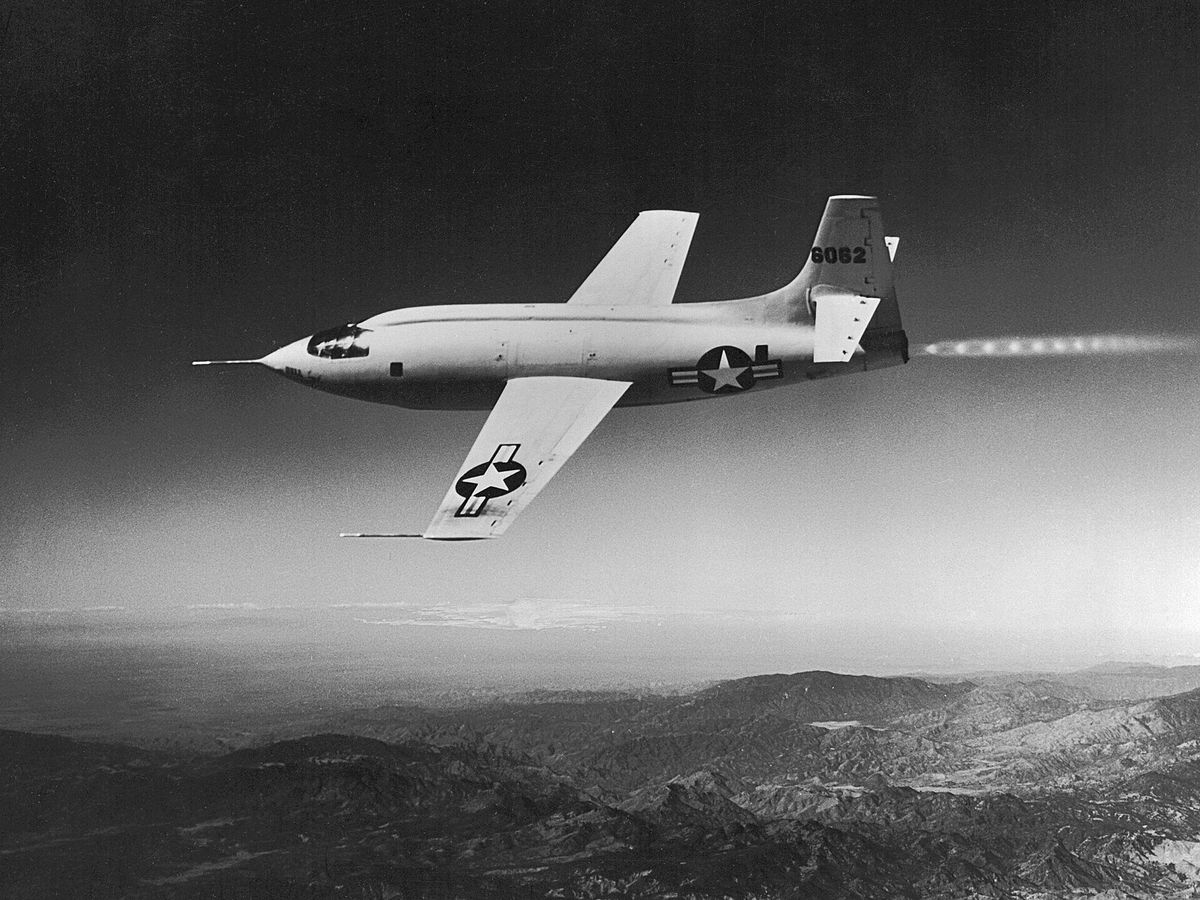

On the morning of October 14, 1947, a small orange rocket plane dropped from the bomb bay of a bomber above the California desert, lit its engine and climbed. Before long its pilot, a captain from West Virginia5 named Charles "Chuck" Yeager, was going faster than sound. According to NASA2, he reached Mach 1.06 at 43,000 feet, "becoming the first man to fly supersonic."
Why the sound barrier scared people
By the end of the Second World War, fighters diving at high speed were running into something engineers called compressibility. A NASA history of the period by John D. Anderson Jr. notes that the wing of the P-38 "lost lift when it encountered the compressibility burble."3 A December 1948 article in Collier's magazine, reproduced in the same history, explained that wind tunnel tests with small models showed the flow of air over a plane in the transonic range was "partly subsonic and partly supersonic."3 When the NACA engineer John Stack put a model in the test section near Mach 1, "the flow field in the test section essentially broke down."3
That gap in the data fed a public idea of a wall in the sky. The same NASA history puts it bluntly: "The myth of the sound barrier had its beginning in 1935"3, and the notion of a physical barrier to flight spread widely from there.
The airplane and the team
The X-1 came out of a meeting on November 30, 1944, when Robert J. Woods of Bell Aircraft visited the office of the Army engineer Ezra Kotcher and was asked whether Bell would build such a plane. "Woods said yes."3 The Army Air Forces selected Bell to build three X-1 aircraft2. Its fuselage was "the same shape as a 0.50 caliber machine gun bullet, which was known to be stable at supersonic speeds," NASA says. The Smithsonian lists the motor as a Reaction Motors, Inc. rocket engine of 6,000 pounds of thrust1.
The program was a joint effort of the Air Force and the National Advisory Committee for Aeronautics11, the NACA, which later became NASA. The partners did not always agree on pace. NASA history notes that the Army approach was in conflict with "the NACA's more careful and scientific approach,"3 but "the Army was paying for the X-1, and the Army's views prevailed." On June 30, 1947, the two sides agreed on a two-phase flight program2: the Army Air Forces would push the X-1-1 toward Mach 1, and the NACA would then fly the X-1-2 for research data.
Yeager flew that first phase, picked from over 125 senior pilots6, according to a NASA biography. Jack Ridley was a fellow project pilot4 on the X-1, and Robert "Bob" Hoover, later a famous air show pilot, was the back-up pilot for Chuck Yeager8, the Smithsonian notes. Yeager named the plane "Glamorous Glennis" in tribute to his wife1.
Creeping up on Mach 1
NASA records his first powered flight in the X-1-1 on August 29, reaching Mach 0.852, and over the following six weeks he edged closer, reaching Mach 0.997 on October 10. In a horseback riding accident the weekend before the record flight, Yeager broke two ribs3, and he told no one at Muroc about it except his close friend Ridley.
The Smithsonian tells it this way: "With two broken ribs, Yeager was unable to seal the hatch of the X-1 by himself4," and "the end of a broom handle used as a lever made it possible for Yeager to seal the hatch on the day of the flight."
The flight on October 14, 1947
The X-1 did not take off on its own. It rode up in the bomb bay of a Boeing B-29, and accounts of the release height range from 20,000 to 25,000 feet. Yeager's own flight report, as quoted by This Day in Aviation, puts the drop at 20,000 feet and 250 miles per hour13; the Smithsonian collection record gives 23,000 feet1, and a Smithsonian feature on the aircraft says 25,000 ft4. NASA history gives the moment itself: "At 10:26 a.m., at a speed of 250 miles per hour, the brightly painted X-1 dropped free from the bomb bay of the B-29."3
"The flight was smooth; there was no violent buffeting of the airplane and no loss of control as feared by some engineers," the same NASA history3 says. The Mach meter "moved smoothly through 0.98, 0.99, to 1.02," then "the meter hesitated then jumped to 1.06." The Smithsonian gives the top figures as 700 miles per hour (Mach 1.06) 43,000 feet above the southern California desert5. The flight took place over Rogers Dry Lake at what was then Muroc and is now Edwards Air Force Base, and the National Archives notes that a sonic boom "was heard across the Mojave desert"9.
A record kept secret
"Air Force officials designated the flight and all data as Top Secret two hours later,"2 NASA says. According to History.com, reports of the flight leaked to the press in December 194715, but the achievement was not officially confirmed until June 1948.
On December 17, 1948, President Harry S. Truman presented3 the 1947 Collier Trophy17 to John Stack, Lawrence D. Bell and Yeager. The Collier's headline, reproduced in NASA's history, said the three men "win America's highest aviation award."3 The Smithsonian notes that Yeager also received the MacKay Trophy for 1948 and the Harmon International Trophy for 19545.
What came after
The Air Force contracted with Bell2 for the X-1A, X-1B and X-1D. On December 12, 1953, Yeager took the X-1A to Mach 2.44, then the highest speed ever reached by a piloted aircraft7. It nearly killed him: the X-1A "tumbled completely out of control," and he recovered from an inverted spin before landing on Rogers Dry Lakebed.
Glamorous Glennis itself was retired after a final flight by Yeager on May 12, 19502 and given to the Smithsonian Institution. Today it is displayed at the National Air and Space Museum in Washington, DC1, in the Boeing Milestones of Flight Hall. The museum has since restored it to its original 1947 paint scheme4.
Yeager after the X-1
Yeager later served as Commandant of the USAF Aerospace Research Pilot School9 at Edwards, according to a National Archives photo caption, and in Vietnam he flew 127 missions10, according to a Smithsonian reading of his ribbons. He became the U.S. Defense Representative to Pakistan in 1971 and Director of the Air Force Inspection and Safety Center in 19735. The book The Right Stuff by Tom Wolfe and the film made from it turned him into an immensely popular public figure5. He retired from the U.S. Air Force in 1975 with the rank of brigadier general15, History.com notes.
He died on December 7, 2020, at age 9715. In a statement dated December 8 of that year, NASA Administrator Jim Bridenstine said that "Chuck was the first man to fly at the speed of sound, and his achievements rival any of our greatest firsts in space."12
Trivia
What did the XLR-11 rocket engine in the X-1 burn?
Liquid oxygen and an alcohol-water mixture2.
Who was the second person to fly faster than sound?
NACA pilot Herbert H. Hoover (no relation to Bob Hoover), who became the second man to reach Mach 1, on the first NACA and the first civilian supersonic flight2. He flew the X-1-214, in March 1948.
What was the top speed Glamorous Glennis ever reached?
Mach 1.45 at 40,130 feet, approximately 957 mph16, with Yeager flying, on March 26, 1948, according to the Smithsonian.
Who flew Glamorous Glennis to its highest altitude?
Maj. Frank K. Everest Jr., who reached 71,902 feet on August 8, 194916.
How many times did Glamorous Glennis fly?
781, according to the Smithsonian collection record.
Who formally handed the X-1 over to the Smithsonian?
Air Force Chief of Staff Gen. Hoyt Vandenberg presented it to Alexander Wetmore of the Smithsonian on August 26, 19501.
What medal did Yeager receive for downing five enemy aircraft in a single World War II mission?
The Silver Star10. That mission made him an "ace in a day."
Which national investigation did Yeager join in 1986?
The Presidential Commission investigating the Challenger accident6.
Sources
- Bell X-1, Glamorous Glennis, Smithsonian National Air and Space Museum collection, object A19510007000. Accessed October 14, 2026.
- First Generation X-1, NASA Aeronautics. Accessed October 14, 2026.
- Research in Supersonic Flight and the Breaking of the Sound Barrier, chapter 3 of From Engineering Science to Big Science (NASA SP-4219), NASA History Office, 1998. Accessed October 14, 2026.
- Take a Closer Look at the Bell X-1, Smithsonian National Air and Space Museum. Accessed October 14, 2026.
- Record-Breaking Chuck Yeager, a Pilot with the Right Stuff, Smithsonian National Air and Space Museum, 2020, updated 2025. Accessed October 14, 2026.
- X-1 Biographies: Charles E. (Chuck) Yeager, NASA History. Accessed October 14, 2026.
- Yeager's Mach 2.44 Flight in the X-1A, NASA image article. Accessed October 14, 2026.
- Remembering the Extraordinary Man and Pilot Robert A. Bob Hoover, Smithsonian National Air and Space Museum. Accessed October 14, 2026.
- Captain Chuck Yeager: Breaking the Sound Barrier, The Unwritten Record, National Archives, October 13, 2022. Accessed October 14, 2026.
- What Chuck Yeager's Medals and Ribbons Tell Us About His Career, Air and Space Quarterly, issue 9, Smithsonian National Air and Space Museum. Accessed October 14, 2026.
- Breaking the Barrier, NASA image article. Accessed October 14, 2026.
- NASA Administrator Statement on Passing of Gen. Chuck Yeager, NASA release 20-125, December 8, 2020. Accessed October 14, 2026.
- This Day in Aviation, 14 October 1947 (Bell XS-1 and Chuck Yeager). Accessed October 14, 2026.
- This Day in Aviation, 10 March 1948. Accessed October 14, 2026.
- Yeager breaks sound barrier, History.com, This Day in History, October 14. Accessed October 14, 2026.
- Bell X-1, Smithsonian National Air and Space Museum collection. Accessed October 14, 2026.
- Robert J. Collier Trophy, Smithsonian National Air and Space Museum collection, object A19520061000. Accessed October 14, 2026.