Kennedy's Cuban Missile Crisis Address, October 22, 1962
Key Points
- A U-2 photographed Soviet missile sites under construction in Cuba on October 14, 1962, and the images reached the White House the next day.
- On October 22, 1962, Kennedy announced a naval quarantine of Cuba in a televised address, a word chosen because a blockade assumed a state of war.
- Khrushchev said on October 28 that the missiles would be dismantled, and the quarantine ended on November 20, 1962.
- The crisis led to the Hot Line, set up by an agreement signed in Geneva on June 20, 1963, which ran on telegraph circuits with teletype equipment at each end.
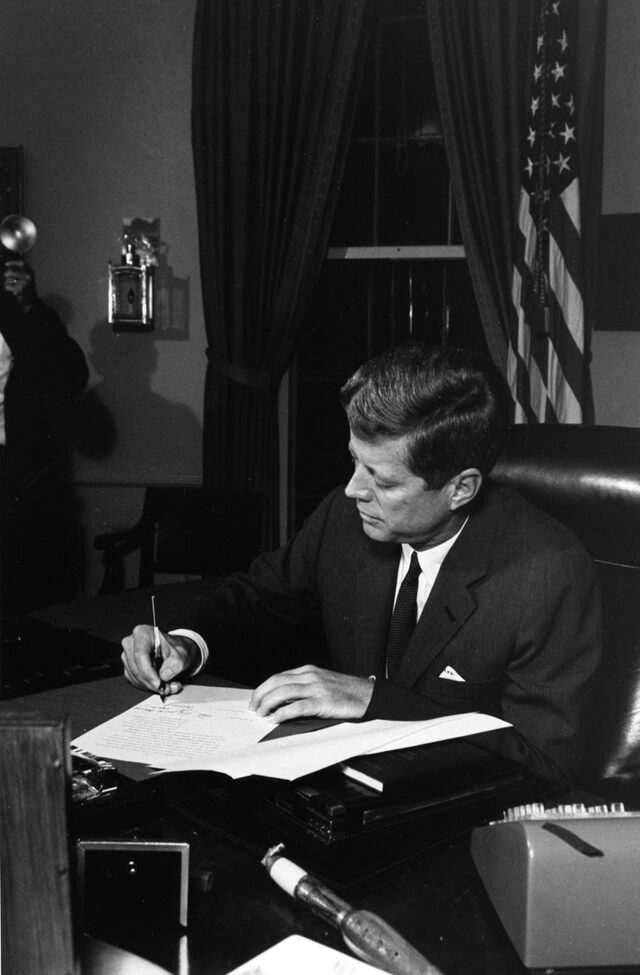

On the evening of October 22, 1962, President John F. Kennedy went on national television to tell the country that the Soviet Union was building missile sites in Cuba. He opened with "Good evening, my fellow citizens"2 and the first step he announced was a naval quarantine. The State Department's Office of the Historian calls the crisis that followed "the moment when the two superpowers came closest to nuclear conflict"1.
How it started
In July 1962, according to the Office of the Historian, Soviet premier Nikita Khrushchev reached a secret agreement with Fidel Castro to place Soviet nuclear missiles in Cuba1, to deter any future invasion after the failed Bay of Pigs landing. On September 4, Kennedy publicly warned against bringing offensive weapons into Cuba1.
On October 14, a U-2 took pictures that clearly showed sites for medium-range and intermediate-range ballistic missiles under construction1, and the images reached the White House the next day. The pilot that Sunday morning was Major Richard Heyser4 of the Air Force.
Why "quarantine" and not "blockade"
Kennedy's advisers split. The Office of the Historian notes that some, including all the Joint Chiefs of Staff, argued for an air strike followed by an invasion1, and others favored stern warnings. He chose a middle course, a naval quarantine, and the word was deliberate. A blockade assumed a state of war existed1, and calling it a quarantine also helped win the support of the Organization of American States.
In the address, Kennedy said that "a strict quarantine on all offensive military equipment under shipment to Cuba is being initiated"2, and that ships found carrying offensive weapons would be turned back. He also said: "It shall be the policy of this Nation to regard any nuclear missile launched from Cuba against any nation in the Western Hemisphere as an attack by the Soviet Union on the United States, requiring a full retaliatory response upon the Soviet Union."2
The week after the speech
The Joint Chiefs moved to DEFCON 31 as the quarantine began. On October 24, Khrushchev called the U.S. "blockade" an "act of aggression"1. Over October 24 and 25, some ships bound for Cuba turned back, and others were stopped, found to carry no offensive weapons and let through1. Meanwhile, reconnaissance flights showed the missile sites nearing operational readiness1.
Two messages from Khrushchev followed. The first, on the evening of October 26, proposed removing the missiles if the United States promised not to invade Cuba1. The second, on October 27, added the removal of U.S. Jupiter missiles from Turkey1. The same day a U-2 was shot down over Cuba1. Its pilot, Major Rudolf Anderson Jr., was the only U.S. fatality by enemy fire during the crisis5, and he was posthumously awarded the first Air Force Cross.
How it ended
Kennedy answered the first message and set the second aside1. Robert Kennedy then met secretly with the Soviet ambassador, Anatoly Dobrynin, and told him that the United States planned to remove the Jupiter missiles from Turkey anyway1, but that this could not be part of any public deal. On the morning of October 28, Khrushchev announced that the Soviet missiles would be dismantled and removed1.
The quarantine stayed until the Soviets agreed to take their IL-28 bombers out too, and it ended on November 20, 19621. The Jupiter missiles left Turkey in April 19631.
The Hot Line it led to
Kennedy and Khrushchev struggled throughout the crisis to understand each other's intentions1, and a direct link between the White House and the Kremlin followed. The agreement was signed at Geneva on June 20, 19633. The State Department's account describes a wire telegraph circuit and a radiotelegraph circuit, with teletype equipment at each end3. It was used during the Arab-Israeli wars of 1967 and 19733.
Trivia
- On what date did a U-2 photograph the missile sites in Cuba? October 14, 19621.
- Who flew that U-2? Major Richard Heyser4.
- Why did Kennedy call it a quarantine? A blockade assumed a state of war existed1.
- How did Kennedy open the October 22 address? "Good evening, my fellow citizens"2.
- Which U.S. missiles in Turkey did Khrushchev's second message name? The Jupiter missiles1, removed in April 1963.
- Who was the first recipient of the Air Force Cross? Major Rudolf Anderson Jr.5, awarded it after he was shot down over Cuba.
- What equipment did the 1963 agreement place at each end of the Hot Line? Teletype equipment3, linked by telegraph and radiotelegraph circuits.
Sources
- The Cuban Missile Crisis, October 1962, Milestones: 1961 to 1968, Office of the Historian, U.S. Department of State. Accessed October 20, 2026.
- John F. Kennedy, Radio and Television Report to the American People on the Soviet Arms Buildup in Cuba, October 22, 1962, The American Presidency Project, UC Santa Barbara. Accessed October 20, 2026.
- Memorandum of Understanding Between the United States of America and the Union of Soviet Socialist Republics Regarding the Establishment of a Direct Communications Link (Hot Line Agreement), Bureau of International Security and Nonproliferation, U.S. Department of State. Accessed October 20, 2026.
- Richard S. Heyser, Wikipedia. Accessed October 20, 2026.
- Rudolf Anderson, Wikipedia. Accessed October 20, 2026.