The Erie Canal Opens, 1825: Clinton and the Wedding of the Waters
Key Points
- The Erie Canal opened on 26 October 1825, when Governor DeWitt Clinton left Buffalo aboard the Seneca Chief for a nine-day voyage to New York City.
- Clinton poured a keg of Lake Erie water into the Atlantic off Sandy Hook soon after the fleet reached the city on 4 November, so the famous ceremony came at the end of the trip, not the start.
- The canal was 363 miles long, 40 feet wide and 4 feet deep, with 83 locks, and was built largely by hand.
- The Erie Canal Foundation says the canal cut the cost of freight from Buffalo to New York City from $100 to $10 per ton.
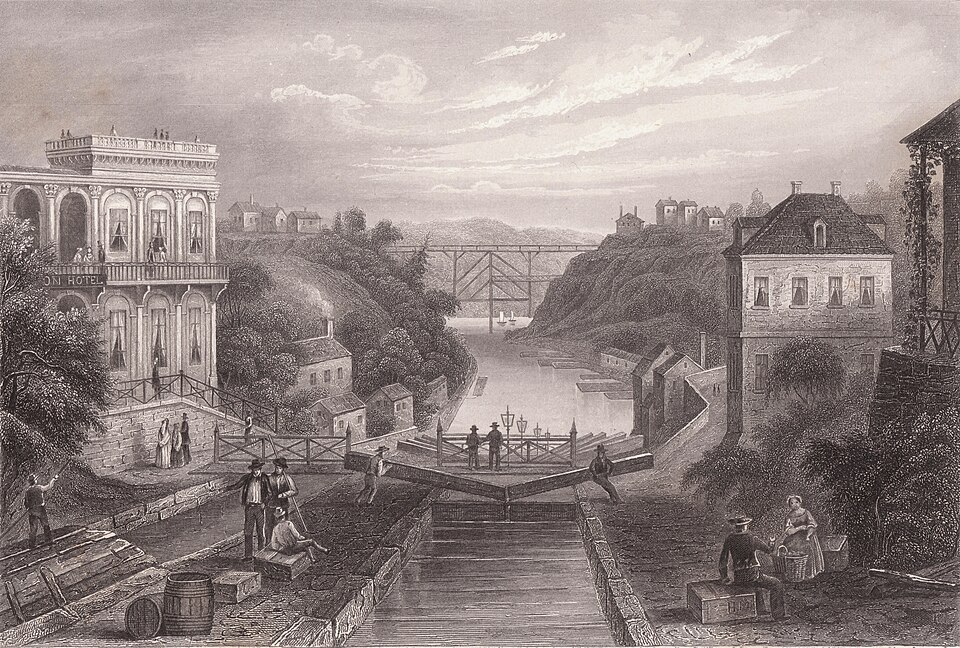

On 26 October 1825, a cannon fired in Buffalo and a canal boat named the Seneca Chief started toward New York City with Governor DeWitt Clinton aboard. The Erie Canal was done, and the state celebrated for more than a week. Monday, 26 October 2026, is the 201st anniversary.
A ditch people mocked
The idea of a canal across New York had many fathers. A history written for the New York primary-source project Consider the Source says it is difficult to name the originator3, though De Witt Clinton is the name most tied to it. Opponents called it Clinton’s big ditch1 as a jab. In 1809, the Erie Canal Museum notes, Thomas Jefferson called the prospect of a canal through New York “little short of madness”1, and federal funding looked unlikely.
The case for it was the roads. The museum says that in 1800 it took around two and a half weeks to travel overland from New York City to Cleveland1. The Erie Canal Foundation puts the old freight trip from Buffalo to New York City at over two weeks and $100 per ton2, and says the canal cut it to six days and $10 per ton.
Built by hand, mostly by amateurs
Work began on July 4, 1817, three days after Clinton took office as governor1. The Foundation describes a canal built largely by hand with picks, shovels, and black powder2, and lists 83 locks, 18 aqueducts and a 565-foot rise between Albany and Buffalo2. When finished it was 40 feet wide and 4 feet deep2 and ran 363 miles2. The museum adds that the country had no professional engineers1 then, so the work fell to talented amateurs such as James Geddes and Benjamin Wright, and that Canvass White traveled to Great Britain to cover 2,000 miles of English canals on foot1 to learn what he could.
One early champion was a flour merchant. The museum says Jesse Hawley wrote 14 essays on the canal under the pen name Hercules1 after time in debtors’ prison in Canandaigua.
The opening, day by day
The Wedding of the Waters began on October 26, 1825, and the museum calls it the first complete voyage on the newly completed Canal1, which took nine days. Clinton, the Consider the Source history says, was aboard the Seneca Chief as it entered the Erie Canal at Buffalo3. Wikipedia’s entry on the boat says the first cannon fired in Buffalo at 10:00 a.m.4 and that gunners passed the signal on from cannon to cannon along the route. Ninety minutes later3, according to that history, New York City learned of it from the relay.
Along the way there were speeches and meals. At Albany, 600 diners toasted the accomplishment3 at tables set up on a long bridge across the canal basin. Not every stop was cheerful. Wikipedia reports that at Weedsport a cannon misfired, killing two gunners4, and that in Rome and Schenectady mourners4 gathered who saw the canal taking business from their downtowns.
On November 4, steamboats towed the fleet down the Hudson to New York City. Soon after, the boats assembled off Sandy Hook, where, in the words of the Consider the Source history, Clinton poured a keg of Lake Erie water into the Atlantic Ocean3 to symbolize the wedding of the waters. The museum quotes his remarks, which called the canal the navigable communication1 between what he called “our Mediterranean Seas” and the Atlantic Ocean. So the date most people remember, October 26, is the day the voyage began, and the keg was poured at the end of it. A ball on November 7 closed the festivities, with a scale model of a packet boat made of maple sugar3 floating in a vat of Lake Erie water.
What came after
The Foundation says the canal paid for itself within nine years2 and that its tolls exceeded the cost of building it. The state authorized an enlargement in 1836, to 70 feet wide and 7 feet deep2, and a modern Barge Canal system followed in 19182. Clinton did not see most of that. He was elected to a fourth term as governor in 1826 and, the history notes, died in office in February 18283.
Trivia
- Which boat carried Governor Clinton out of Buffalo? The Seneca Chief3.
- What did Thomas Jefferson call the idea of a canal through New York in 1809? “Little short of madness”1.
- On what date did construction begin? July 4, 18171.
- How many locks did the Erie Canal have when it was completed? 832.
- Under what pen name did Jesse Hawley publish his essays promoting the canal? Hercules1.
Sources
- DeWitt Clinton and the Erie Canal, Reflections on Erie’s Waters, Erie Canal Museum. Accessed October 26, 2026.
- History of the Erie Canal, The Erie Canal Foundation. Accessed October 26, 2026.
- F. Daniel Larkin, Historical Context: De Witt Clinton and the Erie Canal, Consider the Source Online. Accessed October 26, 2026.
- Seneca Chief, Wikipedia. Accessed October 26, 2026.