Ether Day at 180: The 1846 Boston Operation That Changed Surgery
Key Points
- On October 16, 1846, at Massachusetts General Hospital in Boston, the dentist William T. G. Morton gave a patient ether and the surgeon John Collins Warren removed a tumor from the patient's neck.
- The room has been called the Ether Dome ever since, and in medical history the date is known as Ether Day.
- On November 21, 1846, Oliver Wendell Holmes Sr. suggested the word "anaesthesia" in a letter to Morton.
- Crawford Williamson Long had removed a tumor from the neck of a man named James Venable under ether in Jefferson, Georgia, on March 30, 1842, but his report did not appear until 1849.
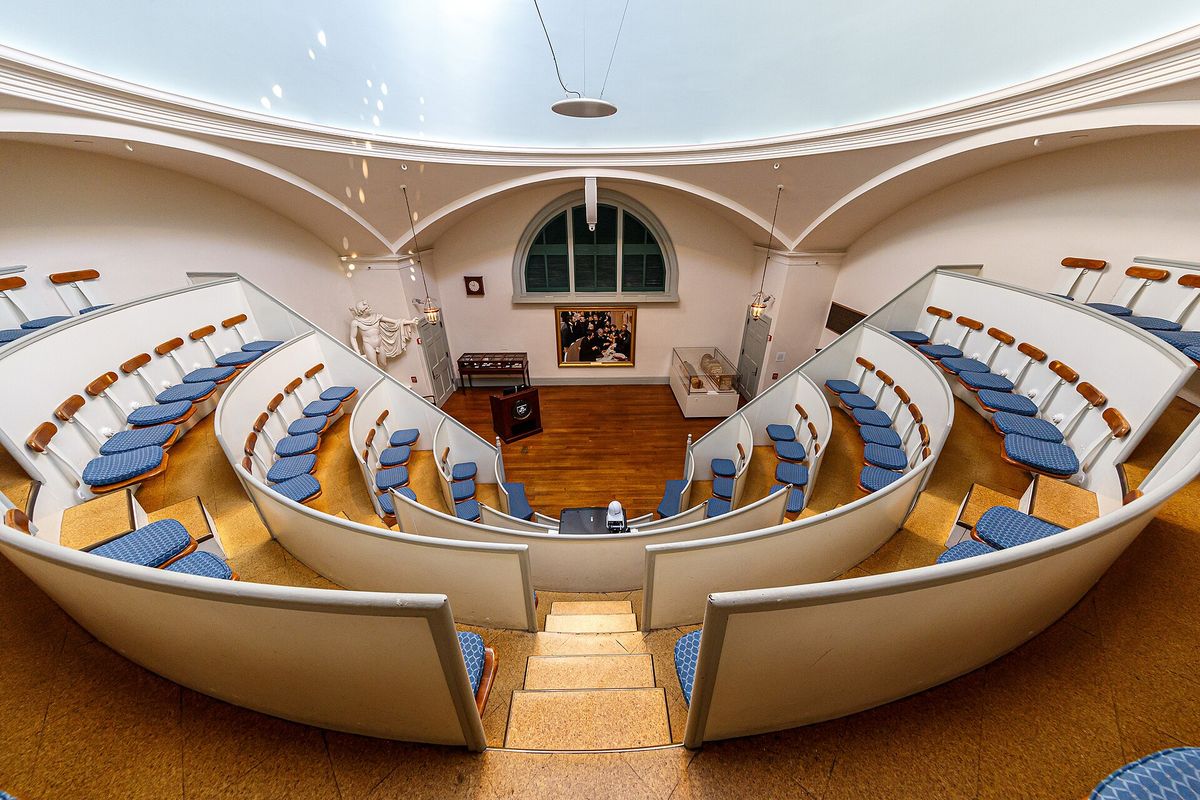

On October 16, 1846, in the operating theater at the top of Massachusetts General Hospital9 in Boston, a dentist gave a young man ether and a surgeon cut a tumor from his neck. The room has been called the Ether Dome ever since, and in medical history the date is known as "Ether Day"8. Friday, October 16, 2026, is the 180th anniversary.
Surgery before ether
A history of anaesthesia published by the World Federation of Societies of Anaesthesiologists calls surgery before anaesthesia "a terrifying last resort in a final attempt to save life."11 A 2006 post on a Nature blog was blunter, saying "operating rooms were virtual torture chambers; patients felt and saw everything."10
Relief had been hinted at decades earlier. Humphry Davy suggested in 1800 that "nitrous oxide inhalation might be used to dull pain in some surgical operations,"8 but, as J.M.S. Pearce wrote in Hektoen International, "nobody tested this idea for more than forty years."7
The Boston room where that changed was originally called the "surgical amphitheater"3, and it was the hospital's first operating room3. More than 8,000 operations were performed here between 1821 and 18673, according to Mass General's Russell Museum.
A dentist, a surgeon and a patient
William T. G. Morton, a former partner of7 the dentist Horace Wells, began a dental practice in Boston in March 18447. John Collins Warren, Mass General co-founder and head surgeon3, agreed to let Morton demonstrate a chemical he said could conquer pain during surgery3. The chemical was sulfuric ether3.
The demonstration took place before an audience of physicians and medical students8. The patient, twenty-year-old Edward Abbott7 (the hospital's library guide calls him Gilbert Abbott), was seated in a chair while Morton gave him the ether. Warren then removed a small tumor from the neck of Gilbert Abbott1. Afterward, the patient reported that he felt his neck had been scraped, but the procedure didn't hurt3.
In the museum's telling, as Warren finished operating, "he turned to the audience and exclaimed: 'Gentlemen, this is no humbug.'"4 The museum's page on the Ether Dome gives a looser version, saying Warren "proclaimed to the doctors who were watching that this new idea was 'no humbug.'"3 Writing in Hektoen International, Summer A. Niazi and Jack E. Riggs note that no written record alluding to this statement appeared until 185913, in Nathan P. Rice's book Trials of a Public Benefactor, which, by Rice's own notes, was written at Morton's house and under his supervision13.
A new word for a new state
On November 18 Henry J. Bigelow, a junior surgeon who had witnessed the MGH surgeries, published an account of Morton's October administrations8 in the Boston Medical and Surgical Journal, and by December 18465 ether had already spread to England.
The procedure still lacked a name. On November 21, Dr. Oliver Wendell Holmes Sr., in a letter to Morton, suggested the word "anaesthesia" to describe the mental state produced by the inhalation of ether vapor8.
Who really came first
Credit for the discovery turned into a long and bitter legal dispute10, and Morton was not the first person to put a surgical patient under ether. In the small town of Jefferson, Georgia9, a physician named Crawford Williamson Long removed a tumor from the neck of a man named James Venable9. The date was March 30, 18429. Long and Venable both knew ether from the "ether frolics"9 of the day, gatherings where people inhaled it for fun. Long delayed publication for seven years9, wanting more cases first, and his report did not appear in the Southern Medical and Surgical Journal until 18499. By then, the Boston demonstration had already made ether famous.
Horace Wells, Morton's old partner, had tried a different gas. He tested nitrous oxide on himself, then went to demonstrate his technique at Massachusetts General Hospital in January 18457. The patient cried out during the operation7, though he later said he had felt no pain, and Wells was ridiculed and abruptly left the operating room7.
The third claimant was Charles T. Jackson, Morton's chemist9 and mentor8. Jackson claimed that the discovery was his7, and he denounced Morton as a "swindler"9. Morton, for his part, toiled unsuccessfully for years to get the U.S. Congress to recognize his "discovery"9 with a monetary award.
The Ether Monument
Boston's tribute deliberately avoids giving credit to any individual10. The Ether Monument is the oldest monument in the Boston Public Garden, installed in 186812. At its top, two figures sculpted by John Quincy Adams Ward12 show the Good Samaritan caring for an injured stranger he met on the road12, a Bible story about the relief of suffering. Pearce notes that the monument "bears no man's name"7.
The Ether Dome today
In 1867, after a new operating room was built,3 the room stopped being an operating theater. The Ether Dome was designated a National Historic Landmark in 19651, and it sits on the fourth floor of the Bulfinch Building2.
As of October 16, 2026, Mass General's library guide says the dome is frequently used for lectures, meetings, and presentations2, and that when it is not in use it is open for tours. In the room hangs "Ether Day 1846" painted by Warren and Lucia Prosperi2, a painting of the operation. The Russell Museum, down the street, advises that "the Dome is often used for meetings"6 and asks visitors to call ahead to find out when it is free.
Trivia
What name did Morton give his ether preparation while keeping its identity secret?
"Letheon"8. He would not divulge what it was.
What number was the letter patent that Morton and Charles T. Jackson filed in November 1846?
Number 48488.
What operation did a surgeon named Hayward perform under ether at Mass General on November 7, 1846?
He amputated a leg8.
When Horace Wells breathed nitrous oxide to have one of his own molars pulled, who did the pulling?
The dentist John Riggs7, using gas provided by Colton.
Which Egyptian mummy shares the Ether Dome, and when did it come to the hospital?
Padihershef, donated to the hospital in 182314.
After it stopped being an operating room, what was the Ether Dome used for?
It was used as a nurses' dorm, a nurses' dining hall, and for storage3.
What pun is Oliver Wendell Holmes reported to have made about the Ether Monument?
He reportedly wrote that it was a monument to "ether or either"9, a dig at the credit fight.
In what year did the Friends of the Public Garden lead the most dramatic restoration of the Ether Monument and its fountain?
200612.
Sources
- Ether and Ether Dome History, The History of MGH, MGH Guides, Treadwell Library, Massachusetts General Hospital, last updated October 1, 2026. Accessed October 16, 2026.
- Ether Dome Today, The History of MGH, MGH Guides, Treadwell Library, Massachusetts General Hospital, last updated October 1, 2026. Accessed October 16, 2026.
- The Ether Dome, Paul S. Russell, MD Museum of Medical History and Innovation, Massachusetts General Hospital. Accessed October 16, 2026.
- Portrait of John Collins Warren (1778-1856), Paul S. Russell, MD Museum of Medical History and Innovation, Massachusetts General Hospital. Accessed October 16, 2026.
- Emery Brown, MD, PhD: Medicine transformed, Paul S. Russell, MD Museum of Medical History and Innovation, Massachusetts General Hospital. Accessed October 16, 2026.
- Plan Your Visit, Paul S. Russell, MD Museum of Medical History and Innovation, Massachusetts General Hospital. Accessed October 16, 2026.
- J.M.S. Pearce, The 'Ether Controversy', Hektoen International, Spring 2021. Accessed October 16, 2026.
- A.J. Wright, What November may bring: the first 37 days of surgical anesthesia, Hektoen International, vol. 8, no. 2, Spring 2016. Accessed October 16, 2026.
- Roger K. Thomas, The surprising (and Long) story of the first use of ether in surgery, The Conversation, March 28, 2019. Accessed October 16, 2026.
- Corie Lok, To ether or either, Nature blogs, November 22, 2006. Accessed October 16, 2026.
- David Wilkinson, History of Anaesthesia: a personal view, World Federation of Societies of Anaesthesiologists. Accessed October 16, 2026.
- Ether Monument, Friends of the Public Garden. Accessed October 16, 2026.
- Summer A. Niazi and Jack E. Riggs, Gentlemen! This is no humbug., Hektoen International, Fall 2020. Accessed October 16, 2026.
- Dominic Smith, WATCH: This operating room changed medical history, STAT, April 11, 2016. Accessed October 16, 2026.