The First Parachute Jump From a Balloon: Garnerin Over Paris, 1797
Key Points
- On 22 October 1797, André-Jacques Garnerin cut his parachute loose from a balloon over the Parc Monceau in Paris, which Guinness World Records lists as the first recorded parachute descent from a balloon.
- Accounts put the height anywhere from an estimated 914 metres to 1,000 metres, and the basket swung so violently that several women in the crowd fainted.
- On 12 October 1799, Jeanne-Geneviève Labrosse came down by parachute from 900 meters and became the first woman to parachute.
- USPA members made an estimated 3.47 million skydives in 2025, with 0.46 deaths per 100,000 jumps.
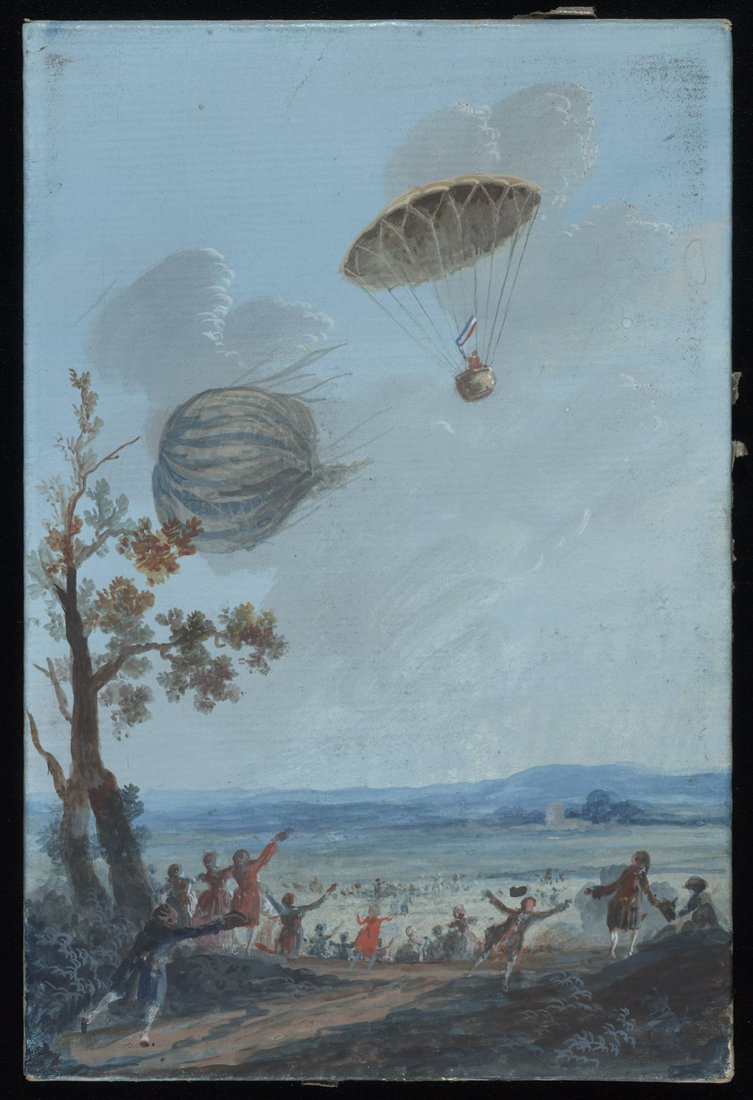

On the evening of 22 October 1797, André-Jacques Garnerin rose over the Parc Monceau in Paris under a balloon, cut himself loose and came down beneath a cloth canopy. Guinness World Records lists it as the first recorded parachute descent from a balloon2. Thursday, 22 October 2026, is the 229th anniversary.
An idea from a prison cell
Garnerin was a student of the ballooning pioneer Professor Jacques Charles6. During the Revolutionary wars he was turned over to the Austrians and held as a prisoner of war in Buda, Hungary, for three years6. A chronicle by the French air force’s Centre d’études stratégiques aérospatiales (CESA) says he made a parachute in 1793 to escape, and his jailers found it and confiscated it1. Out of prison in 1797, he wanted to use the parachute as a means of rescue and descent from a balloon1.
The idea was not new. In 1783, by the CESA account, the physicist Sébastien Lenormand jumped from the height of one storey holding a parasol in each hand1, then dropped animals from the tower of the Montpellier observatory to work out the best diameter. Garnerin’s step was to drop the rigid frame, and he is credited as the inventor of the frameless parachute6.
Twenty-eight minutes past five
A print engraved by Simon Petit the same year gives the time in the revolutionary calendar: 1 Brumaire, Year VI, at 5.28 in the evening4, when “le citoyen Garnerin” went up from the Parc Monceau. The CESA account gives 5pm, in a small balloon with a folded parachute attached1. Strong winds had forced him to delay the start1, and in the Journal de Paris, Garnerin later wrote that he had built the parachute in two days and two nights1 and had to give up several safety measures.
Accounts of the height vary. CESA says he cut the cord at 1,000 metres1, Guinness gives an estimated 914 metres (3,000 feet)2 and History UK 3,200 feet5. The English Wikipedia biography puts the canopy at about 7 m (23 feet) across6, with Garnerin riding in a basket attached to the bottom of the parachute6.
A violent ride down
The effort of cutting the cord, and the air escaping from the edges of the canopy, set the basket swinging in violent jolts1. A cry of terror rose from the crowd, and several women fainted1. Afraid of hurting the spectators below, Garnerin could not throw out his ballast1 to steady himself. History UK says he landed shaken but unhurt half a mile from the balloon’s takeoff site5, while French Wikipedia says he came down in front of an admiring crowd that expected to see him die7, with a sprained ankle7.
The hole in the top
The swinging came from a closed canopy, and the cure was a vent, though the sources split on whose idea it was. Wikipedia’s article on the parachute credits Jérôme Lalande, a French astronomer9, and dates it to 1804, when Lalande introduced a vent in the canopy to eliminate violent oscillations8. The CESA chronicle credits Garnerin himself with a circular opening at the centre of the canopy, topped by a pipe one metre tall1, and calls it an essential step toward the modern parachute1.
Jeanne-Geneviève and Élisa
Jeanne-Geneviève Labrosse, who became the wife of André-Jacques Garnerin10, first flew on 10 November 179810. On 12 October 179910 she went up in a gondola, released the balloon and came down by parachute from an altitude of 900 meters10, and with that became the first woman to parachute10.
The family business passed to a niece. Élisa Garnerin, born in 179111, toured the provinces of France, Spain, Italy, and other parts of Europe11, making 39 descents in all between 1815 and 183511.
Over London in 1802
The Garnerins came to England in 1802 during the brief peace12, the Peace of Amiens6. On 21 September the balloon ascended from North Audley Street to a height of 8,000 feet12 before he descended in his parachute to a field near St Pancras Church12. Wikipedia calls it the first parachute descent ever made in England6.
The official aeronaut
In France he held the post of aérostier des fêtes publiques7, the balloonist for public celebrations, until 1804, when Sophie Blanchard replaced him7. He died on 18 August 1823, at the age of 546. He was struck by a falling beam6 while walking around the site where a new balloon was being built; History UK describes it as a balloon accident while preparing to test a new parachute5.
The National Air and Space Museum keeps a bronze commemorative medal with a relief bust of Garnerin3, its reverse showing his parachute and basket and the words PREMIERE DESCANT EN PARACHUTE PARC MONCEAU 22 OCTBRE 17973.
From a basket to the drop zone
CESA dates the parachute’s arrival in armed forces to the trials of Adolphe Pégoud in 1913 and the First World War1. Wikipedia’s history of the parachute records that the first Soviet mass jumps led to the development of the parachuting sport in the Soviet Union8, and that after World War II, parachuting became a popular sport, and new materials like nylon replaced silk8.
In 2025, United States Parachute Association members made an estimated 3.47 million skydives13, and there were 16 civilian skydiving fatalities in the United States13, or 0.46 deaths per 100,000 jumps13.
Trivia
- Who coined the word “parachute”, and when? Sébastien Lenormand, in 17858.
- Who flew with Garnerin on 8 July 1798, four months before Labrosse first flew? A woman recorded as “Citoyenne Henri”10.
- Where did Élisa Garnerin take off on 20 September 1815? From the bowling green at the Jardin de Tivoli11, leaving the balloon after eleven and a half minutes and landing safely near Meudon.
- How did Élisa Garnerin’s 1818 show in Madrid go? It was a fiasco11, and she and her father were taken to prison for their own protection before leaving for France that night.
- Which French town named a street after Jeanne Garnerin in 2006? Wissous, on 17 October 200610.
- Who invented the first knapsack parachute? Gleb Kotelnikov of Russia, in 19118.
- Who made the first premeditated free-fall parachute jump from an airplane? Leslie Irvin8.
- Who donated the Garnerin medal to the National Air and Space Museum? General Pierre Lissarague3.
Sources
- Le 22 octobre 1797, André-Jacques Garnerin effectue le premier saut en parachute depuis un ballon, La chronique du CESA, Centre d’études stratégiques aérospatiales, Armée de l’Air. Accessed October 22, 2026.
- First parachute jump from a balloon, Guinness World Records. Accessed October 22, 2026.
- Medal, Andre Jacques Garnerin, National Air and Space Museum, Smithsonian Institution. Accessed October 22, 2026.
- Simon Petit, Experience du parachûte, Le I.er Brumaire an 6 (22 Octobre 1797), print, 1797, Bibliothèque nationale de France, via Wikimedia Commons. Accessed October 22, 2026.
- The first parachutist, This Day in History, 22 October, History UK. Accessed October 22, 2026.
- André-Jacques Garnerin, Wikipedia. Accessed October 22, 2026.
- André-Jacques Garnerin, Wikipédia, French edition. Accessed October 22, 2026.
- Parachute, Wikipedia. Accessed October 22, 2026.
- Jérôme Lalande, Wikipedia. Accessed October 22, 2026.
- Jeanne Geneviève Garnerin, Wikipedia. Accessed October 22, 2026.
- Élisa Garnerin, Wikipedia. Accessed October 22, 2026.
- Edward Hawke Locker, Monsieur Garnerin, the Intrepid Aeronaut, print, London Museum collections. Accessed October 22, 2026.
- Safety, FAQs, United States Parachute Association. Accessed October 22, 2026.
