Lincoln Delivered the Gettysburg Address on November 19, 1863
Key Points
- Abraham Lincoln gave the Gettysburg Address on November 19, 1863, at the dedication of the Soldiers’ National Cemetery, after a two-hour oration by Edward Everett.
- David Wills invited Lincoln on November 2, 1863, while Everett had been invited in September, and the planners asked the president for a few appropriate remarks.
- Estimates of the crowd range from about 10,000 (Smithsonian) to approximately 15,000 (National Park Service), and the Abraham Lincoln Presidential Library and Museum counts the speech at 272 words.
- Five copies survive in Lincoln’s hand: two at the Library of Congress, the Everett copy in Illinois, the Bancroft copy at Cornell University and, by Cornell University Library’s account, the Bliss copy at the White House.
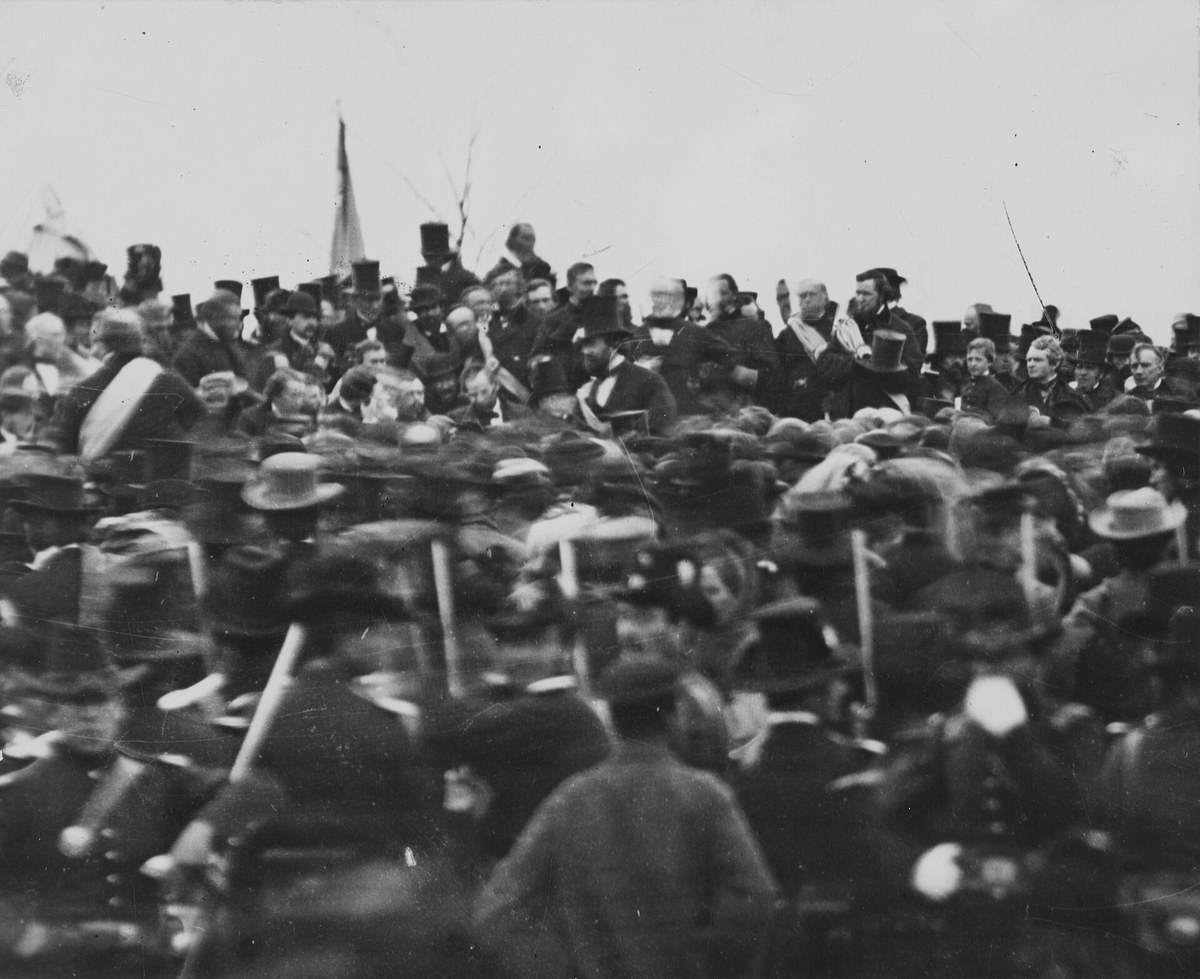

On November 19, 1863, Abraham Lincoln spoke at the dedication of the Soldiers’ National Cemetery at Gettysburg, Pennsylvania1. The battle, the dedication and his address have become seminal moments in the history of the Civil War and the nation3, though Lincoln was never meant to be the main event. Thursday, November 19, 2026, marks 163 years since the two minute speech. Five copies of the speech survive in his hand, and the earliest is presumed to be the only working draft written before delivery1.
An invitation for a few remarks
Several states felt their soldiers deserved a better resting place than the shallow graves left on the battlefield, and Gettysburg citizen David Wills convinced Pennsylvania to buy seventeen acres for a proper burial ground2. Wills was a prosperous 32-year-old attorney who owned the largest house on the town square8. He conceived the idea of a national cemetery, organized the dedication, and explained to Lincoln that the cemetery was planned and financed by the states that had soldiers buried there1.
His formal invitation to the president is dated November 2, 1863, while Edward Everett, the principal speaker, had received his invitation in September1. The planners asked Lincoln to follow the main oration with “a few appropriate remarks.”3 The National Park Service says the president was asked as an afterthought and had only about two weeks to prepare2. The Library of Congress notes that the late date has led some to argue Wills never expected Lincoln to come, but a one-page enclosure of the same date urged the president to stay at Wills’s own home1.
The train, the house and the envelope myth
Lincoln arrived at the Gettysburg railroad station the day before the ceremony, on a special train that also carried Cabinet members and foreign ambassadors, and was escorted to the Wills home8. That evening serenaders and crowds gathered outside calling for him, and he came out but declined to make a speech8.
A long-lived story has him dashing off the address on an envelope during the ride8. The earliest surviving draft points elsewhere. The first page of the Nicolay copy is on Executive Mansion stationery, which supports the idea that it was drafted in Washington1. Cornell University Library says that page was written in ink sometime before November 18, and the second page in pencil later, possibly at the Wills house5. Lincoln apparently produced the final written version in a second-floor bedroom there8.
Two hours, then two minutes
Everett had been governor of Massachusetts, a U.S. senator and president of Harvard, and the Smithsonian calls him the most celebrated speaker of the day3. He gave a two-hour oration that the Smithsonian says is remembered more for its length than its content3.
The National Park Service says approximately 15,000 people were on hand2, the Smithsonian gives an estimated 10,0003, and Abraham Lincoln Online says more than 10,0008. By the Park Service account, Lincoln’s two minute speech was over before most of the crowd realized he had begun2, and it was so short that most of the photographers who came to record the occasion missed their chance3.
The Abraham Lincoln Presidential Library and Museum counts the address at 272 words6. All five handwritten copies are a little different, so it is impossible to determine precisely what he said that day6. The two 1863 drafts lack the phrase “under God,” while the three later copies include it, and three correspondents at the dedication put it in their telegraph reports7. By the museum’s summary, Lincoln called for a “new birth of freedom.”6
A note from Everett the next day
On November 20, Everett wrote to Lincoln praising the “eloquent simplicity & appropriateness” of his remarks1. He added that he would be glad if he could flatter himself that he had come “as near to the central idea of the occasion, in two hours, as you did in two minutes.”1
At the cemetery itself, Lincoln had heard only the polite applause given to men of his station, a contrast with the praise that spread across the country once people had time to read the address1.
Where the five copies are
Lincoln gave the first two drafts to his secretaries, John Nicolay and John Hay, and Hay’s descendants donated both to the Library of Congress in 19161. Cornell University Library says both are now at the Library of Congress5. The other three were written out in February and March of 1864 for charitable causes supporting Union soldiers5.
Everett requested one for the Metropolitan Fair in New York5, and he bound it into a book with a copy of his own speech to be sold there6. Illinois acquired that copy in March 1944 for $60,000, and it is kept at the Abraham Lincoln Presidential Library and Museum6. The museum lists it on display from November 6 to 22, 20266.
Historian George Bancroft asked for a copy to benefit the Baltimore Sanitary Fair, where his stepson Alexander Bliss planned to sell a book of manuscripts5. Lincoln wrote on both sides of the paper, which made it unusable for the book, so Lincoln let Bancroft keep it. It stayed in his family for decades before it was sold, and it was donated to Cornell University in 19497. Cornell University Library calls it the copy at Cornell5. Lincoln then wrote the fifth and final copy for Bliss in early March 1864, the only one with a title, a date and his full signature5.
Cornell University Library says the Bliss copy is now in the Lincoln Bedroom at the White House5, and its text is the one inscribed on the south wall of the Lincoln Memorial7.
Lincoln in the crowd
One rare photograph of the ceremony shows the audience pressed in to hear the speakers, with Lincoln seated, hatless and barely recognizable3. The Library of Congress identifies him at the center of the platform with his bodyguard Ward Lamon and Pennsylvania governor Andrew Curtin, and says Hay, Nicolay, Everett and Wills may be among those nearby1. In two other images of the crowd taken by Alexander Gardner that day, a Library of Congress patron spotted a figure believed to be Lincoln, white-gloved in his stovepipe hat, in a military procession1.
Trivia
- Who photographed Lincoln with Nicolay and Hay in his Washington studio on November 8, 1863? Alexander Gardner1, the week before the trip to Gettysburg.
- Which author popularized the story that Lincoln wrote the address on the train, and in what book? Mary Raymond Shipman Andrews, in her 1906 book The Perfect Tribute7.
- Which ancient speech do historians compare the structure of the address to? Pericles’s Funeral Oration from the Peloponnesian War7.
- What did Oscar Cintas pay for the Bliss copy at auction? $54,0004, which the Smithsonian calls a record price at the time for a document at public auction.
- Since what year has Lincoln’s old office in the White House been called the Lincoln Bedroom? Since 1945, when President Harry S. Truman directed that Lincoln-era bedroom furnishings be placed there4.
- What numbers appear at the top of the two pages of the Everett copy? 57 and 58, the page numbers from the book it was once bound into6.
- Who paid the rest of the price after Illinois schoolchildren raised about $50,000 for the Everett copy? Chicago businessman Marshall Field III6.
- Which wounded Gettysburg cobbler did Lincoln meet after the ceremony? John L. Burns, who had joined Union troops in the battle8.
Sources
- Gettysburg Address, Exhibition Items, Library of Congress. Accessed November 15, 2026.
- Gettysburg Address, Lincoln Home National Historic Site, National Park Service. Accessed November 15, 2026.
- The Gettysburg Address: Dedication of the Soldiers National Cemetery, November 19, 1863, Albert H. Small Documents Gallery, National Museum of American History, Smithsonian. Accessed November 15, 2026.
- The Gettysburg Address: The White House Copy of the Gettysburg Address, Albert H. Small Documents Gallery, National Museum of American History, Smithsonian. Accessed November 15, 2026.
- In Lincoln’s hand, Remembering Lincoln at Gettysburg, Cornell University Library. Accessed November 15, 2026.
- Gettysburg Address, Everett Copy online exhibit, Abraham Lincoln Presidential Library and Museum. Accessed November 15, 2026.
- Versions of the Gettysburg Address, American Battlefield Trust. Accessed November 15, 2026.
- Abraham Lincoln’s Stay in the David Wills House at Gettysburg, Pennsylvania, Abraham Lincoln Online. Accessed November 15, 2026.