Guggenheim at 67: Frank Lloyd Wright and the Spiral on Fifth Avenue
Key Points
- The Solomon R. Guggenheim Museum opened on October 21, 1959, six months after Frank Lloyd Wright died in Arizona at the age of 91.
- Wright was commissioned in 1943, and the Guggenheim names design changes, extra land and rising postwar building costs as causes of the 16-year delay, with the 1949 death of Solomon R. Guggenheim delaying it further.
- In 1956, 21 New York artists judged the design “not suitable for a sympathetic display of painting and sculpture.”
- On July 7, 2019, the museum was one of eight Frank Lloyd Wright works inscribed on the UNESCO World Heritage List.
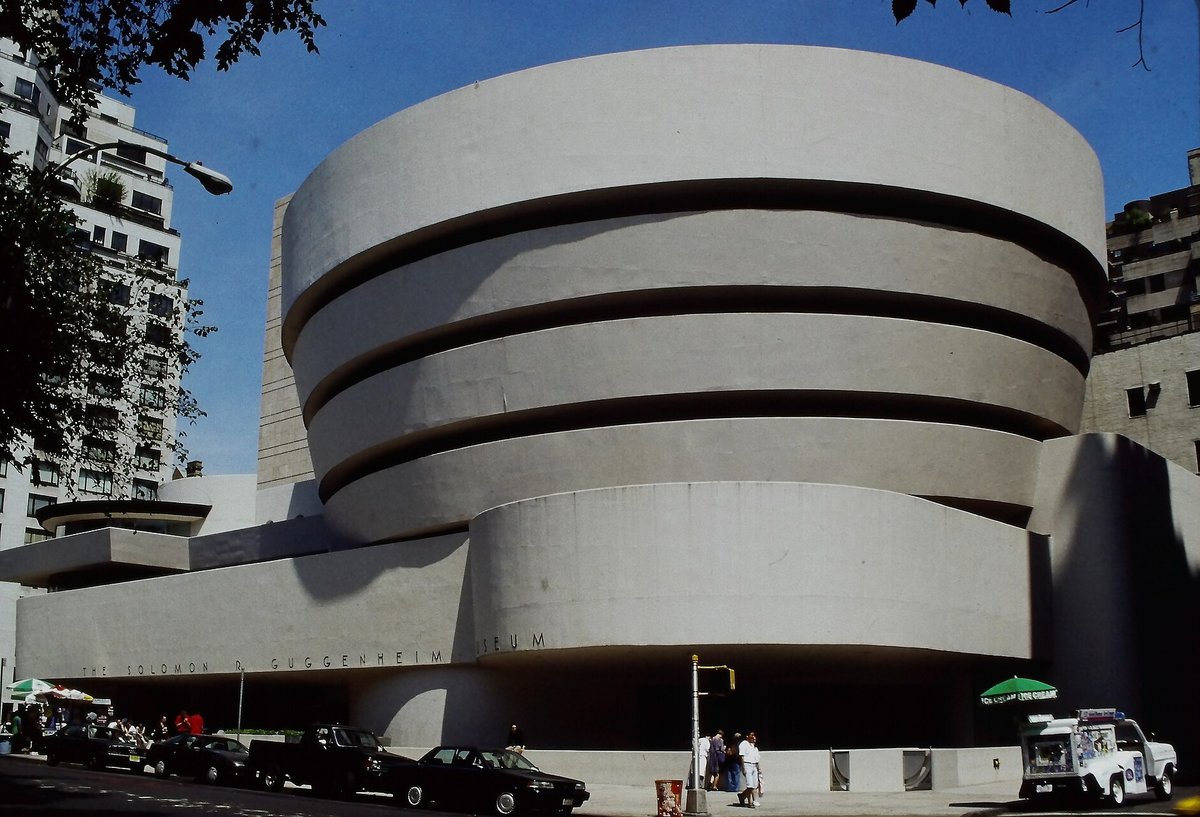

The Solomon R. Guggenheim Museum opened on October 21, 19593, on Fifth Avenue in New York. It opened, in the museum’s own words, “to an enthusiastic public”, six months after Frank Lloyd Wright’s death2. Wednesday, October 21, 2026, is the 67th anniversary of that day.
A museum for paintings with no subject
Solomon R. Guggenheim came to modern art late, and through the German abstract painter and collector Hilla Rebay5. He started collecting it in 19275, when he was in his 60s, and from the early 1930s the Guggenheims used several suites that they occupied at the Plaza Hotel5 to show the growing collection, open to the public by appointment. In 1937, Solomon founded the Guggenheim Foundation with Rebay as its curator and director5.
For two decades, by the museum’s account, she collected and promoted nonobjective painting with a crusading zeal4. The Museum of Non-Objective Painting opened in 1939 in temporary quarters on East 54th Street, with Rebay as director4, and by the early 1940s3 the collection needed a permanent building.
The 1943 letter
Rebay wrote to Frank Lloyd Wright in 1943, telling him, as the Frank Lloyd Wright Foundation quotes her, that she needed “a fighter, a lover of space, an originator, a tester and a wise man”9. In 1943, Frank Lloyd Wright was commissioned to design a building to house the Museum of Non-Objective Painting1. The site came later. Locations in Manhattan on 36th Street, 54th Street, and Park Avenue, as well as in the Riverdale section of the Bronx2, were considered first. Between 1944 and 1951 the foundation acquired three tracts of land between East 88th and 89th streets on Fifth Avenue2, across from Central Park.
Wright had never received a significant commission in New York9, and he did not undersell this one. He vowed the building would “make the building and the painting an uninterrupted, beautiful symphony such as never existed in the World of Art before”9, and he claimed it would make the Metropolitan Museum of Art “look like a Protestant barn”9.
Sixteen years to build
The Guggenheim blames the 16-year delay1 on modifications to the design, the acquisition of additional property, and the rising costs of building materials following World War II1. Then the death of the museum’s benefactor, Solomon R. Guggenheim, in 1949 further delayed the project1. Rebay left too. In 1952, after Solomon’s death in 1949, she resigned as director of the foundation and museum4. Over the whole stretch, Wright produced over 700 sketches9.
Ground was finally broken in August 1956 for the museum, renamed in Solomon R. Guggenheim’s memory2. On December 10, 19566, a letter reached the director, James Johnson Sweeney6, from 21 well-respected New York artists, including Philip Guston, Franz Kline, and Robert Motherwell6. They judged the design “not suitable for a sympathetic display of painting and sculpture”6 and, in the museum’s summary, argued that the sloping ramp signaled a “callous disregard”6 for the viewing of art. The ramp in question had a floor sloped at three degrees6. Wright answered in Newsweek that the artists “know too little of the nature of the mother art, architecture”6. As a Guggenheim archives essay puts it, “The museum opened three years later, slope and all.”6
Wright dies, the doors open
Wright did not see it finished. He died in Arizona in April 1959, at the age of 912. That fall, visitors in “hats and furs crowded to see it”11.
The reviews split hard. Wright’s architecture soon prompted “fiery debate”11, in the words of the New York Times. “One of Mr. Wright’s most joyous monstrosities,” opined the New York Mirror11, and another account described “slither[ing] up the ramp, one hip higher than the other”11. The architect Philip Johnson went the other way and called it “Mr. Wright’s greatest building. New York’s greatest building.”11
The ramp and the rotunda
The Frank Lloyd Wright Foundation says the museum resembles a white ribbon curled into a cylindrical stack that grows continuously wider as it spirals upwards towards a glass ceiling9. Inside, an intensely cinematic helical spiral ramp climbs gently from ground level to a skylight at the top9.
Its influence is easier to agree on than its walls. In the words of the critic Paul Goldberger, quoted by the museum, “almost every museum of our time is a child of the Guggenheim.”1
A tower, a facelift and a world listing
Wright’s original plans for the Guggenheim Museum called for a ten-story tower behind the smaller rotunda1, but largely for financial reasons, Wright’s proposed tower went unrealized1. A four-story tower by Wright’s son-in-law William Wesley Peters2 was completed in 1968. In 1990 the museum was designated a New York City Landmark2, and the Wright building closed for a restoration and expansion project2 that added a taller tower by Gwathmey Siegel & Associates Architects1, which incorporates the foundation and framing of a smaller 1968 annex1. In 1992, after a major interior renovation, the museum reopened1 with the whole original building now devoted to exhibition space and completely open to the public for the first time1.
The outside came next. From September 2005 to July 2008, the Guggenheim Museum was enclosed in scaffolding7. The building was in good structural condition, but the work called for the removal of eleven coats of paint, filling of exterior cracks, treatment of corroded steel structures, and repair and reinforcement of the concrete7. In 2008 the Secretary of the Interior and the National Park Service also made it a National Historic Landmark, 49 years after the museum’s opening2, early by the usual rule, since a building is typically recognized as a federal landmark only after it has been standing for 50 years2.
In 2015 the United States nominated the museum, along with nine other buildings designed by Frank Lloyd Wright1, for the UNESCO World Heritage List. On July 7, 2019, eight of Frank Lloyd Wright’s major works were inscribed to the UNESCO World Heritage List10 as The 20th-Century Architecture of Frank Lloyd Wright1, with the decision announced in Baku, Azerbaijan2. The eight10 are Unity Temple, the Frederick C. Robie House, Taliesin, Hollyhock House, Fallingwater, the Herbert and Katherine Jacobs House, Taliesin West and the Guggenheim, and the Wright Foundation calls them the first modern architecture designation in the United States on the World Heritage List10.
Visiting, as of October 21, 2026
The museum stands at 1071 Fifth Avenue2. Children under 12 and members always visit for free8, and every Tuesday and Sunday, from 4 to 5:30 pm, you can pay what you wish for admission8. The suggested contribution is $10, and minimum is $18. Only a limited number of tickets are available on-site8 in those hours, so the museum strongly recommends reserving ahead.
Trivia
- Which young architect designed the gallery for the Museum of Non-Objective Painting? William Muschenheim5.
- How did Solomon Guggenheim meet Hilla Rebay? Through a portrait. His wife, Irene, had commissioned her to paint his portrait5.
- What stood on the future museum site from October 22 to December 13, 1953? A model Usonian house by Wright, beside a pavilion of models and large photographs of his work2.
- Where was the collection kept while the museum was built? In a townhouse at 7 East 72nd Street2.
- Which architect served as Clerk of the Works and photographed the building as it took shape? William H. Short2.
- Which cartoonist drew the opening for The New Yorker? Alan Dunn, in the November 28, 1959, issue11.
- Which artist projected light onto the restored facade in 2008? Jenny Holzer, with For the Guggenheim7, shown every Friday evening from September 26 through December 31, 2008.
- What did the museum restaurant The Wright win in 2010? A James Beard Award2, for its restaurant design.
Sources
- Frank Lloyd Wright and the Guggenheim New York, The Guggenheim Museums and Foundation. Accessed October 21, 2026.
- The Frank Lloyd Wright Building Timeline, The Guggenheim Museums and Foundation. Accessed October 21, 2026.
- History, The Guggenheim Museums and Foundation. Accessed October 21, 2026.
- Hilla Rebay, The Guggenheim Museums and Foundation. Accessed October 21, 2026.
- Solomon R. Guggenheim, The Guggenheim Museums and Foundation. Accessed October 21, 2026.
- Kate Lingley, Three Degrees in the Forecast: The 1956 Artists’ Response to Frank Lloyd Wright’s Ramp, The Guggenheim Museums and Foundation, September 16, 2026. Accessed October 21, 2026.
- Guggenheim Museum Restoration Complete, The Guggenheim Museums and Foundation, August 22, 2008. Accessed October 21, 2026.
- Discounts, Plan Your Visit, The Guggenheim Museums and Foundation. Accessed October 21, 2026.
- Solomon R. Guggenheim Museum, Frank Lloyd Wright Foundation. Accessed October 21, 2026.
- In the News: Inscription of Eight Wright Buildings to UNESCO World Heritage List, Frank Lloyd Wright Foundation, July 15, 2019. Accessed October 21, 2026.
- Caitlin Dover, This New Yorker Cartoon Documented the Guggenheim’s 1959 Opening, Frank Lloyd Wright Foundation, July 10, 2017. Accessed October 21, 2026.