Hayes, Tilden and the Disputed Election of 1876, 150 Years On
Key Points
- The 150th anniversary of the 1876 presidential election is November 7, 2026 (a Saturday), and Rutherford B. Hayes won it 185 electoral votes to 184 for Samuel J. Tilden.
- By the Library of Congress figures, Tilden led the popular vote, 4,288,191 to 4,033,497, but fell one electoral vote short.
- The White House Historical Association says a 15-member Electoral Commission awarded the disputed votes of four states to Hayes in a series of 8 to 7 decisions.
- Hayes took the oath in secret on Saturday, March 3, 1877, and publicly on Monday, March 5.

Saturday, November 7, 2026, marks the 150th anniversary of the 1876 presidential election. Wikipedia's account of the election gives the date as November 7, 18764. The Library of Congress says Rutherford B. Hayes, a Republican, defeated Samuel J. Tilden, a Democrat, in a controversial contest, and that Tilden won the popular vote yet fell one vote short of an Electoral College majority1. The result was not settled for almost four months.
The numbers on the Library of Congress chart
The Library's resource guide lists the final tally as 185 electoral votes and 4,033,497 popular votes for Hayes and his running mate William A. Wheeler, against 184 electoral votes and 4,288,191 popular votes for Tilden and Thomas A. Hendricks1. By those figures Tilden finished ahead in the popular vote by 254,694 (other tallies differ by a few hundred to a couple thousand votes). Wikipedia puts turnout at 82.6 percent of eligible voters and Tilden's share of the popular vote at 50.9 percent4.
The guide cites a CQ Press reference volume, Presidential Elections, 1789-2008, for those figures1. A single electoral vote decided a contest in which the losing candidate had the larger popular count, which is why the election still turns up whenever people ask how the Electoral College can split from the popular vote.
Election night and four disputed states
The White House Historical Association says returns on election night leaned toward a Democratic victory, and that New York Times editor George F. Jones telegraphed Hayes that he had lost3. Hayes then realized that if he held the North and carried more Southern states he could win the Electoral College by a single vote3.
Republican election boards in South Carolina, Florida and Louisiana declared Hayes the winner, Democrats disputed those returns, and rival state governments in South Carolina and Louisiana sent competing sets of electoral certificates, which left twenty electoral votes in doubt3. In Oregon, Hayes won the vote, but a question about the eligibility of one elector put that state's result in dispute as well3. Tilden won the popular vote by more than 200,000, and disputed results in the four states left him one electoral vote short of the 185 needed3.
The association also describes political violence and suppression of the Black vote across the South during the campaign, quoting the Reconstruction historian Eric Foner on a "reign of terror" in parts of South Carolina3. The disputed returns came out of that setting.
One state chose its electors by legislature
Colorado had been admitted as the 38th state on August 1, 1876, and its legislature, not its voters, chose its electors. Wikipedia calls 1876 the last presidential election in which a state's electors were appointed that way4. It is a small detail inside a large dispute, and a handy one for trivia.
The Electoral Commission
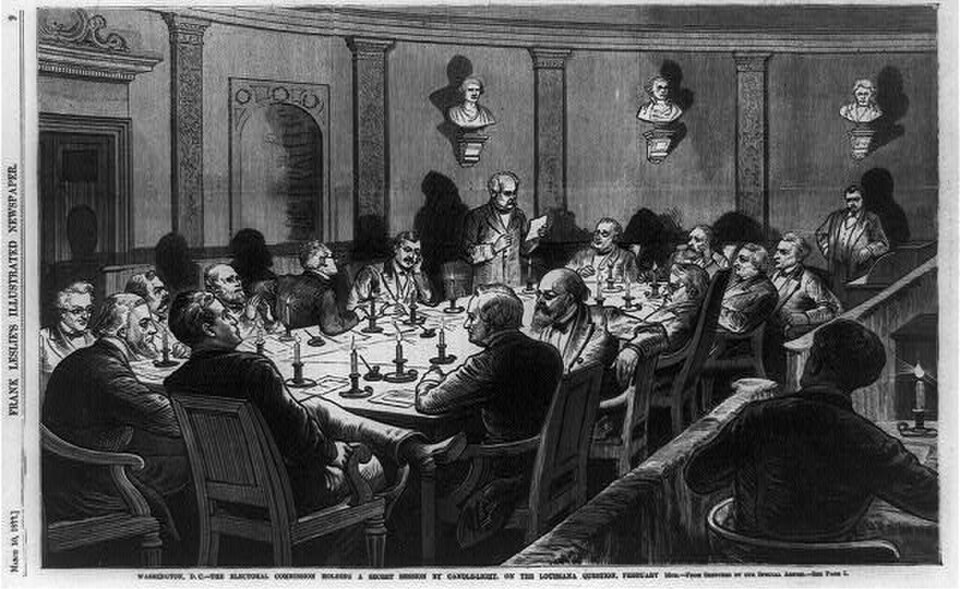
Congress passed a law on January 29, 1877, creating a 15-member Electoral Commission, and the commission began meeting on January 314. The association says it had five members from the House, five senators and five Supreme Court justices, with four of the justices named in the bill and given the chance to pick a fifth3. Tilden called the commission an "abandonment of the constitution"3.
The justices first chose Associate Justice David Davis, regarded as an independent, but the Illinois legislature elected him to the Senate and he resigned from the Court, forfeiting his place on the commission3. Joseph P. Bradley, whom President Grant had nominated to the Court in 1870, became the fifth justice3. The commission then awarded the electoral votes of all four disputed states to Hayes through a series of 8 to 7 decisions3.
The Library holds a print titled "Washington, D.C.--the Electoral Commission holding a secret session by candle-light, on the Louisiana question, February 16th"1, which is the picture at the top of this page. The Library's digital collections link the full text of The Proceedings of the Electoral Commission of 1877, published in the Congressional Record2.
Wormley House and the final count
On February 26, five Republicans and four Southern Democrats met at Wormley House, a hotel owned by James Wormley, a wealthy Black entrepreneur. The association says the Democrats agreed not to block Hayes's election on the condition that Republicans withdraw federal troops from the South3. Meanwhile, Tilden's supporters in the House introduced dilatory measures to stall the count, and Speaker Samuel Randall, a Democrat, ruled them out of order3. On the morning of March 2, 1877, Hayes was declared the winner, 185 to 1843.
The Library's list of historic newspaper highlights shows how the news read at the time. The National Republican of Washington ran "Suspense, Possibly Tilden, Hopefully, Hayes" on November 8, 1876, and "Glorious News!" on November 9. After the final count it ran "The Agony Over! Hayes Elected President" on March 2, 18772.
A secret oath on a Saturday night
Because March 4, 1877, fell on a Sunday, the public inauguration was set for Monday, March 5. President Grant insisted that Hayes take the oath early, and on the evening of Saturday, March 3, Hayes was sworn in by Chief Justice Morrison R. Waite in the Red Room of the White House, before a state dinner3. The Rutherford B. Hayes Presidential Library and Museums confirms that he took the oath secretly that day in the Red Room5. Newspapers did not report the ceremony until the morning of March 5, and Hayes took the oath again publicly at the Capitol3.
What came after
The association says Hayes's inauguration marked the end of Reconstruction and of any significant federal presence in the South, and that he withdrew troops from around state buildings in South Carolina and Louisiana within two months of taking office (the association's word is courthouses, and the Hayes Library says statehouses)3. In his letter accepting the Republican nomination, Hayes also said he would serve a single term3. Wikipedia notes that Congress later passed the Electoral Count Act in 1887 to set more detailed rules for counting electoral votes when a state sends more than one slate of electors4.
Trivia
- How many electoral votes did Hayes win in the final count? 185, to Tilden's 1843.
- Which justice was first chosen as the fifth member of the commission's Supreme Court group, then resigned to take a Senate seat? David Davis3.
- Who owned the Washington hotel where Republicans and Southern Democrats met on February 26, 1877? James Wormley3.
- According to Wikipedia, which state's legislature, rather than its voters, appointed that state's electors in 1876? Colorado4.
- Who administered the secret oath to Hayes on March 3, 1877? Chief Justice Morrison R. Waite, in the Red Room of the White House3.
- According to Wikipedia, which 1887 law set more detailed rules for counting electoral votes? The Electoral Count Act4.
Sources
- Presidential Election of 1876: A Resource Guide, Introduction, Library of Congress Research Guides (last updated October 2, 2026). Accessed November 3, 2026.
- Presidential Election of 1876: A Resource Guide, Digital Collections, Library of Congress Research Guides. Accessed November 3, 2026.
- The Election of 1876, White House Historical Association. Accessed November 3, 2026.
- 1876 United States presidential election, Wikipedia. Accessed November 3, 2026.
- Biography, Rutherford B. Hayes Presidential Library and Museums. Accessed November 3, 2026.