John Glenn Returns to Space at 77: Discovery Launch, October 29, 1998
Key Points
- John Glenn launched on Space Shuttle Discovery from Kennedy Space Center on October 29, 1998, at age 77, while still serving as a senator from Ohio.
- His first flight, Friendship 7 on February 20, 1962, made him the first American to orbit the Earth, about 36 years before his second.
- NASA worked with the National Institute on Aging on research into bone and muscle loss, balance, sleep and immune changes, with Glenn as a test subject.
- NASA's history office wrote in October 2023 that Glenn's record as the oldest person to orbit the Earth stands, while older people have since made short suborbital Blue Origin flights.
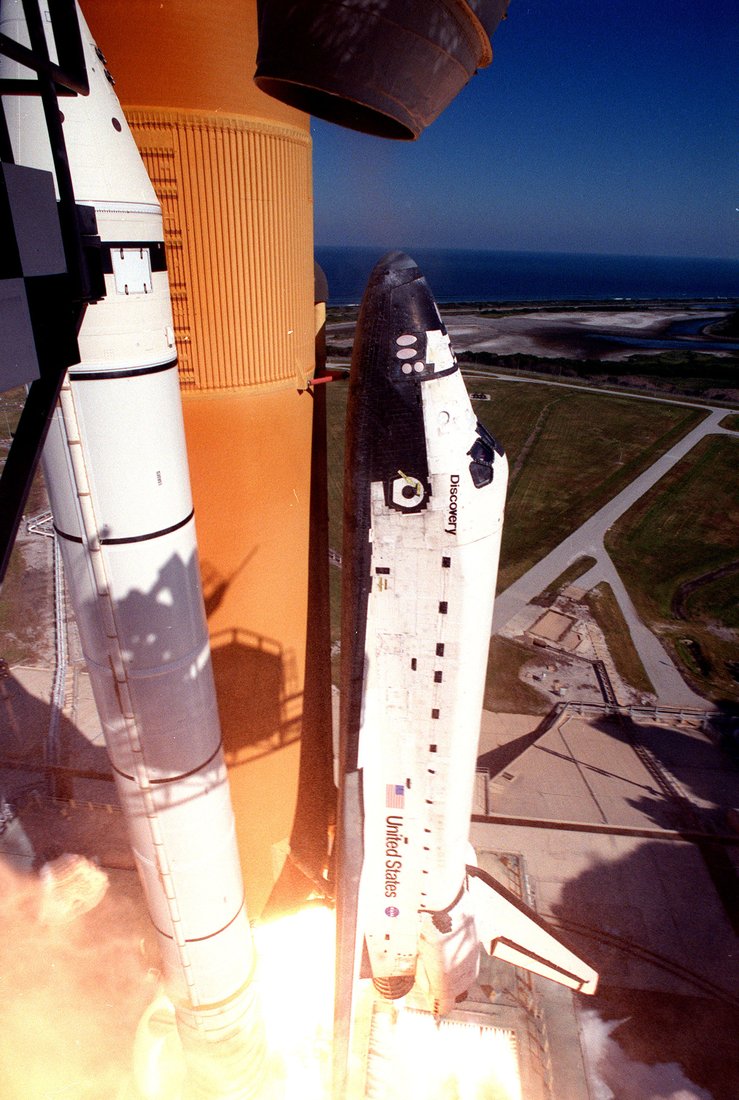

At 2:19 p.m. Eastern time on October 29, 1998, Space Shuttle Discovery lifted off from Launch Pad 39B at Kennedy Space Center1 with a senator from Ohio aboard. John Glenn was 77 and still serving in the Senate when he flew4. On February 20, 1962, he had become the first American to orbit the Earth3, and NASA's mission page puts the gap between the two flights at about 36 years, 8 months and 9 days1. Thursday, October 29, 2026, is 28 years to the day since that second launch.
Launch day
It was Discovery's 25th liftoff2. The countdown was held for a master alarm during cabin leak checks and for aircraft in restricted airspace, and after main engine start the door of the drag chute compartment came off, which NASA says posed no problem for the mission1.
Seven people flew. Curtis L. Brown was commander and Steven W. Lindsey was pilot, with Scott E. Parazynski, Stephen K. Robinson and Pedro Duque as mission specialists and Chiaki Mukai and Glenn as payload specialists1. Duque represented the European Space Agency and Mukai the National Space Development Agency of Japan2. On the way up, Brown and Lindsey flew the ascent with Parazynski as flight engineer and Duque on the flight deck, while Glenn, Robinson and Mukai rode in the middeck2.
How a senator got a seat
NASA's history office says the agency essentially grounded Glenn after his 1962 mission for fear of losing a national hero2. He resigned from the Manned Spacecraft Center on January 16, 1964, and retired from the Marine Corps on January 1, 19655.
Glenn learned that spaceflight causes physiological changes that resemble some effects of aging, and as a senator he lobbied NASA Administrator Daniel S. Goldin to let him fly as a test subject2. Goldin agreed in principle on two conditions: Glenn had to pass the same physicals as the other astronauts, and the flight had to carry valuable peer-reviewed research2. He passed.
NASA announced on January 16, 1998, that Glenn would fly as a payload specialist2, 34 years to the day after he left the Manned Spacecraft Center. The rest of the crew was named on February 13, and the seven held a press conference at Johnson Space Center on February 20, 1998, the 36th anniversary of Friendship 72. On April 14, 1998, President Clinton visited Johnson Space Center and introduced the crew2.
Aging, measured in orbit
NASA teams worked with the National Institute on Aging, part of the National Institutes of Health, to build the research program, which looked at bone and muscle loss, balance disorders, sleep disturbances and changes in the immune system2. Medical tests on Glenn and Duque examined balance and perception, immune response, bone and muscle density, metabolism, blood flow and sleep1. For Glenn that meant blood draws, centrifuging samples and a sleep study, all aimed at comparing the effects of weightlessness with the effects of aging2.
NASA counts more than 80 experiments, including medical and materials research1, and the list ran from bone cells and protein crystal growth to plant growth and the balance organs of toadfish2. The Spartan 201-5 free flyer studied the Sun's corona and solar wind, flew on its own as far as 30 miles from the shuttle, and was recaptured by Robinson with the robotic arm on flight day 62. A payload called HOST served as a test bed in orbit for hardware planned for the third Hubble servicing mission1. The crew also took about 2,500 Earth observation images2.
Coming home
Discovery landed at Kennedy Space Center on November 7, 1998, at 12:04 p.m. EST, on Runway 33, and rolled 9,508 feet in 59 seconds without deploying its drag chute1. NASA's 25th anniversary history gives the flight as 134 orbits in 8 days, 21 hours and 44 minutes2, and the mission page puts the distance traveled at about 3.6 million miles1. Back in Houston, a large crowd met the crew at Ellington Field, Senator Kay Bailey Hutchison, Goldin and Mayor Lee P. Brown among them2.
The first flight, in 1962
Glenn's 1962 flight was Mercury-Atlas 6, which NASA calls the first manned orbital mission of the United States5. The Smithsonian's National Air and Space Museum says he completed three orbits in the capsule he named Friendship 7 and splashed down in the Atlantic 4 hours, 55 minutes and 23 seconds after launch3.
Glenn overcame problems with the automatic control system that would have ended an unmanned flight, and a faulty telemetry signal suggested the heat shield might be loose, so Mission Control told him not to jettison the retrorocket package, to help hold the shield in place3. NASA transferred the capsule to the Smithsonian in 1963, and it has been shown in buildings on the National Mall ever since3.
The senator
Glenn was elected to the U.S. Senate in November 1974 and retired in January 19995, two months after the landing. NASA's 2016 tribute calls him a four-term senator from Ohio6. The Senate's own biography says he represented Ohio for 25 years, served on the Foreign Relations and Armed Services committees, and became known as a tireless advocate for science and health research4.
The record, as of October 29, 2026
Guinness World Records says Glenn was 77 years and 103 days old when STS-95 launched, which made him the oldest man in space at the time7. That mark has since fallen to short trips past the edge of space. Wally Funk flew at 82 years and 169 days on Blue Origin's July 2021 flight, and William Shatner at 90 years and 205 days that October, on the New Shepard suborbital spacecraft7. Guinness now lists Ed Dwight as the oldest man in space, at 90 years and 253 days on May 19, 2024, after a Blue Origin flight that lasted 9 minutes and 53 seconds8.
NASA's history office wrote in October 2023 that Glenn, at 77, became the oldest person to orbit the Earth, “a record that stands to this day”2. NASA announced Glenn's death on December 8, 20166.
Trivia
- In which Ohio town was John Glenn born? Cambridge, Ohio, on July 18, 19215.
- In July 1957, how long did Glenn take to fly from Los Angeles to New York in the F8U Crusader? 3 hours and 23 minutes5.
- Which NASA center was renamed for Glenn on March 1, 1999? The Cleveland center, renamed the John H. Glenn Research Center at Lewis Field5.
- In what year did Glenn receive the Presidential Medal of Freedom? 20126.
- Which company built the Friendship 7 capsule? McDonnell Aircraft3.
- What small satellite, built by the Naval Postgraduate School, did the STS-95 crew deploy on the mission's second day? PANSAT2.
- What was Discovery's next mission after STS-95, and what first did it bring? STS-96, the first shuttle docking with the International Space Station2.
- Which Senate committee did Glenn chair? The Committee on Governmental Affairs4.
Sources
- STS-95, NASA mission page. Accessed October 29, 2026.
- John Uri, 25 Years Ago: STS-95, John Glenn Returns to Space, NASA History, October 30, 2023. Accessed October 29, 2026.
- Mercury Friendship 7, Smithsonian National Air and Space Museum, collection object A19670176000. Accessed October 29, 2026.
- John Glenn, Featured Biography, United States Senate. Accessed October 29, 2026.
- Biography of John H. Glenn, NASA (last updated July 25, 2023). Accessed October 29, 2026.
- NASA Remembers American Legend John Glenn, NASA release 16-118, December 8, 2016. Accessed October 29, 2026.
- William Shatner breaks record for oldest person in space after Blue Origin flight, Guinness World Records, October 13, 2021. Accessed October 29, 2026.
- Oldest person in space (male), Guinness World Records. Accessed October 29, 2026.