Sistine Chapel Ceiling, 1512: The Unveiling, the Scaffold, the Soot
Key Points
- Marking the 500th anniversary in 2012, Benedict XVI recalled the Celebration of Vespers on October 31, 1512, while the Vatican Museums say Julius II inaugurated the chapel with a solemn Mass on November 1.
- Michelangelo's May 8, 1508 contract was for twelve apostles; he called that plan a "poor thing" and received a new commission.
- Restorers in the 1980s worked from a moveable bridge that fit the holes bored for Michelangelo's wooden scaffolding.
- Japan's Nippon Television paid for the cleaning with a grant of more than $4 million in exchange for exclusive photographic rights.
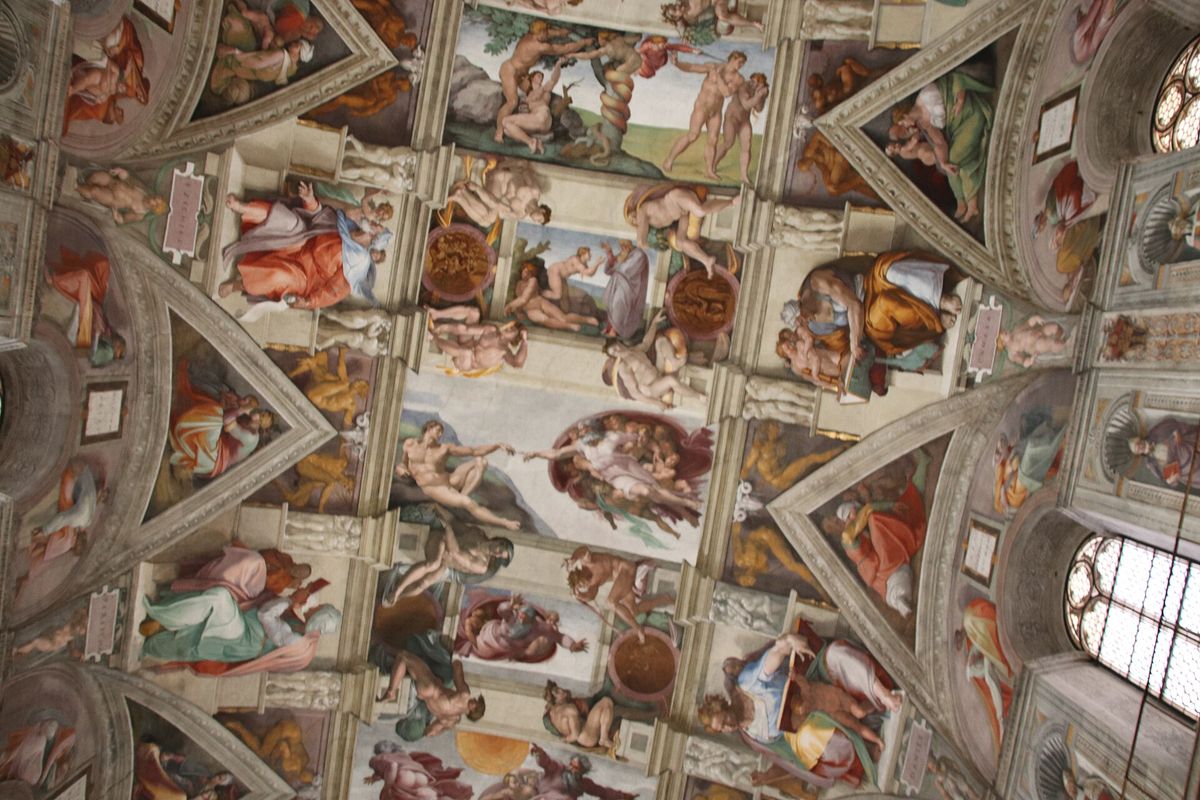

Saturday, October 31, 2026, is 514 years since Pope Julius II showed the finished ceiling Michelangelo had painted over his chapel. Which day counts as the unveiling depends on the source. When Pope Benedict XVI marked the 500th anniversary at First Vespers of All Saints in the chapel in 2012, he spoke of the act by which Julius II inaugurated the fresco and of "those present at the Celebration of Vespers on 31 October 1512"3. The Vatican Museums say the work was finished in October 1512 and that on November 1, the Feast of All Saints, Julius II inaugurated the chapel with a solemn Mass2. Giorgio Vasari's Lives, in Gaston de Vere's English translation, says Michelangelo took down the rest of the scaffolding and "threw it open to view on the morning of All Saints' Day"4. The vespers fell on the eve, the Mass on the feast day.
A crack came first
According to the Vatican Museums, Julius II ordered the ceiling redone probably because of structural damage from excavations to the north and south of the building, dug for the Borgia Tower and the new St Peter's1. A long crack had opened in the ceiling in May 1504, and Bramante set tie rods above the chapel to hold it1.
On May 8, 1508, Michelangelo signed a contract for twelve apostles in the pendentives with ornamental motifs filling the rest1. He considered that plan a "poor thing," so the pope gave him a new commission and left the planning of the program to him, probably with advice from theologians of the papal court1. He was 33 when he began5.
What went up there
Down the middle run nine stories from Genesis, framed by painted architecture, with nude figures holding medallions inscribed with texts from the Book of Kings1. Twelve prophets and sibyls sit on monumental thrones, Christ's forefathers fill the spandrels and lunettes, and the four corner pendentives show episodes of Israel's miraculous salvation1. Benedict XVI put the surface at more than 1,000 square metres of plaster, done in about four years3.
The museums date the first half, from the entrance wall to the Creation of Eve, to August 15101, which means the second half took a little over two years more. Vasari, who gives no date for it, says that when Julius, impatient, made him open the vault with only half of it painted, "No sooner was it thrown open than all Rome was drawn to see it"4.
The scaffold, two versions
In Vasari's account, Julius had Bramante build the scaffolding, and "Bramante made it all supported by ropes, piercing the vaulting"4. Michelangelo went to the pope and told him the scaffolding would not do4. The pope answered, in front of Bramante, that he should make it after his own fashion, and the new scaffold was "erected upon props so as not to touch the walls"4.
The restorers of the 1980s used something Michelangelo left behind. The Christian Science Monitor reported in 1986 that they worked from a "moveable bridge designed to fit in the same holes bored for Michelangelo's wooden scaffolding," which hid only one sixth of the ceiling at a time6.
Vasari's numbers
Vasari claims that "in twenty months he carried that work to perfect completion by himself alone"4. Against the Vatican Museums' dates, a contract in May 1508 and a finish in October 1512, the real job ran more than four years.
On money, he writes that Michelangelo "was paid by the Pope three thousand crowns on several occasions, of which he had to spend twenty-five on colours"4. He also says the years of working "with his face upwards" left Michelangelo "not able to read letters or look at drawings save with his head backwards"4.
Four centuries of soot
Before the cleaning the ceiling looked dusky, which scholars blamed on dust and dirt, fungi, varnishes, wine used in earlier restorations and candle soot from papal conclaves and other ceremonies5. Cleaning began in 1980 under Gianluigi Colalucci, who became the Vatican's chief restorer in 19795. His team spent 10 years on the ceiling and four more on the Last Judgment, working a mild solvent across the vault inch by inch5.
Japan's Nippon Television paid for the project with a grant of more than $4 million in exchange for exclusive photographic rights5.
Not everyone liked what came out from under the grime. Alessandro Conti of the University of Bologna told the Monitor that the restorers were "removing a series of glazings applied by Michelangelo"6, and the Columbia art historian James Beck called the project an "artistic Chernobyl"5. In 1990 the New York Times critic Michael Kimmelman wrote that "The newly revealed ceiling looks overwhelmingly beautiful," and Carmen C. Bambach of the Metropolitan Museum of Art later said "The cleaning basically gave us a new Michelangelo"5.
On April 8, 1994, John Paul II preached at the unveiling of the restored Michelangelo frescoes and called the chapel "the sanctuary of the theology of the human body"7. The Vatican Museums frame the work more widely, as a complete restoration of the chapel's frescoes between 1979 and 19992.
Trivia
- Before Michelangelo, what did Pier Matteo d'Amelia paint on the chapel's ceiling? A starry sky2.
- On what date did Sixtus IV consecrate the chapel? August 15, 1483, dedicated to Our Lady of the Assumption2.
- Which pope commissioned Michelangelo, in late 1533, to paint the Last Judgment on the altar wall? Clement VII2.
- According to Vasari, what did the carpenter who rebuilt the scaffolding do with the ropes he no longer needed? He made up a dowry for his daughter4.
- When Julius II wanted the ceiling enriched with gold because it looked poor, what did Michelangelo answer, according to Vasari? "Holy Father, in those times men did not bedeck themselves with gold"4.
- Which pop artist is named among the signers, with Robert Motherwell and Robert Rauschenberg, of a letter asking John Paul II for a "precautionary" pause in the cleaning? Andy Warhol5.
- At one point in its history, what had the Last Judgment wall been coated with? According to Colalucci, a glue made from horses' hoofs5.
- In what year did the Vatican first hire Gianluigi Colalucci? 19605.
Sources
- The Ceiling, Sistine Chapel, Vatican Museums. Accessed October 31, 2026.
- Sistine Chapel, Vatican Museums. Accessed October 31, 2026.
- Benedict XVI, Address at the Celebration of Vespers for the 500th anniversary of the Sistine Chapel ceiling, October 31, 2012, The Holy See. Accessed October 31, 2026.
- Giorgio Vasari, Life of Michelagnolo Buonarroti, in Lives of the Most Eminent Painters, Sculptors and Architects, Vol. 09, translated by Gaston du C. de Vere, Project Gutenberg. Accessed October 31, 2026.
- Gianluigi Colalucci, who gave fresh color to Michelangelo's frescoes, dies at 91, The Nation (Thailand), April 10, 2021. Accessed October 31, 2026.
- Karen Wolman, Washing away grime or an artist's genius? A shade of doubt dogs the Sistine Chapel restoration, The Christian Science Monitor, September 11, 1986. Accessed October 31, 2026.
- John Paul II, Homily at the unveiling of the restorations of Michelangelo's frescos in the Sistine Chapel, April 8, 1994, The Holy See. Accessed October 31, 2026.
- File:Sistine Chapel Ceiling by Michelangelo (48466107736).jpg, Wikimedia Commons. Accessed October 31, 2026.