The Spruce Goose Flies Once: Long Beach, November 2, 1947
Key Points
- On Sunday, November 2, 1947, Howard Hughes flew the H-4 Hercules over Long Beach Harbor, about one mile at roughly 70 feet by the ASME account, and it never flew again.
- Henry Kaiser brought the idea of a giant flying transport to Hughes, and wartime limits on critical materials led to a hull of Duramold, a laminated wood that was mostly birch rather than spruce.
- Hughes was photographed preparing to testify before the Senate War Investigating Committee on August 6, 1947, where he was accused of misusing government funds.
- Hughes kept the airplane in a climate-controlled hangar until his death in 1976, and after a move that ran from 1992 to 1993 it is on exhibit in McMinnville, Oregon, as of October 31, 2026.
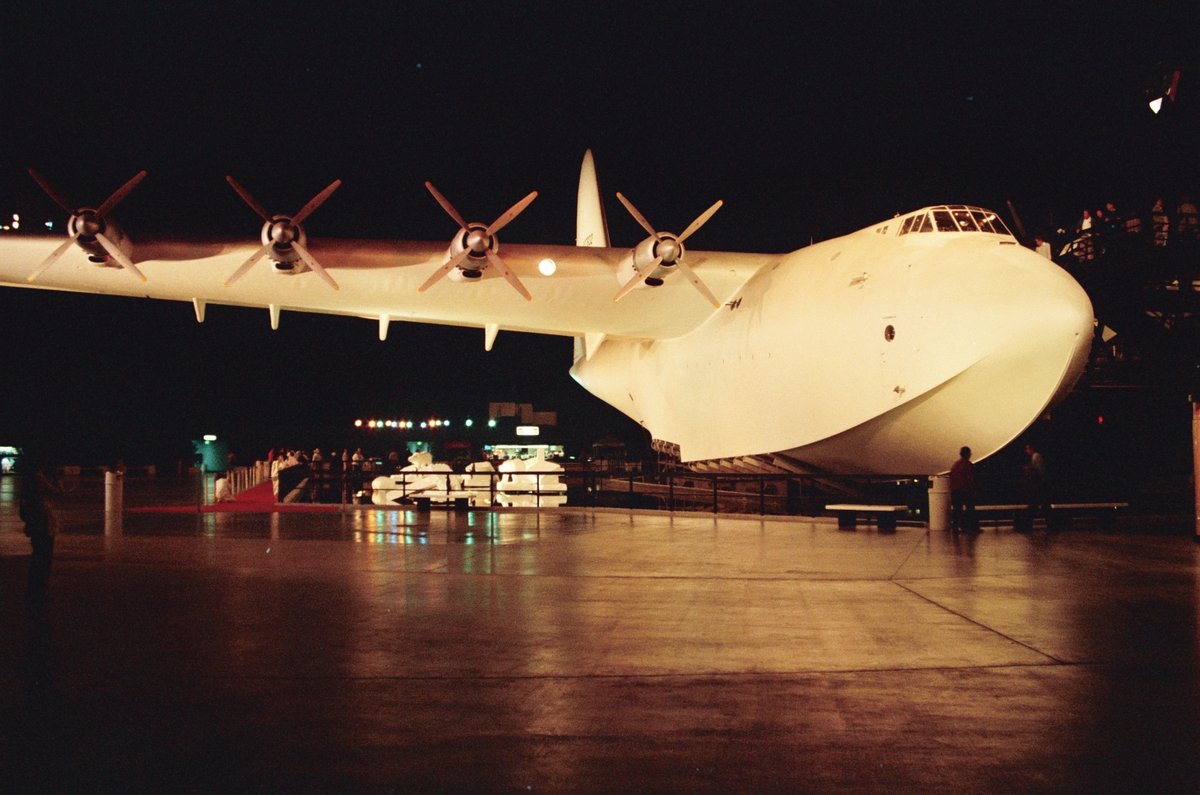

Monday, November 2, 2026, marks 79 years since the Hughes H-4 Hercules left the water for the only time. On Sunday, November 2, 1947, with Howard Hughes at the controls, the flying boat flew about one mile over Long Beach Harbor at roughly 70 feet3, by the account of the American Society of Mechanical Engineers. The aircraft the press called the Spruce Goose never flew again, and its estimated performance was never verified through flight testing9.
A cargo plane for a war at sea
The museum that now holds the aircraft says Henry Kaiser conceived the idea of a massive flying transport and turned to Howard Hughes to design and build it1. Kaiser went to Hughes after several major aircraft makers declined his proposal for flying cargo ships6, and the Kaiser and Hughes venture won an $18 million government contract to design, engineer and build three flying boat prototypes6, with work starting in the fall of 1942. The museum dates the contract to November 16, 19421.
The airplane was initially called the HK-19. When Kaiser withdrew from the project in 1944, it was redesignated the H-4 Hercules1. In the end only one prototype was constructed4.
Why a giant airplane was built of wood
The museum describes the job as made even more challenging by the government’s restrictions on materials critical to the war effort1, and steel and aluminum were rationed5. So the hull was built of Duramold, thin wood veneers bonded together with waterproof resins6, which the museum calls a birch-based wood lamination process1.
That makes the famous nickname wrong. The ASME landmark page notes that the airframe and surfaces are laminated wood, mostly birch3, and the Los Angeles Almanac says the frame was actually constructed of birch rather than spruce4. Hughes disliked the Spruce Goose name6, and critics also called it the “Flying Lumberyard”5.
The museum lists a wingspan of 319 feet 11 inches, a length of 218 feet 8 inches, a height of 79 feet 4 inches and an empty weight of 300,000 pounds1, and calls it six times larger than any aircraft of its time1. Power came from eight Pratt & Whitney R-4360 Wasp Major radial engines1. Its designed loaded weight was 400,000 pounds9, and the Long Beach Post puts its cost at more than $23 million5.
The Senate hearing behind the flight
By 1947 the war was over and the airplane had not flown. A photograph in the University of Nevada, Las Vegas, Hughes collection shows Hughes preparing to testify before the Senate War Investigating Committee on August 6, 19478.
The accusation was that Hughes had misused government funds6. HistoryNet says Senator Owen Brewster of Maine led the attack, and that Hughes in turn accused him of collusion with Pan American Airways6, which a national airline bill Brewster had sponsored would have given a monopoly on government passenger and mail routes. Hughes told the senators that if the flying boat was a failure, he would probably leave the country and never come back6. The UNLV collection says he came out of the hearings, in public opinion, a persecuted aviation hero8.
Twenty-six seconds over Long Beach
The Long Beach Post says Hughes had planned only a taxi run that day and had not intended to fly until the following spring5. The engines started a little after 2 p.m.5, while thousands of onlookers watched5. HistoryNet gives a 20-man crew plus seven members of the press and seven other invited guests6, though most of the newsmen had gone ashore before the third run6. The museum names David Grant as co-pilot1.
On that third run, HistoryNet says, Hughes had the flight engineer lower the flaps 15 degrees into a stiff headwind6, and the boat lifted out of the water for 26 seconds and reached 70 feet6 before settling back down.
Accounts of the hop disagree. The museum gives just under half a mile at 25 feet, for about 30 seconds1. The Long Beach Post gives 33 feet, about a half-mile and 26 seconds5. The Los Angeles Almanac says just under a mile, lasting just under a minute4. None of them has it flying a second time.
Out of sight for 33 years
Hughes kept the airplane in a climate-controlled hangar until he died in 19761. The Long Beach Post says a crew of about 300 maintained it at roughly $1 million a year5. The museum says the Spruce Goose was kept out of the public eye for 33 years1.
After Hughes died, the Aero Club of Southern California acquired the plane in 19805, and by 1983 the Wrather Corporation was displaying it in a domed hangar next to the Queen Mary1 in Long Beach. In 1992 the museum’s founders submitted the winning proposal1 for it. The aircraft was disassembled and barged up the West Coast and the Columbia and Willamette rivers5, a trip that took several months from 1992 to 19934.
As of October 31, 2026, the airplane is on exhibit in McMinnville, Oregon, at the North American Aerospace Museum, the new name of the Evergreen Aviation & Space Museum2.
Trivia
- How many fully equipped soldiers was the flying boat designed to carry? As many as 7509.
- How wide were the H-4’s four-bladed Hamilton Standard propellers? 17 feet, 2 inches in diameter9.
- What horsepower was each of the eight engines rated at? 3,000 horsepower3.
- Which three size records does the museum say the aircraft still holds? Largest seaplane, largest wooden aircraft and largest propeller plane ever built1.
- According to the museum, how did the airplane cover the last 7.5 miles to McMinnville, and when? By truck, in February 19931.
- On what date did the McMinnville museum hold its grand opening? June 6, 20011.
- To how many workers was the maintenance crew eventually cut? 505.
- On what date did the Senate approve the committee that became known as the Truman Committee? March 1, 19417.
Sources
- North American Aerospace Museum (formerly Evergreen Aviation & Space Museum), The Spruce Goose, exhibit page. Accessed October 31, 2026.
- North American Aerospace Museum, home page. Accessed October 31, 2026.
- American Society of Mechanical Engineers, Howard Hughes Flying Boat, HK-1, Landmark #219. Accessed October 31, 2026.
- Los Angeles Almanac, The Spruce Goose (Hughes H-4 Hercules). Accessed October 31, 2026.
- Tim Grobaty, Local history: The 26-second flight of the Spruce Goose, Long Beach Post, November 4, 2022 (updated November 1, 2024). Accessed October 31, 2026.
- Christopher Warner, Why Howard Hughes Flew the Spruce Goose Only Once, HistoryNet (from Aviation History, Winter 2023), November 2, 2022. Accessed October 31, 2026.
- Truman Committee, Senate Historical Office, United States Senate. Accessed October 31, 2026.
- Senate Hearings, Howard Hughes digital collection, University of Nevada, Las Vegas, University Libraries Special Collections. Accessed October 31, 2026.
- 2 November 1947, This Day in Aviation. Accessed October 31, 2026.