Teapot Dome: Albert Fall Convicted of Bribery, October 25, 1929
Key Points
- On October 25, 1929, a jury in Washington found former Interior Secretary Albert B. Fall guilty of accepting a bribe, and he was later sentenced to one year in prison and a $100,000 fine.
- After Harding moved the naval oil reserves to Interior in 1921, Fall leased Elk Hills in California to Edward L. Doheny’s company and Teapot Dome in Wyoming to Harry Sinclair’s Mammoth Oil Company.
- Senator Thomas Walsh led the Senate inquiry, and in January 1924 Doheny testified that he had loaned Fall $100,000 in November 1921.
- In 1927 the Supreme Court unanimously affirmed rulings against both leases, and in 1930 a jury acquitted Doheny of paying the bribe Fall was convicted of taking.
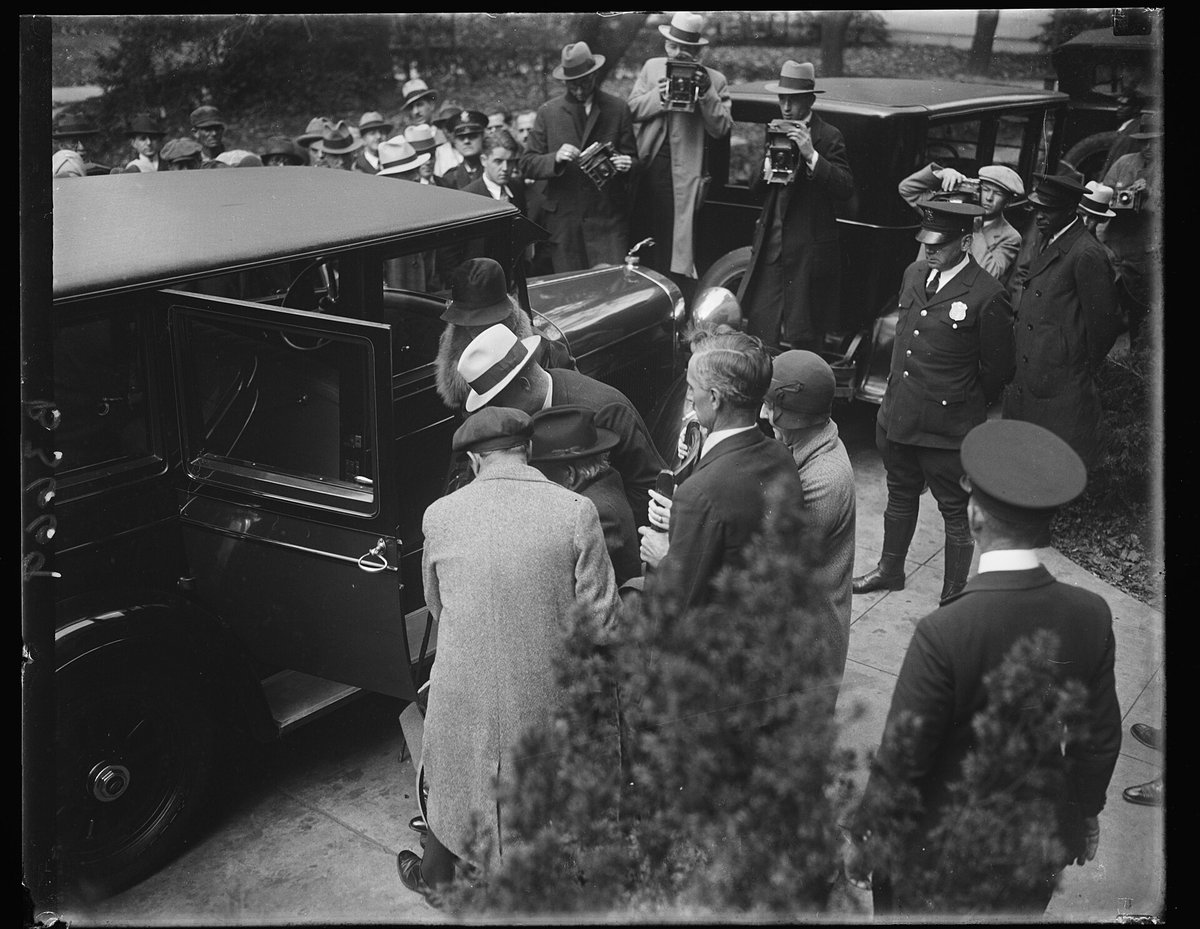

On October 25, 19291, a jury in Washington found Albert B. Fall guilty of accepting a bribe while he served as secretary of the interior under Warren G. Harding. History.com calls him the first individual to be convicted of a crime committed while serving as a presidential Cabinet member1. The case behind it took its name from a rock in Wyoming.
Oil set aside for the Navy
As the Navy moved its fleet from coal to oil, President William H. Taft set aside two California reserves in 1912, Naval Reserves No. 1 (also known as Elk Hills) and No. 22. In 1915, Woodrow Wilson created Naval Reserve No. 3 in Wyoming, which was known as Teapot Dome because of the shape of an unusual rock formation within the reserve2. Surveys estimated the three held 435 million barrels of oil3, and a 1920 law put them under the secretary of the Navy2.
Fall, born in Frankfort, Kentucky2, had represented New Mexico in the Senate since the territory achieved statehood in 19122, and Harding, a friend from the Senate, chose him for Interior. Soon after taking office, Fall asked Navy Secretary Edwin Denby to move the reserves to his department, citing drainage2 from wells on neighboring land. Harding signed the order on May 31, 19212.
Two oilmen, two leases
Edward L. Doheny, founder of Pan-American Petroleum and Transport Company2, had known Fall since their prospecting days in the 1880s2. In November 1921, Fall told him he was “ready to receive”2 a loan of $100,000 in cash to buy the Harris ranch, whose water rights he wanted for his own Three Rivers Ranch2. Doheny’s son Ned withdrew the cash in New York and carried it to Fall2 in Washington. The next year Doheny signed a contract to build a fuel depot at Pearl Harbor, and on December 11, 1922, his company got a lease to drill in the entire eastern half of Elk Hills2.
Harry Sinclair, founder of Sinclair Oil Corporation2, negotiated for Teapot Dome in secret, with no other oil companies invited to bid2. He formed Mammoth Oil Company to do the drilling, Fall signed the lease on April 7, 19222, and Denby added his signature on April 12. About a month later Sinclair gave Fall’s son-in-law, Mahlon Everhart, $198,000 worth of Liberty Bonds2, and Everhart later collected another $35,000 in Liberty Bonds and $36,000 in cash2 on Fall’s behalf.
A senator follows the money
The Wall Street Journal broke the Teapot Dome story on April 14, 19223, and the next day Senator John Kendrick of Wyoming introduced a resolution4 that set an investigation moving. Republican leaders expected little to come of it and let the panel’s most junior minority member, Montana Democrat Thomas Walsh4, lead it.
Hearings began on October 23, 19232. When questions turned to how Fall had paid for the Harris ranch, he sent the committee a letter saying the newspaper owner Edward “Ned” McLean had loaned him $100,0002. Walsh traveled to Florida, where McLean told him he had written checks to Fall but that Fall had returned the checks without cashing them2. On January 24, 1924, Doheny told the committee he had loaned Fall $100,0002 in November 1921, out of a friendship of more than 30 years2. The New York Times headline the next day read “Doheny Lent Fall $100,000 in Cash; Sent in Bag, No Interest, No Security”2. By the Senate’s own account, Senator Walsh became a national hero4.
Courts cancel the leases
The government sued to cancel both leases, and in 1927 the Supreme Court unanimously affirmed2 the appeals court rulings against them, in cases decided on February 28 and October 10, 19272. Justice Pierce Butler wrote that Fall had acted as a “faithless public officer”2. The Navy had its reserves back five years after2 Fall signed them away. Court fights that grew out of these inquiries also produced McGrain v. Daugherty (1927), which, the Senate notes, explicitly established Congress’s right to compel witnesses to testify before its committees4.
Trial after trial, one conviction
On December 16, 19262, a jury acquitted Fall and Doheny of conspiracy. Sinclair’s first conspiracy trial ended in a mistrial2 in November 1927, after evidence that detectives had followed jurors, and a second jury acquitted Sinclair2 in April 1928. He still went to jail for contempt of court and contempt of Congress, serving nearly seven months2 of a nine month combined sentence.
Fall’s own bribery trial began with jury selection on October 7, 19292, before Justice William Hitz. Court physicians reported that he had bronchial pneumonia2, and he returned to court in a wheelchair on October 112. After the guilty verdict, Hitz sentenced him to one year in prison and a $100,000 fine2, matching the money from Doheny. The judge said he was showing the mercy the jury had recommended, and that otherwise he would have imposed three years in prison2 and a $300,000 fine.
An appeals court affirmed the conviction in 1931, and the Supreme Court declined to hear the case2. On the night of July 20, 1931, an ambulance carried Fall through the gates of the New Mexico State Penitentiary in Santa Fe2. He was released in May 1932, having served less than ten months, all of which he spent in the prison hospital2. Meanwhile, on March 22, 1930, a jury acquitted Doheny2 of paying the very bribe Fall had been convicted of taking. Fall died in 1944 at age eighty-three2.
What the name came to mean
The Federal Judicial Center history counts nine federal court trials and several appeals2, and Fall’s conviction was the only guilty verdict arising directly from the scandal2. Revelations that Sinclair and Doheny had given to both major parties helped bring about the Federal Corrupt Practices Act of 19252. Once back in Navy hands, the two reserves remained almost entirely unused until 19762. Before Watergate, Teapot Dome was regarded as the “greatest and most sensational scandal in the history of American politics”5, and the same history concludes that the name has become synonymous with graft, corruption, and the weakening of public faith in government2.
Trivia
- What happened to the handle and spout of Teapot Rock? Windstorms wore them away, the handle in 1930 and the spout in 19626.
- About how tall is Teapot Rock? About 75 feet6. It sits roughly 19 miles north of Casper and was added to the National Register of Historic Places in 1974.
- Who bought the Teapot Dome oil field from the Department of Energy in 2015? Stranded Oil Resources Corp.5, for $45 million.
- Which 1927 novel, inspired by Doheny’s life, became the basis for a 2007 film? Upton Sinclair’s Oil!2, which became There Will Be Blood.
- What was Fall’s convict number? 69912.
- Who was the next former cabinet official to go to prison after Fall? Former Attorney General John N. Mitchell2, for his role in Watergate.
- Which detective agency shadowed jurors in Sinclair’s first conspiracy trial? The Burns Detective Agency2, according to an affidavit that said sixteen of its people had watched all but one of the jurors.
- Which president said in 1950 that the name Teapot Dome “stands as an everlasting symbol of the greed and privilege that underlay one philosophy about the West”? Harry Truman3.
Sources
- HISTORY.com Editors, Cabinet member guilty in Teapot Dome scandal, HISTORY, February 9, 2010, updated October 22, 2026. Accessed October 25, 2026.
- Jake Kobrick, United States v. Albert B. Fall: The Teapot Dome Scandal, Federal Judicial Center, 2020. Accessed October 25, 2026.
- Senate Historical Office, One Hundred Years Since Teapot Dome, United States Senate, July 1, 2024. Accessed October 25, 2026.
- Senate Investigates the Teapot Dome Scandal, United States Senate. Accessed October 25, 2026.
- Teapot Dome scandal, Wikipedia. Accessed October 25, 2026.
- Teapot Rock, Wikipedia. Accessed October 25, 2026.