The 1861 Telegraph Line That Put the Pony Express Out of Business
Key Points
- On October 24, 1861, the line from California reached Salt Lake City and completed the first transcontinental telegraph network.
- Congress backed the line with a $40,000 a year subsidy, and two companies built it from opposite ends until the halves met in Salt Lake City.
- The Pony Express was formally shut down on October 26, 1861, after about 18 months.
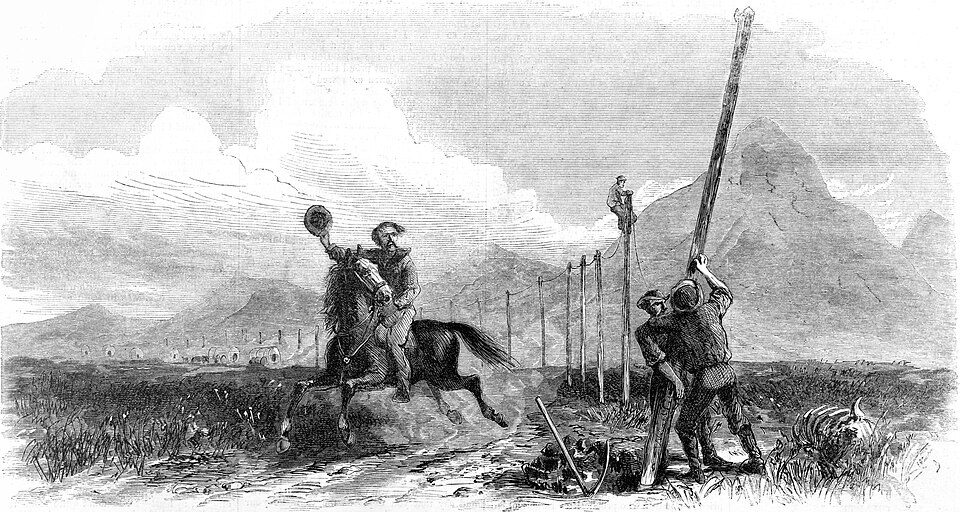

On October 24, 1861, the wire coming east from California arrived at Salt Lake City's downtown telegraph office, and the country's first coast to coast telegraph was finished3. Saturday, October 24, 2026, marks 165 years since then. For the first time, Washington, D.C., and San Francisco could trade messages almost instantly1. Two days later the Pony Express, which had carried the fastest mail across the West, was officially shut down4.
Two lines, one meeting point
On June 16, 1860, Congress passed a bill directing the Treasury to pay toward a telegraph line across the continent4. The subsidy came to $40,000 a year1. The work went to Western Union. Its co-founder, Hiram Sibley, was the only bidder left2.
The job was split in two. The Pacific Telegraph Company built west from Nebraska, and the Overland Telegraph Company built east from Nevada, where the line joined California's existing wires2. Edward Creighton managed the Pacific company's construction, which began in Nebraska Territory in early July 18613. Wire and insulators came by sea to San Francisco, and because the Plains had few trees, poles had to be hauled in from the mountains1. When it was done, some 2,000 miles of iron wire hung from about 27,500 poles2.
The Pacific company's line reached Salt Lake City first, on October 17, 1861, and the first messages went out the next day. Brigham Young sent the first one, congratulating company president Jeptha H. Wade3. The western line arrived on October 243.
Loyalty by wire
The line opened during the Civil War1, and its first messages spoke to that. Frank Fuller, the acting governor of Utah Territory, telegraphed President Abraham Lincoln that the territory's citizens were loyal to the United States3. California's chief justice, Stephen J. Field, sent Lincoln what History.com calls the first transcontinental telegram and, it says, predicted the link would help keep the western states loyal to the Union1. A 1995 Utah state history counts Lincoln and Young among the officials whose messages opened the line6.
The end of the Pony Express
William H. Russell, Alexander Majors and William B. Waddell set up the company that became the Pony Express, which ran from St. Joseph, Missouri, to Sacramento, California, covering more than 1,800 miles in 10 days4. The first mail reached San Francisco on April 14, 1860, 11 days after leaving St. Joseph5.
The service never made a profit because it did not win a government contract to carry letters. Some ledgers suggest its backers lost about $200,000 on roughly $90,000 in revenue5. Once San Francisco could reach New York City directly by wire, the Pony Express was formally shut down on October 26, 1861, after about 18 months. Its last letters did not finish the route until November4. The new line had made the Pony Express obsolete2.
Trivia
- In which city did the two telegraph lines meet? Salt Lake City3.
- Who sent the first message from Salt Lake City over the Pacific Telegraph Company's line? Brigham Young3.
- Which California judge sent Lincoln what History.com calls the first transcontinental telegram? Stephen J. Field1.
- Where did the Pony Express route begin and end? St. Joseph, Missouri, and Sacramento, California4.
- How many days after the line was finished did the Pony Express officially end? Two4.
Sources
- Western Union completes the first transcontinental telegraph line, HISTORY.com Editors, History.com, November 16, 2009, updated May 28, 2025. Accessed October 24, 2026.
- First transcontinental telegraph, Wikipedia. Accessed October 24, 2026.
- Pacific Telegraph Company, Wikipedia. Accessed October 24, 2026.
- History and Culture, Pony Express National Historic Trail, National Park Service. Accessed October 24, 2026.
- Maris Fessenden, The Pony Express Was Short-Lived And Costly, Smithsonian Magazine, April 14, 2015. Accessed October 24, 2026.
- Miriam B. Murphy, The Telegraph was the Information Highway of the 1860s, Utah History to Go, October 1995. Accessed October 24, 2026.