Tutankhamun's Tomb: The First Step Found on November 4, 1922
Key Points
- By Howard Carter's own journal, about 10am on November 4, 1922, his team uncovered the first step of a sunken staircase in the Valley of the Kings, the entrance to Tutankhamun's tomb.
- By sunset on November 5, the team had cleared down to the 12th step and exposed a plastered, sealed doorway, and Carter cabled Lord Carnarvon in England.
- Carter did not yet know whose tomb it was, and he first saw the Antechamber through a small hole on November 26, 1922.
- The Griffith Institute describes the work as a ten year excavation and publishes Carter's records.

At about ten in the morning on November 4, 1922, Howard Carter's team uncovered something beneath almost the first of the ancient workmen's huts they were clearing in the Valley of the Kings. In his own words, it was the first traces of the entrance of the tomb1, the first step of a sunken staircase. The tomb was Tutankhamun's, though Carter had found nothing yet that named its owner. His journal says he discovered the step himself, though other accounts credit a workman. The 104th anniversary is Wednesday, November 4, 2026.
Four days of clearing huts
Carter's journal for the first season opens with a short trip. He arrived at Luxor on a Saturday morning, October 28, 19221, and on November 1 commenced operations in the Valley of the Kings1. He was picking up an earlier dig where it had stopped, at the northeast corner of the entrance to the tomb of Ramesses VI. Beneath the rubble sat ancient stone huts of the Necropolis workmen1, and clearing and planning them took until the fourth of November1.
Then came the step. Carter wrote that a short time was enough to show it was a steep excavation cut in the bed rock1, about four metres below the entrance of the tomb of Ramesses VI, and of the type of sunken staircase that led into tombs of the Eighteenth Dynasty. Nothing more could be told, he added, until the heavy rubbish at the foot of it was cleared.
November 5 and a sealed door
Clearing took the rest of that day and most of the next. By sunset on November 5, Carter's journal says the team had cleared down to the level of the 12th step1, exposing the upper part of a plastered and sealed doorway. The only seal impressions he could read were those of the Royal Necropolis seal, which he described as Anubis (symbolizing a king) over nine foes1.
He made a small hole under the wooden lintel, about 35 by 15 centimetres, and with an electric torch saw that the passage beyond was completely filled with stones and rubble up to its ceiling1. He closed the hole again. Carter recorded that the opening seemed small for a royal tomb and wondered whether he had found the tomb of a noble or a royal cache1. He also admitted a miss: had he dug a few inches deeper, he wrote, he would have exposed seal impressions showing Tutankhamun's name, and he would then have fervently worked on1 without the doubt. Instead he refilled the excavation for protection and went home.
That night he cabled Lord Carnarvon, who was in England. The journal gives the message: “At last have made wonderful discovery in Valley a magnificent tomb with seals intact recovered same for your arrival congratulations”1. A separate record, Carter's pocket diary, is quoted by the Griffith Institute for the same date, and it reads ‘Discovered tomb under tomb of Ramses VI investigated same & found seals intact.’2 The journal dates the first step to November 4 and the sealed doorway to November 5, and the archive's pocket diary entry, which speaks of finding the seals intact, is dated November 5 as well. The two records agree. The Wikipedia account of the tomb gives 4 November 1922 as the day the discovery began with a single step at the top of the entrance staircase3.
The wait for Carnarvon
The next weeks were mostly preparation and waiting. On November 6 Carter's men worked feverishly covering and making safe the discovery1, and by November 7 the journal says the news of the discovery spread fast all over the country1. On November 8 Carter received a wire from Carnarvon, who then said he proposed to arrive Alexandria twentieth1. Carnarvon reached Luxor on November 23, and put up at Carter's house1.
On November 24 Callender, whom Carter had wired for on November 9, reached the first doorway. Carter's count was sixteen steps1. With the whole doorway bare, impressions bearing Tutankhamun's cartouche could be made out, and the upper plaster showed traces of two distinct re-openings and successive re-closings1. The rubbish on the stairs also held broken boxes bearing the names of Akhenaten, Smenkhkare and Tutankhamun. Those mixed names pushed Carter toward the idea that he was about to open a royal cache1 of the Amarna family rather than a single burial.
November 26: a candle through a hole
The first doorway was opened on November 25. Behind it was a blocked descending passage, and after clearing 9 metres of the descending passage1 the team met a second sealed doorway on the afternoon of November 26. Carter made a tiny breach in its top left corner. An iron testing rod and darkness told him there was empty space beyond. He had candles brought, because they were the standard warning against foul gases in an ancient chamber, and widened the hole while Carnarvon, Callender and others waited behind him.
Carnarvon asked whether he could see anything. Carter's journal has him answering, “Yes, it is wonderful”1. He then listed what the candle showed: two black effigies of a king, gilded couches, painted caskets, alabaster vases, a golden inlaid throne and, in a confusion, parts of chariots. The first impression, he wrote, suggested the property-room of an opera-house of a vanished civilization1.
On November 27 they entered with an electric installation and made a careful inspection of the first chamber, which Carter later named the Antechamber. Beneath a couch in the southwest corner they found another sealed doorway broken open1, leading to a smaller chamber later called the Annexe. Carter reasoned from a sealed doorway between two guardian statues that the team had reached only the anterior portion of a tomb1, and that the king probably lay behind it. On November 29 there was a sort of official opening1 with invited guests, and a special report to The Times was sent to Luxor by special runner about 3pm1.
Why it had been missed
According to the Wikipedia article on the tomb, many of the valley's tombs were found by excavators working for Theodore M. Davis from 1902 to 1914, and Davis never found Tutankhamun's tomb because he thought no tomb would have been cut into the valley floor3. Carter and his patron Carnarvon then tried to clear the valley down to bedrock. The same article says the tomb's low position allowed its entrance to be hidden by debris deposited by flooding and tomb construction3, which fits Carter's own note that the workmen's huts sat over the entrance.
What came after
Carter's journal for that first season also notes the death of Carter's patron Lord Carnarvon (April 5th 1923)1. The work went on without him. The Griffith Institute describes it as a ten year excavation2, and its archive holds the complete records, deposited after Carter's death by his niece Phyllis Walker. Wikipedia lists the team members who worked throughout as Carter, the chemist Alfred Lucas, the photographer Harry Burton and four foremen: Ahmed Gerigar, Gad Hassan, Hussein Abu Awad and Hussein Ahmed Said3. The same article puts the end of clearing the tomb itself in November 19303, with the last shipment of conserved goods sent to Cairo in February 1932.
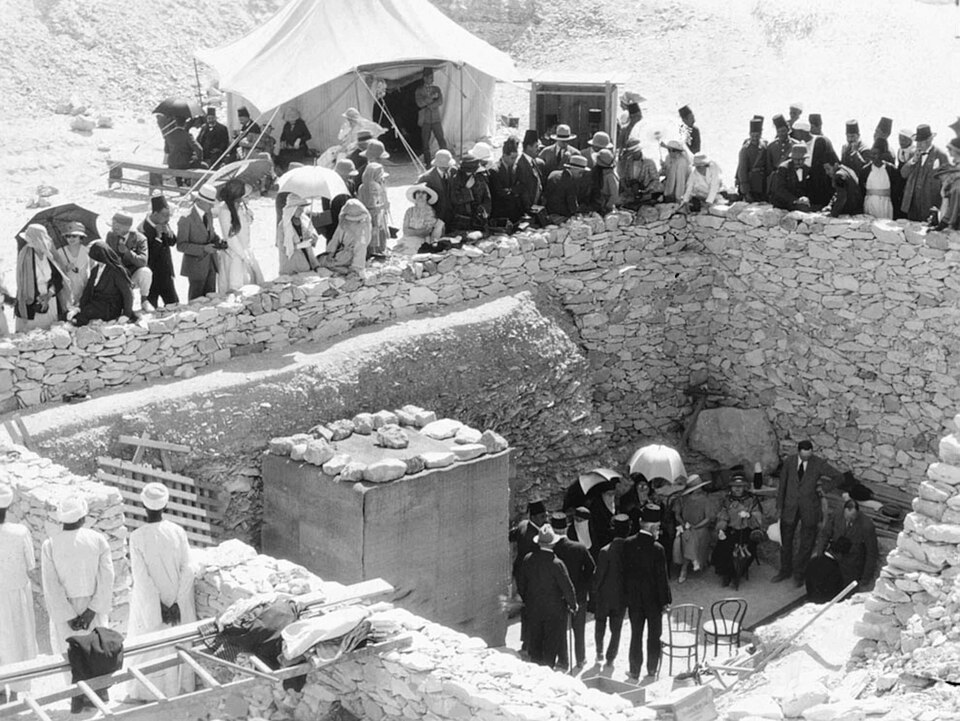
The crowds started early. The photograph at the top of this article shows tourists around the retaining wall of the entrance pit, in late February 1923, when the tomb was first opened for public viewing4, as published in the May 1923 issue of National Geographic.
Trivia
What was the only seal Carter could read on the first sealed doorway on November 5, 1922?
The Royal Necropolis seal, which Carter described as Anubis over nine foes1.
How many steps did the staircase turn out to have?
Carter's count on November 24, 1922 was sixteen steps1.
What did Carter's first impression of the Antechamber's furniture suggest to him?
He wrote that it suggested the property-room of an opera-house of a vanished civilization1.
Who did Carter cable on the night of November 5, 1922, and where was that person?
He cabled Lord Carnarvon, then in England1, with the message that he had made a wonderful discovery in the Valley.
Which earlier excavator never found the tomb, according to Wikipedia, because he thought no tomb had been cut into the valley floor?
Theodore M. Davis, whose excavators worked in the valley from 1902 to 19143.
Sources
- Howard Carter, Journal for the 1st excavation season, October 28th 1922 to May 30th 1923, TAA i.2.1, Tutankhamun: Anatomy of an Excavation, Griffith Institute, University of Oxford. Accessed November 2, 2026.
- Tutankhamun: Anatomy of an Excavation, Griffith Institute, University of Oxford. Accessed November 2, 2026.
- Tomb of Tutankhamun (KV62), Wikipedia, the free encyclopedia. Accessed November 2, 2026.
- File:Tourists outside Tutankhamun's tomb, February 1923.jpg, Wikimedia Commons, from Maynard Owen Williams, At the Tomb of Tutankhamen, National Geographic, May 1923. Accessed November 2, 2026.