Vietnam Veterans Memorial Dedication, November 13, 1982
Key Points
- A Library of Congress finding aid lists the Vietnam Veterans Memorial's dedication under November 13, 1982, during a National Salute to Vietnam Veterans held November 10 to 14, while the National Park Service's overview gives November 11.
- Public Law 96-297, approved on July 1, 1980, authorized the memorial fund to establish a memorial on about two acres in Constitution Gardens and said the United States would be put to no expense.
- The fund received 1,421 design entries, and on May 1, 1981, an eight-member jury chose the design of Maya Ying Lin.
- The Park Service says the names run in order of death from the middle of the wall outward and back, so that the first deaths, in 1959, and the last, on May 15, 1975, meet in the middle.
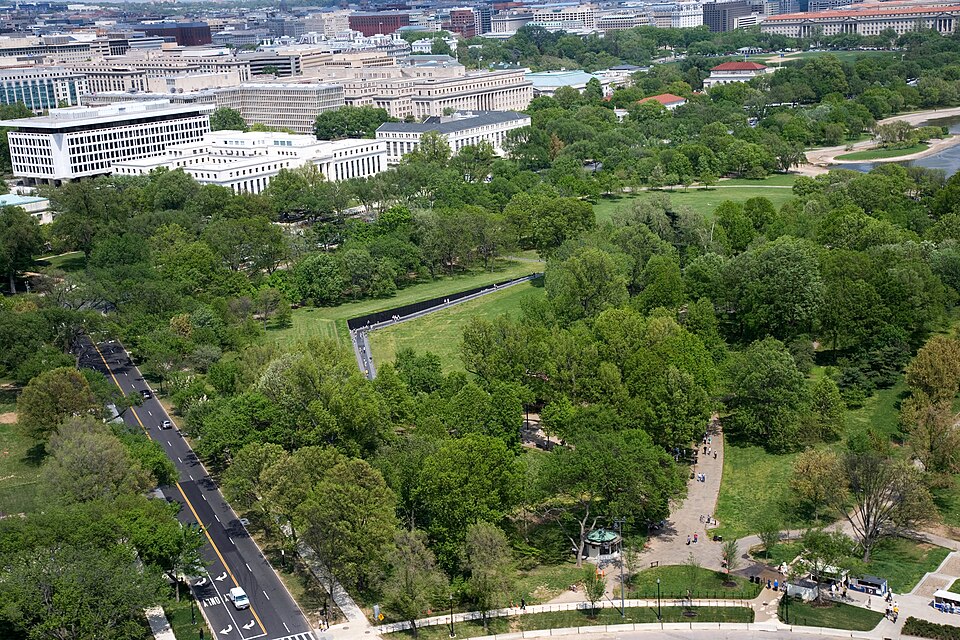

Friday, November 13, 2026, falls 44 years after the date of the Vietnam Veterans Memorial dedication in Washington, D.C., as the Library of Congress finding aid for the memorial fund's records lists it, November 13, 19821. The memorial is a wall of black granite that was chosen in an open competition and argued over before it was built. The National Park Service's own page dates the dedication two days earlier, and that difference is worth sorting out below.
A law, a fund and a patch of lawn
The National Park Service says that after watching the film The Deer Hunter, Vietnam veteran Jan Scruggs decided that his fellow soldiers needed a tangible symbol of recognition from America2. By 1979 a memorial fund was formed2, and the Library of Congress finding aid says the Vietnam Veterans Memorial Fund was incorporated on April 27, 19791, a nonprofit set up to erect a national memorial to American veterans of the Vietnam conflict.
Congress then passed a joint resolution that became Public Law 96-297, approved on July 1, 19803. It authorized the fund to establish a memorial on public grounds in West Potomac Park, on a site of approximately two acres in the area known as Constitution Gardens3. The design and plans were subject to the approval of the Secretary of the Interior, the Commission of Fine Arts and the National Capital Planning Commission3. The law also said neither the United States nor the District of Columbia would be put to any expense in establishing the memorial3, which left the cost of establishing the memorial to others. Once built, maintenance and care of the memorial would be the responsibility of the Secretary of the Interior3.
1,421 designs, one choice
The fund solicited designs in open competition and received 1,421 entries1. On May 1, 1981, an eight-member jury announced that it had selected the design submitted by Maya Ying Lin1. She was a 21-year-old Yale architecture student, and the Park Service describes the selection as unanimous2.
The central element of her design is a shiny black granite wall in a wide V shape, with one arm directed toward the Lincoln Memorial and the other toward the Washington Monument2. Visitors see their own faces reflected in the walls bearing the etched names2.
The controversy
The design was not welcomed by everyone. The Library of Congress finding aid says the chevron-shaped black granite memorial represented a negative symbol to many, and that a prominent critic called it "a black gash of shame and sorrow"1. It adds that construction of the memorial proved divisive, mirroring the political passions and controversies concerning the war1. The fund's records include hearings before the Commission of Fine Arts and the National Capital Planning Commission, agencies whose approval of the design was necessary before construction could begin1.
Changes followed. The Park Service says the design choice proved controversial, and eventually a flag and a figurative sculpture of servicemen were added to the plan2. The fund's mission was completed in the fall of 1984 with the addition of Frederick Hart's life-size sculpture to the entry plaza of the memorial grounds1.
Building the wall
In 1981 the fund engaged the Cooper-Lecky Partnership, an architectural firm, to assist Maya Lin in developing her design, and Gilbane Building Company to manage construction1. Putting the names on the stone was its own problem. The finding aid says verifying and inscribing the names posed major administrative and technical problems, and that Binswanger Glasscraft Products, using a new stenciling technique, completed the inscriptions in three months1.
The Park Service page, last updated April 20, 2020, gives the total as 58,318 names of men and women who died in combat or are listed as missing in action2. A diamond marks those declared dead and a cross marks those missing2, and if a person marked missing returns alive, a circle is placed around the cross2. The order is chronological. The names of the first men killed, in 1959, start at the highest point of the wall on the right arm and continue toward the shorter end, then resume on the far short end of the left arm and continue back toward the junction2. That way the first deaths and the last deaths, on May 15, 1975, meet in the middle2.
Dedication week, and two dates
The finding aid describes the National Salute to Vietnam Veterans, held November 10 to 14, 1982, as a five-day tribute consisting of commemorative events and the dedication of the memorial1. Its inventory of the fund's records lists a folder headed "Dedication, 13 Nov. 1982"1, and that is the date this article uses. The National Park Service's overview reads differently: it says the memorial wall dedication on November 11, 1982, was accompanied by a 56-hour reading at Washington National Cathedral of all the engraved names of the dead2. Because these two sources do not agree on the day, treat the five-day salute as the safest frame, with November 13 as the dedication date in the Library of Congress records.
What was added later
The Park Service lists the Three Servicemen statue, the Vietnam Women's Memorial, an In Memory plaque and a flagpole among the other features of the site2. The bronze Three Servicemen were created by Frederick Hart, who interviewed dozens of veterans and watched film footage and documentaries so that he could make an artwork that, in his words, "bespeaks the bonds of love and sacrifice that is the nature of men at war"2. The Vietnam Women's Memorial, by Glenna Goodacre, depicts three nurses and one wounded soldier2. The In Memory plaque, dedicated in 2004, honors the men and women who died as a result of their service in Vietnam2.
The fund marked the memorial's first decade, too. The finding aid says it sponsored a year-long program of events culminating on Veterans Day, November 11, 19921. Visitors still leave items at the wall, among them dog tags, flowers, medals, photographs and favorite toys2.
Trivia
How many designs were entered in the competition for the memorial?
1,421 entries1
What law authorized the memorial fund to establish the memorial, and on what date was it approved?
Public Law 96-297, approved on July 1, 19803
Which two landmarks do the arms of the V-shaped wall point toward?
The Lincoln Memorial and the Washington Monument2
In what order do the names on the wall run?
Chronologically from the highest point of the right arm, starting with the first men killed in 1959, to the end of that arm, then from the far end of the left arm back to the junction, so the first and last deaths (the last on May 15, 1975) meet in the middle2
What symbol marks a name on the wall when the person is listed as missing in action?
A cross (a diamond marks those declared dead, and a circle goes around the cross if a missing person returns alive)2
Sources
- Vietnam Veterans Memorial Fund Records, A Finding Aid to the Collection in the Library of Congress, Manuscript Division, Library of Congress. Accessed November 6, 2026.
- Vietnam Veterans Memorial, National Park Service. Accessed November 6, 2026.
- Public Law 96-297, Joint Resolution to authorize the Vietnam Veterans Memorial Fund, Inc., to establish a memorial, July 1, 1980, 94 Stat. 827, U.S. Government Publishing Office. Accessed November 6, 2026.