The WorldWideWeb Proposal at CERN, November 12, 1990
Key Points
- A CERN memo by Tim Berners-Lee and Robert Cailliau, WorldWideWeb: Proposal for a HyperText Project, is dated 12 November 1990.
- The memo asked for 4 software engineers and a programmer, workstations totalling 50k and 30k in other development expenses, with two phases of 3 months each.
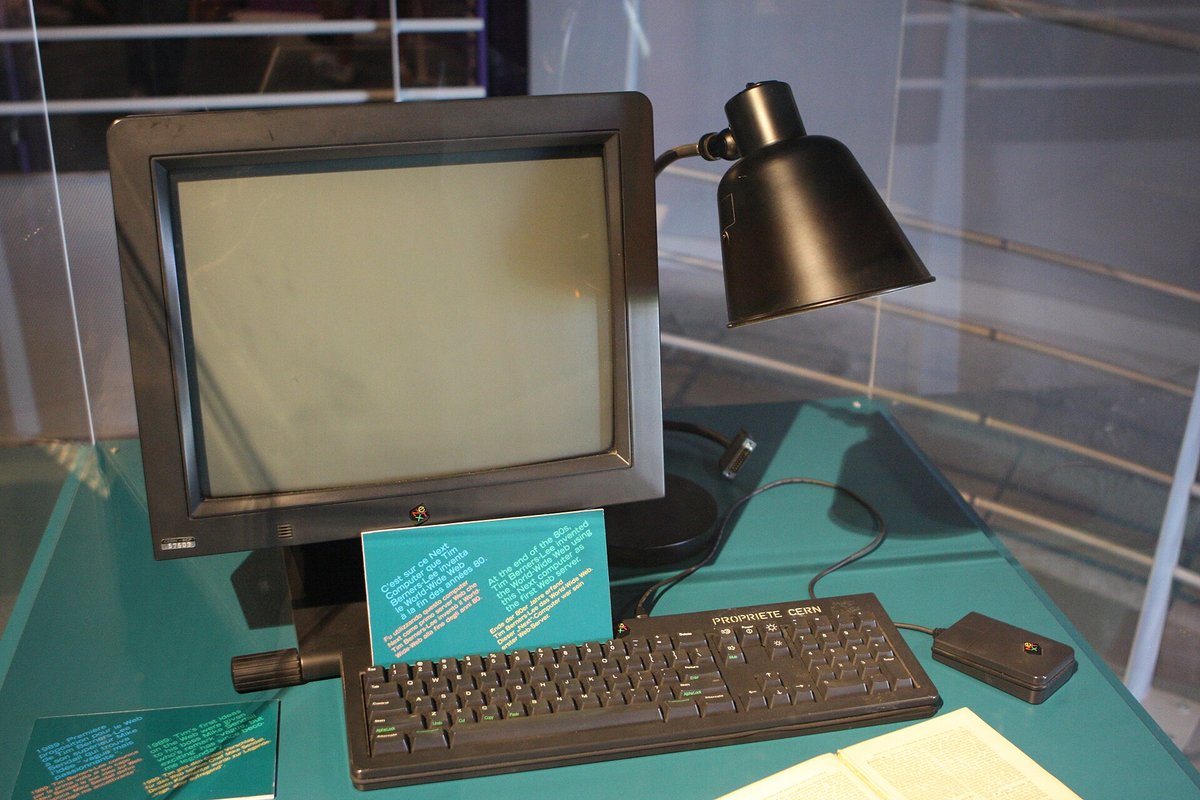
- By the end of 1990 Berners-Lee had the first Web server and browser running at CERN, developing the code on a NeXT computer.
- On 30 April 1993 CERN put three components of the Web software into the public domain.

Thursday, November 12, 2026, marks 36 years since the date on a short CERN memo titled WorldWideWeb: Proposal for a HyperText Project, signed by T. Berners-Lee and R. Cailliau and dated 12 November 19901. It asked for a handful of engineers, some workstations and six months.
The 1989 paper
The idea had been on paper for more than a year by then. Tim Berners-Lee wrote Information Management: A Proposal at CERN, and the W3C copy of it carries two dates, March 1989 and May 19902. Its opening line says the proposal concerns the management of general information about accelerators and experiments at CERN2, and it argues that "The problems of information loss may be particularly acute at CERN"2. The fix it offered was a solution based on a distributed hypertext system2. In a note added to the W3C copy, Berners-Lee wrote that the document was an attempt to persuade CERN management that a global hypertext system was in CERN's interests2.
CERN's account of the Web's 20th anniversary, published 13 March 2009, says Berners-Lee submitted his paper to his boss Mike Sendall, who wrote the words "Vague, but exciting" on the document's cover4. That note gave Berners-Lee the go-ahead to continue4.
What the November 1990 memo asked for
CERN's short history of the Web says the 1989 idea was formalised as a management proposal in November 1990 with Robert Cailliau, a Belgian systems engineer3. The memo lists Berners-Lee under CN and Cailliau under ECP, and is addressed to P.G. Innocenti and G. Kellner of ECP and D.O. Williams of CN, with a long copy list1. It opens with a definition: "HyperText is a way to link and access information of various kinds as a web of nodes in which the user can browse at will."1 The authors proposed a simple scheme to incorporate several different servers of machine-stored information already available at CERN1, and they named the project WorldWideWeb, or W3, meant to serve the high energy physics (HEP) community1.
"The manpower required is 4 software engineers and a programmer," the memo says, adding that one of them could be a Fellow1. Each person would need a state-of-the-art workstation, at 10 to 20k each and 50k in total1, plus an expense of 30k during development for one-user licences, visits to existing installations and consultancy1.
The work came in two phases. Phase one should take 3 months with the full manpower complement, and phase two a further 3 months, though the memo calls that phase more open-ended1. Phase one listed browsers for dumb terminals, VT220 terminals, the Macintosh and the NeXT1, along with a server for Usenet and Internet news, a server for the information stored on CERNVM and listed in the FIND index, and a requirements analysis for the information access needs of a large CERN experiment1. The NeXT browser, built with the NeXTStep tools, was to serve as a fast prototype for interface and navigation ideas1.
Phase two went further. Its goals included the creation of new links and new material by readers1, and the memo sums that up in six words, "At this stage, authorship becomes universal."1 It also drew lines around the work. The project would not do research into fancy multimedia facilities such as sound and video1, and it ruled out sophisticated network authorisation systems and forcing users onto a particular word processor1.
What existed by the end of 1990
Part of the plan was running by the end of 1990. In September 1990, according to CERN's 2009 anniversary article, Berners-Lee took delivery of a computer called a NeXT cube4. CERN's short history says he developed code directly on the NeXT computer that hosted the first web server, and kept it in his office3. By the end of 1990 he had the first Web server and browser up and running at CERN3, and the 2009 article says that by December the Web was up and running, albeit between just a couple of computers at CERN4.
That first browser ran on NeXT machines, and CERN credits it with the first Web editing capability3. The memo had pictured that NeXT version as a prototype, with browsers for terminals and the Macintosh due in the same first phase.
Giving it away in 1993
On 30 April 1993 CERN issued a public statement putting three components of the Web software into the public domain: the basic line-mode client, the basic server and the library of common code5. The statement said CERN relinquishes all intellectual property rights to this code, both source and binary5. CERN's 2023 article on the anniversary says the document was addressed to whom it may concern and allowed anyone to use, duplicate, modify and redistribute the code6.
The public domain route lasted one release. CERN says it released the next version in 1994 as open source instead, keeping the copyright5, and under that licence anyone who wished could still use and modify the Web freely6. CERN's licensing page dates the message announcing that open source release to 15 November 19945, four years and three days after the date on the memo.
As of November 2026, CERN keeps info.cern.ch as the home of the first website, with links to browse the original pages and a line-mode browser simulator7.
Trivia
What was the only name Berners-Lee had for his system around the time of the 1989 proposal?
Mesh, according to his note on the W3C copy of the proposal2
What did the label on the NeXT computer used as the first web server say?
"This machine is a server. DO NOT POWER IT DOWN!!"3
When did the WWW software become available to colleagues using CERN computers?
March 19913
Where did the first Web server in the United States come online, and when?
At the Stanford Linear Accelerator Center (SLAC) in California, in December 19913
Who wrote the simpler line-mode browser that could run on any system?
Nicola Pellow, during her student work placement at CERN3
Which two CERN directors signed the 1993 statement releasing the software?
Walter Hoogland, then Director of Research, and Helmut Weber, then Director of Administration6
What organization did Berners-Lee found at MIT in 1994?
The International World Wide Web Consortium (W3C)3
Sources
- Tim Berners-Lee and Robert Cailliau, WorldWideWeb: Proposal for a HyperText Project, CERN, 12 November 1990, W3C copy. Accessed November 7, 2026.
- Tim Berners-Lee, Information Management: A Proposal, CERN, March 1989, May 1990, W3C copy. Accessed November 7, 2026.
- A short history of the Web, CERN. Accessed November 7, 2026.
- CERN celebrates 20th anniversary of World Wide Web, CERN, 13 March 2009. Accessed November 7, 2026.
- Licensing the Web, CERN. Accessed November 7, 2026.
- Naomi Dinmore, 30 years of a free and open Web, CERN, 30 April 2023. Accessed November 7, 2026.
- info.cern.ch, home of the first website, CERN. Accessed November 7, 2026.